










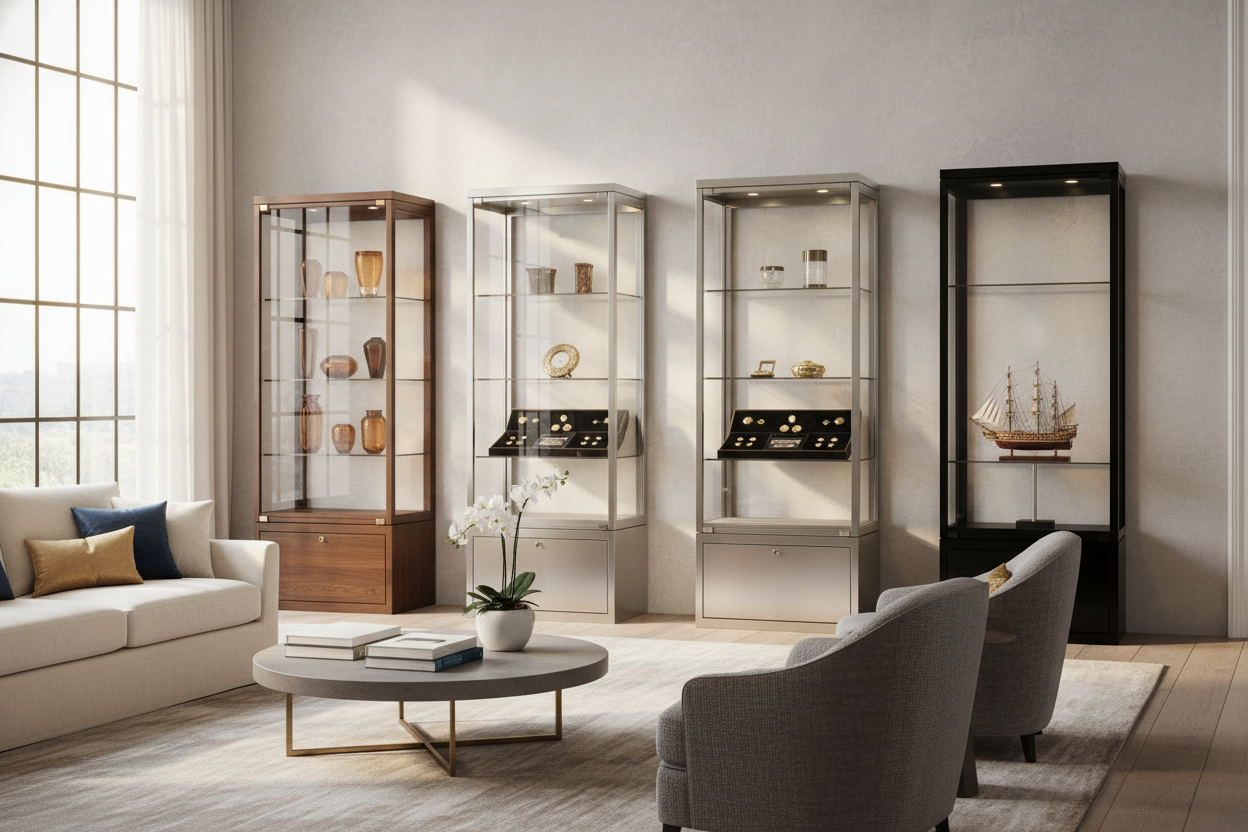
I once spent three months’ rent on a vintage Italian glass vase, only to place it inside a wobbly $40 flat-pack cabinet I’d owned since college. The result? My expensive treasure looked like a cheap plastic knockoff. It was a hard lesson in how the frame dictates the value of the art. When you put a $1,000 sculpture in a flimsy enclosure, the sculpture loses its soul.
We’ve all been there—scrolling through dozens of browser tabs of high end display cases at 2 AM, trying to figure out why one costs $200 and the other costs $2,000. It isn’t just a brand name markup. It’s about the difference between a piece of furniture that protects your collection and one that eventually sags under the weight of it. If you're serious about your collection, the container needs to match the contents.
- Low-iron glass is the gold standard for true color accuracy.
- Hidden hardware is a non-negotiable for a premium, seamless look.
- Integrated, diffused lighting prevents the 'interrogation room' shadow effect.
- Airtight seals are the only way to avoid weekly dusting marathons.
The 'Museum Effect' vs. The 'Thrift Store' Vibe
Think about the last time you walked into a high-end gallery. You didn't just notice the art; you noticed the silence, the precise lighting, and the heavy, seamless enclosures. When you upgrade your standard bookcases and display cabinets, you are doing more than buying storage. You are creating a focal point that tells people, 'This object matters.'
Cheap cabinets wobble when you walk past them. They rattle. They feel temporary. A premium case has structural gravity. It anchors a room and makes even a collection of everyday found objects look like a curated exhibit. If the case feels like it belongs in a dorm room, your collection will look like it does, too.
The 3 Dead Giveaways of a Cheap Glass Cabinet
The difference between a luxury showcase and a budget box is usually found in the details that manufacturers hope you won't notice until the box is open and half-assembled on your floor. Budget brands cut corners on materials that look fine in a low-res photo but feel awful in person. I look for three specific red flags: exposed hardware, 'bottle-green' glass, and harsh lighting.
Visible Cam Locks and Flimsy Hinges
Nothing screams 'cheap' louder than visible silver cam locks. You know the ones—those round metal discs that never quite sit flush and always seem to be staring at you from the corners. High-end construction uses blind joinery or internal tension systems that keep the focus on your items, not the fasteners.
Then there are the hinges. Cheap cabinets use stamped tin hinges that creak and sag after six months. A luxury case uses heavy-duty, soft-close hardware that feels substantial. When you close a high-end door, it should feel like closing the door on a German sedan—solid, silent, and perfectly aligned.
The Dreaded 'Green' Glass Edge
Standard glass has a high iron content, which gives it a distinct green tint. If you look at the edge of a cheap shelf, it looks like swamp water. This tint distorts the colors of whatever you're displaying. If you have a white porcelain collection, it will look slightly sickly behind standard glass.
True luxury cases use low-iron, optic-clear glass. It’s significantly more expensive to manufacture, but the result is a 'disappearing' effect. It’s so clear you’ll occasionally forget it’s even there. If you’re spending money on a case to show off color-critical items like sneakers or minerals, demand low-iron glass.
Harsh, Interrogation-Style Lighting
Cheap cabinets usually come with a single, battery-operated puck light that you stick to the ceiling with double-sided tape. These cast aggressive, vertical shadows that make your items look like they're being interrogated. It’s a mood killer.
I always look for display cases with adjustable lighting that is integrated directly into the frame. Premium cases use vertical LED strips or diffused top-lighting that mimics natural daylight. This creates a soft glow that fills the entire space rather than just spotting the top shelf while leaving the bottom in total darkness.
What Actually Makes High End Display Cases Worth the Splurge?
Beyond the glass and the lights, it’s the engineering you can’t see that justifies the price. For starters, high-end cases are often nearly airtight. They feature subtle silicone or mohair dust seals along the door frame. If you’ve ever spent four hours dusting a collection of 50 miniature figurines, you know that a dust-proof seal is worth its weight in gold.
There is also the matter of stability. Cheap cases are top-heavy and require aggressive wall anchoring just to stay upright. A premium case has a weighted base and a lower center of gravity. It stays put. Furthermore, the joinery is often seamless metal or solid hardwood, not the 1.2 lb/ft³ density particle board that swells the moment a drop of water touches it. Once you invest in quality, you need to know how to style a cabinet for display to ensure you aren't overcrowding that beautiful new real estate.
Can You Fake the Luxury Look on a Budget?
I’ll be honest: you can’t fully fake structural integrity. You can’t 'hack' a thin glass shelf into holding 50 pounds of books safely. However, if a $3,000 case isn't in the cards right now, you can improve a budget piece. Swapping out standard puck lights for high-CRI LED strips and adding weather-stripping to the doors to keep dust out goes a long way.
For those starting out, I often recommend following a designers guide to high end styling for flat-pack furniture. It won't turn MDF into solid oak, but it will help you hide the flaws. Just remember that the goal is eventually to move toward a piece that doesn't need to be 'fixed' the moment it arrives. Real luxury is about the peace of mind that your collection is safe, visible, and beautifully framed.
My Personal Take
I once bought a budget cabinet for my watch collection. Within six months, the weight of the glass doors caused the hinges to pull right out of the side panels. I woke up to a crash at 3 AM. It cost me more to repair the watches than I 'saved' on the cabinet. Now, I won't touch anything that doesn't use reinforced metal joints or solid wood. It's cheaper to buy the right case once than to replace your collection and your furniture twice.
FAQ
Is tempered glass always high quality?
Not necessarily. While it's safer because it shatters into small bits rather than shards, cheap tempered glass often has a wavy distortion. Look for 'optical grade' for the best clarity.
How do I know if a case is dust-proof?
Look at the door gaps. If there is a visible 1/8-inch gap between the door and the frame with no gasket or seal, dust will get in. Premium cases have overlapping edges or gaskets.
Why is low-iron glass so much more expensive?
The process of removing iron from the glass melt is more complex and requires higher-quality raw materials. It’s a specialty product, but the 10-15% increase in clarity is worth every penny for collectors.



Leave a comment
This site is protected by hCaptcha and the hCaptcha Privacy Policy and Terms of Service apply.