










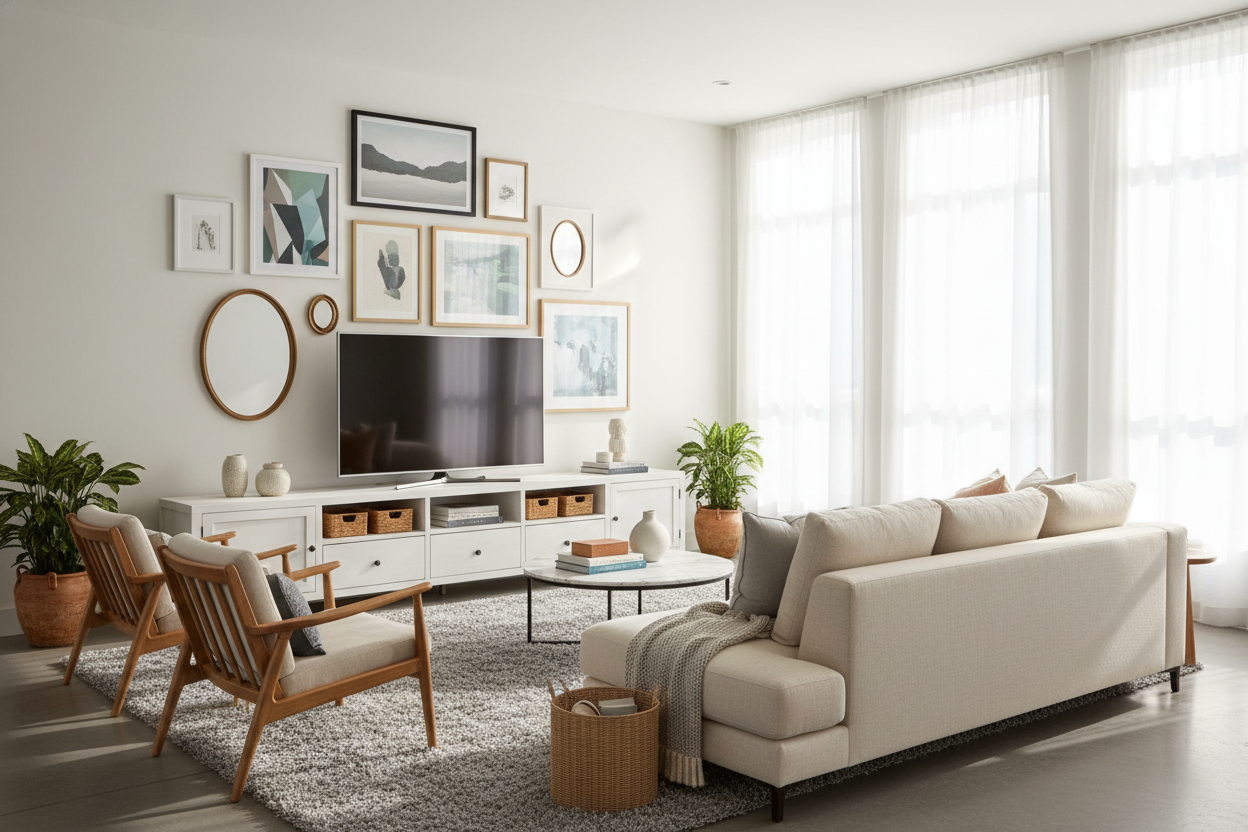
I spent three hours last night staring at a digital cart containing a $2,000 'art' television. I almost hit buy, convinced it was the only way to save my living room from looking like a sports bar. Then I realized I was about to pay a massive premium just to hide a piece of glass, when the real problem wasn't the TV—it was the height.
The secret to a high-end living room isn't a screen that pretends to be a Van Gogh; it's a low tv stand with storage that anchors your wall and lets you build a real gallery around it. When you drop the screen and ground it with the right furniture, the 'giant black box' problem simply disappears.
- Eye-Level Ergonomics: A lower stand prevents neck strain and makes the screen feel like a part of the furniture, not a billboard.
- Visual Real Estate: Lowering the TV opens up 3 to 4 feet of vertical wall space for actual art and shelving.
- Cable Management: A solid console hides the 'spaghetti' of wires that usually ruins a clean aesthetic.
- Budget Friendly: You can buy a killer console and a high-end OLED for less than the price of one designer 'Frame' TV.
The 'Art TV' Lie (And What to Do Instead)
We’ve been conditioned to think that the only way to have a stylish home is to disguise our electronics. The 'Art TV' trend is clever marketing, but it’s an expensive band-aid. You’re paying for a matte screen and a thin bezel, but you’re still left with a flat object on a flat wall. It lacks depth.
Instead of trying to hide the TV, I started treating it like an anchor. By using a short tv cabinet, you create a physical foundation. It’s about layers. A piece of furniture with actual depth—16 to 20 inches—creates a foreground that makes the wall behind it feel like a curated backdrop rather than just a surface.
Why Dropping Your Screen Height Changes Everything
Most people mount their TVs way too high. If you’re looking up even slightly while sitting on your sofa, you’ve failed the ergonomics test. A short media console usually sits between 18 and 22 inches off the floor. This puts the center of a 65-inch screen exactly at eye level.
When the TV is lower, the ceiling feels higher. It’s a classic interior design trick. By keeping the 'heavy' visual elements closer to the floor, you create a sense of airiness. You suddenly have all this breathing room above the screen to hang oversized thrifted frames or a long floating shelf that draws the eye upward.
The Golden Rule: Anchor the Bottom, Decorate the Top
I’ve tried the minimalist route with those tiny, spindly-legged stands. It was a disaster. The TV looked like it was hovering precariously, and the wall above felt top-heavy and anxious. You need a piece with some visual 'thud' to it. I actually swapped my TV stand for a wide storage cabinet and the difference was instant. The room felt settled.
A short tv stand with storage provides a horizontal line that balances the verticality of your room. It acts as a pedestal. Without that solid base, your gallery wall will look like it’s floating away. You want something that feels permanent, even if it’s a budget-friendly find.
Where to Stash the Ugly Stuff
Nothing kills the 'curated gallery' vibe faster than a glowing blue router light or a tangled mess of HDMI cables. This is why open shelving is a trap for media centers. You need closed doors. I look for dedicated media storage pieces that have pre-drilled cable management holes in the back.
In my current setup, I’ve got a PlayStation, a mesh router, and a mess of power strips all tucked behind solid wood doors. It looks like a clean, intentional piece of furniture, not a tech hub. If your console doesn't have holes, grab a 2-inch hole saw bit and a drill. It’s a five-minute fix that changes your life.
How I Built My Gallery Wall Around a Giant Black Box
Here is my formula: place the TV off-center on the tv console short. Don't center it perfectly. By shifting the TV to one side, you break the 'shrine to the television' look. I then fill the remaining space on the console with a tall lamp or a stack of oversized books.
From there, I hang art. Use black frames for at least two of your pieces to echo the black of the TV screen. This makes the TV look like just another frame in the collection. I once made the mistake of using only light wood frames, and the TV stuck out like a sore thumb. Mix in some textures—canvas, glass, maybe a wall basket—to soften the hard edges of the screen.
Finding the Right Dimensions for This Trick
When you’re shopping, the height is the only number that truly matters. You want a short tv stand with storage that is under 24 inches tall. Anything higher and you’re back in 'neck-strain' territory. For width, the console should be at least 6 to 10 inches wider than the TV on both sides. A TV that overhangs its stand looks cheap and accidental.
A modern black TV entertainment center is usually my go-to recommendation. The dark color helps the screen blend in when it's turned off, and the low profile keeps the room feeling open. Don't be afraid of a long, low unit—it doubles as extra surface area for decor, making the TV a secondary character in its own story.
FAQ
Is a 20-inch stand too low for a 55-inch TV?
Not at all. In fact, it’s usually the sweet spot. If your sofa is standard height (about 18-inch seat height), a 20-inch stand puts the middle of the screen right where your eyes naturally rest.
How do I hide cables if my stand has legs?
Use cable raceways that match your wall color, or better yet, use velcro ties to run the cables down the back of the legs. If the stand is low enough, you won't see much anyway.
Can I put a soundbar on a low stand?
Yes, but measure the clearance. Most low stands have enough top surface for a soundbar, but make sure it doesn't block the bottom of your TV's infrared sensor for the remote.


Leave a comment
This site is protected by hCaptcha and the hCaptcha Privacy Policy and Terms of Service apply.