










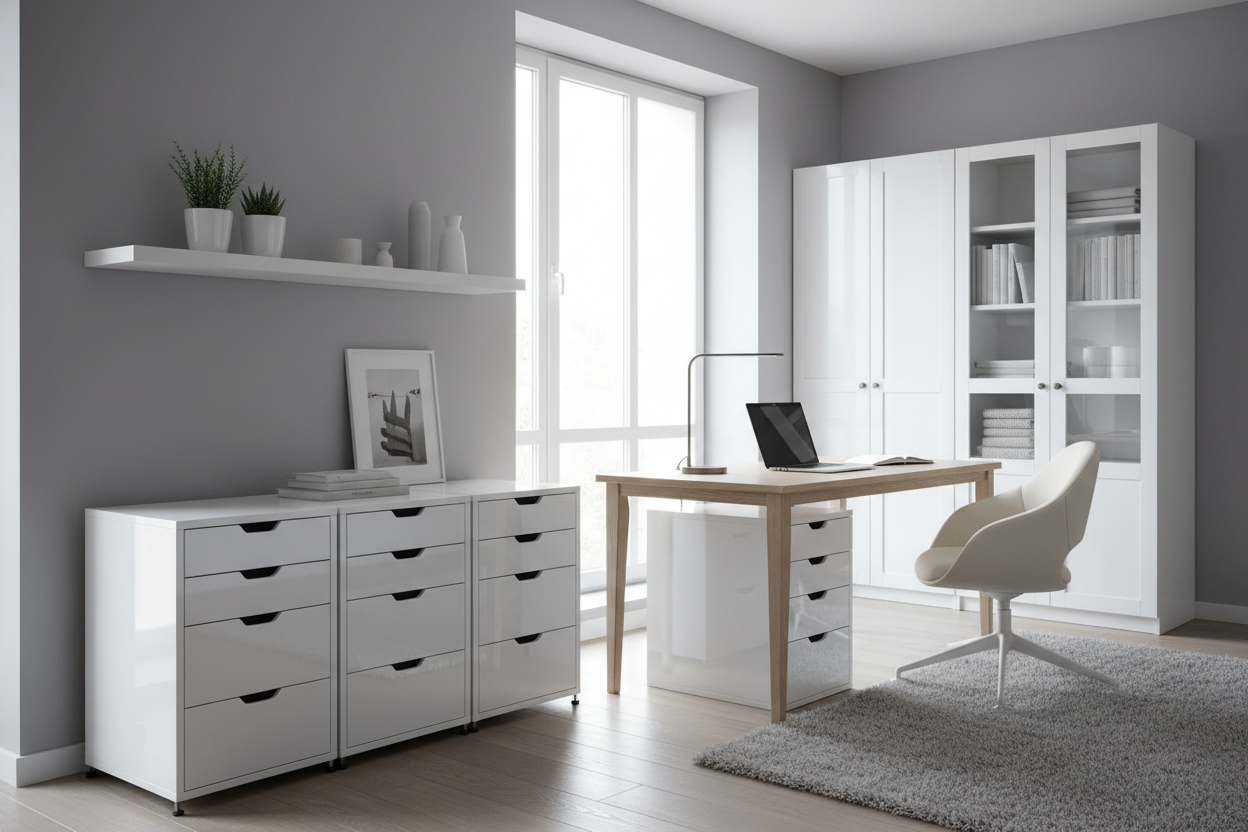
I once spent six months working in a basement office that felt more like a walk-in cooler than a workspace. The walls were 'eggshell' (which looked like wet cement in the dark) and my desk was a heavy, dark walnut beast. By 3 PM, I was basically squinting at my monitor in a cave. I realized my mistake: I was trying to make a dark room feel 'cozy' with dark furniture, but I was actually just burying myself alive. The turning point was swapping out the heavy wood for small white cabinets with drawers.
- White surfaces act as passive light reflectors, bouncing whatever dim light you have back into the room.
- Shallow drawers are the secret to killing 'junk drawer' syndrome before it starts.
- Closed storage eliminates the visual clutter that makes small rooms feel claustrophobic.
- Small footprints (think 12-15 inches deep) keep walkways clear in tight layouts.
The Curse of the Windowless Home Office
There is a specific kind of fatigue that sets in when you work in a room with zero natural light. It’s not just the lack of Vitamin D; it’s the way the walls feel like they’re inching closer every hour. When you fill that space with dark, bulky furniture, you’re essentially creating black holes that swallow what little light your overhead fixtures provide. I’ve seen people try to fix this with ten different lamps, but if the light has nowhere to land and bounce, you’re just sitting in a brightly lit cave.
Finding a Small Space Solution that doesn't feel heavy or oppressive is the first step to reclaiming your sanity. You want pieces that have a small physical footprint but a large visual impact. A dark filing cabinet says 'this is a chore,' while a bright white unit says 'this is a clean slate.' It’s psychological, sure, but when you’re staring at those four walls for eight hours a day, psychology is everything.
How Small White Cabinets With Drawers Actually Fake Natural Light
It’s simple physics, really. Dark matte surfaces absorb light waves, while white surfaces reflect them. In a windowless room, your goal is to maximize 'specular reflection.' Even a matte white finish will reflect significantly more light than a mid-toned wood. When you place a few white cabinets opposite your main light source, they act like softboxes in a photo studio. They catch the light and throw it back into the shadowy corners.
This prevents the furniture from looking like a dark void in the corner of your eye. I’ve found that using multiple smaller units rather than one giant armoire keeps the light moving. A small white storage cabinet with drawers placed near a floor lamp can actually make the floor area feel wider because the light isn't hitting a 'dead end' at the baseboard. It’s a visual trick that makes the floor plan feel continuous rather than chopped up by heavy shadows.
Finding a white cupboard small enough to tuck under sloped ceilings
If you're dealing with a finished attic or a basement under the stairs, you know the pain of the sloped ceiling. You can't fit a standard bookshelf, and a desk often leaves a 'dead zone' behind it. This is where a white cupboard small enough to fit under a 30-inch eave becomes a lifesaver. Before you buy, measure the 'knee wall' height and account for the baseboard. I once bought a gorgeous 28-inch unit only to realize my baseboards were thick enough to push it out three inches, making it hit the slope prematurely. Always leave a one-inch buffer for the 'lean' of the piece.
Hiding the Tech Avalanche (Because Bins Are Useless)
We’ve all tried the 'bin' method. You buy those cute felt or seagrass bins, throw your chargers, external drives, and adapters inside, and call it organized. Two weeks later, you’re digging through a literal bird’s nest of cables trying to find a USB-C cord. Bins are where tech goes to die. Drawers, specifically shallow ones, are the only way to manage the modern tech avalanche. You want a drawer for 'Power,' a drawer for 'Data,' and a drawer for 'The Weird Cords I Might Need Once a Year.'
If you have a lot of vertical space but a tiny floor plan, consider a vertical pairing. I often suggest combining a low drawer unit with a taller piece; in fact, I’ve written about Why A White Bookshelf With Drawers Is The Ultimate Storage Hack For Small Spaces if you want to create a full-wall unit that still feels airy. The drawers handle the ugly stuff (the gray plastic hubs and tangled wires), while the white finish keeps the vertical mass from feeling like it's toppling over on you.
Why a small white storage cabinet with drawers beats open shelving
Open shelving is an Instagram lie. Unless you own exactly four aesthetically pleasing books and a single ceramic vase, open shelves look like a mess. In a dark room, that mess creates 'micro-shadows'—hundreds of little dark spots between your items that make the room feel busy and cramped. A closed cabinet provides a flat, clean surface for light to hit. If you’re torn between hiding your tech and showing off a few treasures, you might consider Why A Small Wood Cabinet With Glass Doors Is The Storage Upgrade You Didnt Know You Needed as an alternative for your 'pretty' things, but for the office gear? Keep it behind a solid drawer front.
How to Keep It from Looking Like a Dental Clinic
The biggest fear with all-white furniture is that your home office will start to feel like a sterile exam room. You avoid this by layering textures. Don’t just buy the cheapest laminate you can find. Look for units with subtle wood grain textures or, better yet, swap out the factory hardware. Replacing generic chrome knobs with heavy unlacquered brass or matte black pulls immediately makes the piece look like a custom built-in rather than a budget find.
I also love adding a 'warm' topper. A small piece of reclaimed wood or even a leather desk mat placed on top of a white cabinet breaks up the color and adds a much-needed organic element. Finally, add a trailing plant like a Pothos. The green leaves against the white cabinet pop beautifully, and since white reflects light, the plant actually gets a little extra 'boost' from the surface it’s sitting on. It’s a win-win for the plant and your eyes.
Personal Experience: The 'Wobble' Factor
I’ve assembled probably fifty of these types of cabinets. My biggest takeaway? Never skip the wood glue. Even if the instructions don't call for it, a tiny dab in the dowel holes makes a world of difference. I once bought a cheap white drawer unit that felt like a Jenga tower every time I pulled a drawer out. After taking it apart and rebuilding it with glue and a few extra l-brackets from the hardware store, it felt like a $500 piece of furniture. Don't trust the cam-locks alone—they are the 'fast food' of furniture assembly.
FAQ
Is matte or high-gloss white better for dark rooms?
High-gloss reflects more light, but it shows fingerprints like crazy. If you have kids or touch the cabinets often, go with a 'satin' or 'eggshell' finish. It still bounces light but hides the smudges better.
How do I keep white cabinets from yellowing?
Yellowing usually happens from direct UV sunlight or cheap lacquer. In a windowless room, you're actually safe from the sun! Just avoid smoking in the room or using heavy oil-based candles nearby.
Are metal white cabinets better than wood/MDF?
Metal cabinets (like the locker style) are incredibly durable and great for an industrial look, but they can be loud. If you want a quiet, cozy office, stick to MDF or solid wood with soft-close drawer slides.

Leave a comment
This site is protected by hCaptcha and the hCaptcha Privacy Policy and Terms of Service apply.