










I am currently staring at a tangle of black HDMI cables and a router that looks like a plastic spider with glowing eyes. It is tucked behind a ceramic vase that is doing a terrible job of hiding it. This is usually the moment when homeowners start Googling built ins family room ideas at midnight, convinced that a wall of custom cabinetry is the only way to save their sanity.
I have been there. I have paid the $5,000 deposits to custom carpenters, and I have also spent four days assembling flat-pack units that I tried to pass off as 'architectural features.' The truth is, permanent built-ins are a massive commitment that people often jump into because they think it is the only 'adult' way to organize a house. It is not.
- Cost: Custom carpentry usually starts at $500 per linear foot; high-end freestanding units are often half that.
- Flexibility: You cannot take built-ins with you when you move, nor can you easily rearrange the room.
- Clutter: Open shelving is a trap; if you do not have doors, you are just displaying your mess.
- Resale: Poorly designed built-ins can actually hurt your home value if they look dated or cheap.
The Reality Check: Permanent Carpentry vs. Freestanding Furniture
Let’s talk numbers. To get a local carpenter to build a wall-to-wall unit with decent crown molding and solid wood doors, you are looking at a minimum of $6,000 to $12,000 depending on your zip code. That is a lot of money to commit to a layout you might hate in five years. I once saw a client spend $15k on a massive media wall only to realize two years later that they wanted to move the TV to the opposite side of the room to avoid glare. They were stuck with a very expensive, very permanent mistake.
On the flip side, the world of living room storage has evolved. We are no longer limited to flimsy particle board that bows under the weight of a single encyclopedia. You can find heavy-duty, kiln-dried hardwood units that offer the same visual weight as a built-in without the permanent mortgage-sized price tag. If you choose a high-quality freestanding piece, it feels intentional. It feels like a design choice rather than a 'temporary fix.' Plus, if you decide to turn the family room into a home gym or a formal dining room later, you just move the furniture.
Why You Need Living Room Built-In Cabinets With Doors
I am going to say something controversial: open shelving is a lie sold to us by professional stagers. Unless you live in a museum and own exactly twelve perfectly bound white books and three identical marble sculptures, open shelves will become a graveyard for random mail, half-broken crayons, and dusty candles. This is why I always advocate for living room built-in cabinets with doors.
You need a place to shove the stuff that makes a house feel like a home but looks like a disaster. I’m talking about the Monopoly box with the taped corners, the extra Xbox controllers, and the fleece blankets that never fold quite right. Choosing the right storage cabinets means prioritizing closed storage on the bottom two-thirds of the unit. It keeps the visual noise down and makes the whole room feel instantly cleaner, even if the inside of those cabinets is pure chaos.
Faking the Look: Securing Built-In Storage Cabinets for Living Room Spaces
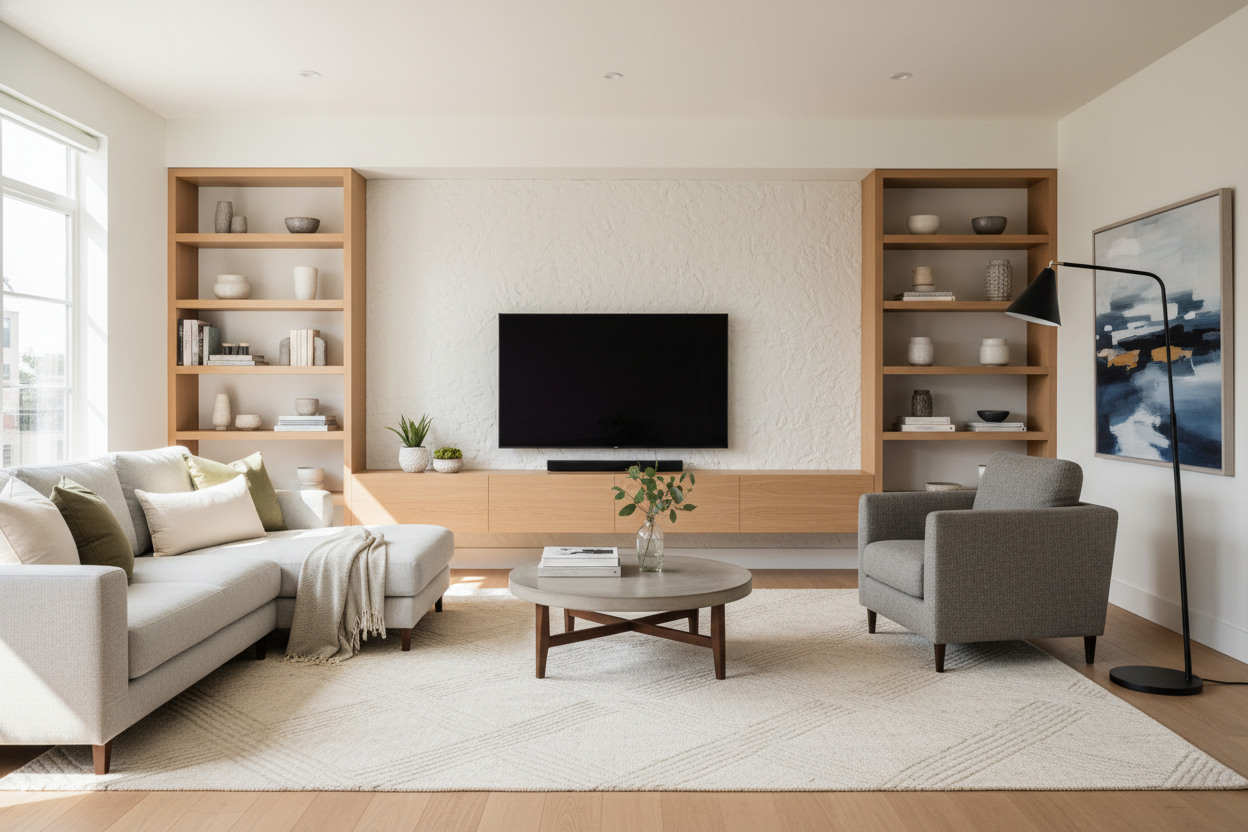
If you want the high-end look without the custom price tag, you can 'fake' built-in storage cabinets for living room use by using a few old-school carpenter tricks. The secret isn't the cabinet itself; it is the trim. When you buy a series of identical freestanding units, you can bridge the gaps with 1x4 lumber and add crown molding across the top. This creates a seamless line that mimics family room built in cabinets perfectly.
I once did this in a rental using three large bookcases. I anchored them to the wall studs (non-negotiable for safety), added a common header board across the top, and used a tube of paintable caulk to fill every single seam. Once I painted the whole thing the same color as the wall, people genuinely thought it was original to the house. If you are looking for a project, learning how to style IKEA built-in cabinets or similar big-box units is the fastest way to save $8,000 while getting that custom aesthetic.
The Exact Dimensions You Need for Family Room Built-In Cabinets
One of the biggest mistakes I see is people building units that are too shallow. A standard bookshelf is 11 or 12 inches deep. That is fine for a paperback, but it is useless for modern life. If you are designing family room built-in cabinets, you need at least 18 to 20 inches of depth for the base cabinets. This allows you to fit a modern AV receiver, a PlayStation, or a chunky storage basket for toys.
Height matters too. I recommend a 'counter' height of 30 to 36 inches for the base section. This gives you a surface to set down a drink or display a lamp. For the upper shelves, don't go all the way to the ceiling unless you have a library ladder or a lot of things you never want to touch again. A 12-inch gap at the top often looks more intentional and less claustrophobic in a standard 8-foot-ceiling room.
My Final Verdict on Wall-to-Wall Media Units
While I love the look of built in cabinets for family room layouts, I have become a convert to the 'substantial freestanding' camp. There is a specific kind of regret that comes with realizing your $10,000 wall unit doesn't fit the new 85-inch TV you want for the Super Bowl. When you have living room cabinets built in, you are locked into the technology and the furniture trends of the year you built them.
Instead of a permanent wall, I often suggest a large sideboard display buffet. A piece like this offers the same heavy-duty storage and the 'anchor' the room needs, but it leaves the wall above it open for art or a TV that can change sizes over time. It is a smarter investment for most people. You get the organization, you get the style, and you get to keep your $10,000 for something else—like a sofa that doesn't have a 1.5 lb foam density that will sag in six months.
FAQ
Do built-ins actually increase home value?
Only if they are high quality. Cheaply made DIY units or dated 'honey oak' built-ins can actually be a deterrent for buyers who see them as a demolition project. If you go custom, stick to classic Shaker styles and neutral colors.
What is the best material for family room cabinets?
Avoid MDF for any shelves that will hold heavy books; it will sag over time. Look for plywood with a hardwood veneer or solid wood frames. If you are painting them, poplar is a great, affordable hardwood choice that takes paint beautifully.
Should I paint my built-ins the same color as the walls?
Yes, if you want them to 'disappear' and make the room feel larger. If you want them to be a focal point, go two shades darker or lighter than your wall color for a sophisticated, layered look.


Leave a comment
This site is protected by hCaptcha and the hCaptcha Privacy Policy and Terms of Service apply.