





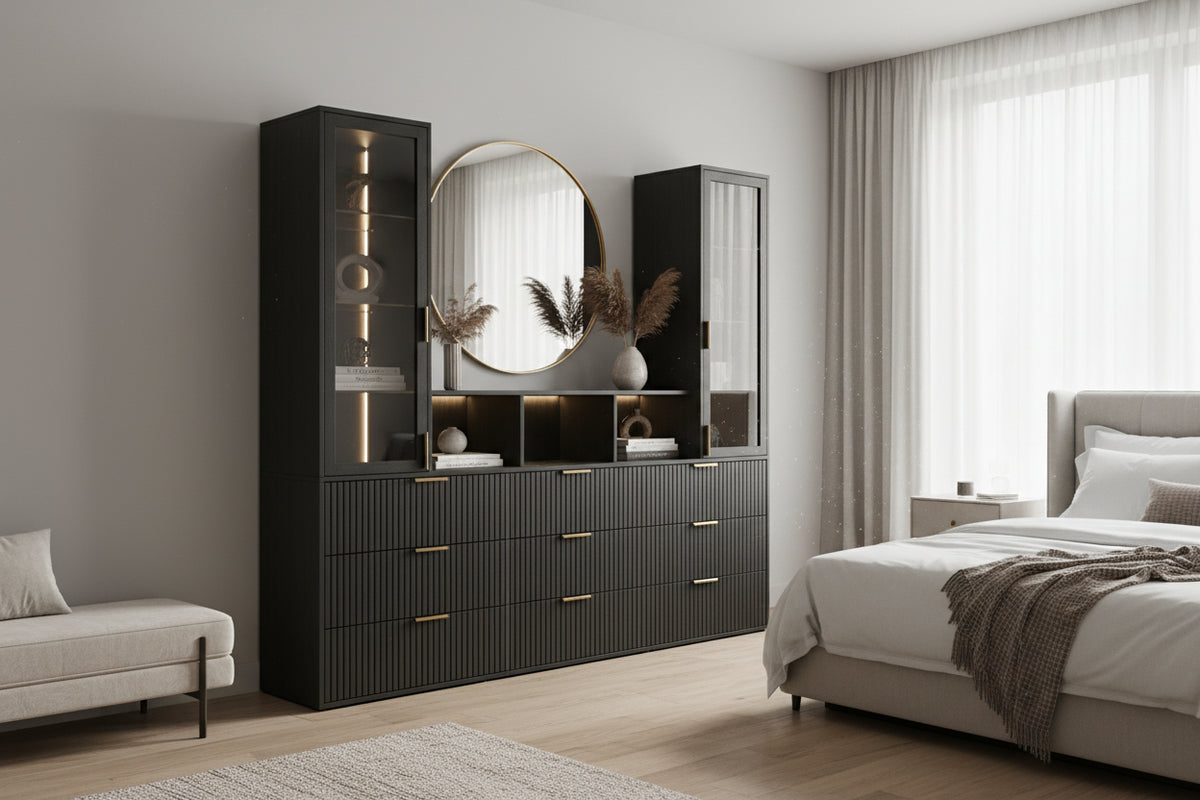
A dresser is a low, wide chest of drawers made for folded clothes. A cabinet stores things on shelves behind doors. Choose drawers for small folded items you reach for every day, doors and shelves for bulky, tall or mixed items, and a piece with both when one wall has to do everything.
This guide compares cabinet vs dresser using measurements from the FUFU&GAGA dressers and chests collection and our sideboards: storage per foot of width, floor space, room-by-room use, the tip-over rule and six picks.
Key takeaways
- Dresser: everything lies in one visible layer, but nothing taller than the drawer fits (4.5 to 4.7 inches inside on our two dresser picks).
- Cabinet: 1.5 to 2 times as much enclosed space per foot of width in our comparison, and room for items up to 23.1 inches tall, but small things need bins.
- Floor space: about equal. An open drawer or door reaches roughly 30 inches from the wall.
- Both in one: a sideboard or accent cabinet with drawers and doors covers both jobs.
- Safety: dressers fall under the federal tip-over rule, 16 CFR part 1261. Cabinets can tip too, so anchor every piece.
What is the difference between a cabinet and a dresser?
Dictionary.com defines a dresser as "a dressing table or bureau" and, in British use, as "a chest of drawers for storing clothing in a bedroom or dressing room, often having a mirror on the top". It defines a cabinet as "a piece of furniture with shelves, drawers, etc., for holding or displaying items".
The dictionary words overlap, and cabinet is the broader one. In furniture listings the split is practical. A dresser is all drawers and is sold for the bedroom. A cabinet, whether it is called a sideboard, buffet, accent cabinet or storage cabinet, has doors with shelves behind them. Our guide to the types of storage cabinets covers the cabinet family, and dresser vs chest of drawers covers the tall, narrow cousin.

| Dresser | Cabinet or sideboard | Combination piece | |
|---|---|---|---|
| Access | Pull a drawer and look down into it | Open a door and reach onto a shelf | Both |
| Interior on our picks | Drawers 4.5 to 4.7 in high, 13.1 to 24.6 in wide | Compartments 23.1 to 23.5 in high; shelves 30.1 to 30.7 in wide | Three to five drawers plus door cabinets 22.4 to 26 in high |
| Best at | Small folded clothes, one kind per drawer | Bulky, tall, heavy or mixed items | One wall that must hold both |
| Weak at | Anything taller than the drawer | Small loose items | Fewer drawers, less shelf |
How much does each hold per foot of width?
Drawers and doors use the same outer box differently, so the fair comparison is interior space divided by wall width. Here it is for three of the FUFU&GAGA picks below, from the interior sizes on each listing.
| Piece | Interior, as listed | Total enclosed | Per foot of width |
|---|---|---|---|
| 47.2 in dresser | 9 drawers, 13.1 x 13.8 x 4.7 in | 7,647 cu in = 4.43 cu ft | 4.43 / 3.93 ft = 1.13 cu ft |
| 54.6 in dresser | 8 drawers, 24.6 x 13.8 x 4.5 in | 12,221 cu in = 7.07 cu ft | 7.07 / 4.55 ft = 1.55 cu ft |
| 63 in 4-door cabinet | 2 compartments, 30.7 x 15 x 23.1 in | 21,275 cu in = 12.31 cu ft | 12.31 / 5.25 ft = 2.34 cu ft |
The cabinet encloses about 1.5 times as much per foot as the wider dresser and about twice as much as the smaller one. A dresser spends width and height on drawer boxes, fronts, slides and the frame between them. A cabinet does not.
Raw volume overstates what a cabinet holds in daily use, though. The 54.6-inch dresser gives you eight layers of 24.6 x 13.8 inches, about 2.4 square feet each, with every item visible from above. A shelf in the 63-inch cabinet is bigger, 30.7 x 15 inches or 3.2 square feet, but there are only a few, and a tall pile means lifting everything to reach the bottom shirt.
The working rule from these numbers: if most of what you store folds flatter than about 4.5 inches, drawers put more of it within reach. If it is bulky or taller than a drawer (a duvet, a stack of sweaters, bags, board games, a printer), shelves hold more of it.
How much floor space do drawers and doors need to open?
Depth is not the difference: all six picks below are 15.7 to 15.9 inches deep.
Drawers. Both dresser picks have drawers 13.8 inches deep inside. A drawer cannot come out farther than its own length, so it reaches at most 15.7 + 13.8 = 29.5 inches from the wall.
Doors. The 63-inch cabinet has four doors, and the listing's diagram labels each 15.3 inches wide. Open at a right angle, a door reaches 15.7 + 15.3 = 31 inches from the wall.
Then add yourself. Dimensions.com's bedroom clearance guide shows 42 to 48 inches of clearance for a dresser and an 18-inch activity zone, and says the space should let someone open a drawer completely and reach inside while standing in front of it. With our numbers, drawer plus activity zone is 13.8 + 18 = 31.8 inches, and door plus activity zone is 15.3 + 18 = 33.3 inches.
The difference is in use. A drawer opens straight toward you and still works partway open. A hinged door sweeps an arc, so beside a bed or in a corner, check that the nearest door can swing fully. A cabinet's lowest shelf also sits just above the floor (the two cabinet picks stand on 5.9 and 6.7 inch legs), so you crouch to reach it.

Dresser vs cabinet by room: bedroom, living room, dining room
Bedroom. A dresser is the default because most bedroom storage is folded clothing: socks, underwear, T-shirts, pajamas. Add a cabinet, or choose one instead, when the overflow is bulky: spare bedding, sweaters, bags. For drawer counts and widths, see our 9 drawer dresser guide.
Living room. A cabinet or sideboard suits the mix a living room collects (games, books, media boxes, blankets) and hides it behind one flat front. A dresser works when the clutter is small, such as remotes and chargers. If a TV is going on top of either, read our guide to putting a TV on a dresser first.
Dining room and entryway. Plates and serving dishes are heavy and stack tall, so shelves with a listed rating do the work (22 to 33 lb per shelf on the picks that give one, against 11 to 18 lb per drawer). Drawers suit cutlery and napkins, which is why a sideboard or buffet often has both.
When does a piece with drawers and doors make sense?
A combination piece, usually sold as a sideboard, buffet or accent cabinet with drawers, puts both kinds of storage in one frame. It suits a multi-purpose room: a studio, a guest room that doubles as an office, or a bedroom short on closet shelves.

- It takes the awkward items. Chunky sweaters, spare linens, board games or a printer do not fit a shallow drawer. They fit behind a door.
- Shelves give vertical flexibility. A shelf you can move or remove adapts to what you own. A drawer's height is fixed.
- Doors hide, drawers sort. Bulky things go out of sight; small daily items stay organized.
The trade-off is count. On the same 47.2-inch width, the dresser pick below has nine drawers, while the accent cabinet has three drawers plus a cabinet 26 inches high inside. If nearly everything you store is folded clothing, the dresser holds it better.
In a bedroom, a finish that matches the bed frame helps a sideboard read as bedroom furniture. On an uneven floor, level any cabinet with shims before you anchor it, or the doors may hang out of line.
Tip-over safety: what the federal rule covers
Dressers are clothing storage units under federal law. The CPSC's clothing storage unit guidance describes the rule, 16 CFR part 1261, written under the STURDY law. It covers free-standing furniture with drawers or hinged doors intended for storing clothing that is at least 27 inches tall, weighs at least 30 pounds and has at least 3.2 cubic feet of enclosed storage. Units manufactured after September 1, 2023 must pass three stability tests, carry warning labels and come with an anti-tip device that meets ASTM F3096 in the package.
The same guidance lists what falls outside the rule, including bookcases, office furniture, dining room furniture and accent furniture not intended for bedroom use. So a sideboard sold for a dining room is not held to that standard, but a loaded cabinet can tip as well. If you fill one with clothes in a bedroom, treat it exactly like a dresser.
The CPSC's Anchor It campaign says anchoring all furniture with drawers, doors and shelves to the wall prevents tip-over injuries and deaths. In its 2026 tip-over release, the agency reports an average of 17,800 emergency department injuries a year from 2020 to 2022, 44 percent of them to people under 18, and says to keep heavier items on lower shelves.
All six picks below list a tipover restraint device as included in their specs. Fix it into a wall stud or an anchor rated for your wall. Open one drawer at a time, because open drawers move weight forward and neither dresser pick lists interlocking drawers. Our anchoring guide shows the steps.
Buying checklist
- List what you will store. Measure your tallest folded stack and tallest object. Under the drawer's interior height means drawers; over it means shelves.
- Measure the wall and the floor. Wall width minus any door swing or vent; in front, the piece's depth plus the drawer or door plus 18 inches to stand.
- Read the interior sizes. Drawer width, depth and height inside, and shelf size, not just the overall size.
- Read the ratings. Per drawer, per shelf and for the whole piece, and whether shelves adjust.
- Find the tip restraint line. Look for "Tipover Restraint Device Included" in the spec.
Our picks: two dressers, two cabinets, two with both
All six need assembly (see our flat-pack assembly guide). Where a listing leaves something out, the "Skip it if" line says so.
47.2" Modern White Dresser With 9 Pull-out Drawers
A low dresser with a 3-by-3 layout and round wood knobs. Each of the nine drawers is 13.1 inches wide, 13.8 deep and 4.7 high inside, on metal slides with safety stops. The listed drawer rating is 15 lb. Size: 27.6" H x 47.2" W x 15.7" D, 90.77 lb, finished back.
Best for: small folded things kept one kind per drawer (socks, underwear, T-shirts, baby clothes) on a wall under 4 feet wide.
Skip it if: you fold sweaters or jeans into wide stacks: the drawers are only 13.1 inches wide inside.
54.6" Rustic Wood Dresser with 8 Drawers
A double dresser with framed fronts, black metal pulls and a rustic wood grain. All eight drawers are 24.6 inches wide, 13.8 deep and 4.5 high inside, on metal slides with safety stops, and each is rated for 11 lb. Size: 33.1" H x 54.6" W x 15.7" D, 134.2 lb, finished back.
Best for: a main bedroom dresser for clothes that lie flat in one visible layer.
Skip it if: you want to load drawers with denim or books (11 lb per drawer) or anything taller than 4.5 inches.
63" Modern Minimalist White 4-Door Storage Cabinet for Living Room and Entryway
A black cabinet with white patterned, handle-free doors that open with a press. The interior is 23.1 inches high, 30.7 wide and 15 deep, and the shelves, 30.7 x 15 inches, move between three positions or lift out. Size: 30.7" H x 63" W x 15.7" D on 5.9 inch legs, 90.2 lb, finished back.
Best for: bulky or tall things. With a shelf out, a compartment takes items up to 23.1 inches high.
Skip it if: you need a stated shelf rating for dishes or books. The listing gives none.
63.2" Modern White/Black Sideboard with 4 Pop-Up Doors
A handle-free sideboard whose doors pop open with a push, in white or black. The cabinet is 23.5 inches high and 14.6 deep inside, with adjustable shelves 30.1 inches wide and 14.8 deep, each rated for 30 lb; the listed capacity for the whole piece is 120 lb. Size: 31.5" H x 63.2" W x 15.9" D on 6.7 inch feet, 90.5 lb.
Best for: a dining or living room where you want a stated shelf rating for plates, books or games.
Skip it if: the back will be visible (it is unfinished), your load will pass 120 lb in total, or you need drawers.
59.1" Modern Minimalist White/Black Contemporary Buffet Storage Sideboard Cabinet with 5 Drawers and 4 Doors
Two large drawers across the top, three small drawers down the center, and a double-door cabinet on each side with a shelf you can raise, lower or remove. The listing rates each drawer for 18 lb, each shelf for 22 lb and the whole piece for 200 lb. Shelves are 21.5 inches wide and the cabinet interior is 22.4 inches high. Size: 33.5" H x 59.1" W x 15.7" D, 118.58 lb, in white, black or gray.
Best for: one wall that must do everything: small items in five drawers, bulky ones behind four doors.
Skip it if: you need every drawer's interior size. The listing gives one, 5.1" H x 11.8" W x 10.8" D, without saying which drawers it describes.
47.2" Modern White/Brown Accent Cabinet with 3 Drawers and 2 Doors
A compact hybrid: three drawers stacked on one side and a two-door cabinet beside them. The drawers are 13.5 inches wide and 11.8 deep inside, on metal slides with safety stops. The cabinet is 26 inches high and 14 deep inside, with a fixed shelf rated for 33 lb. Size: 30.7" H x 47.2" W x 15.7" D, 84.2 lb, finished back, in white or brown.
Best for: a small bedroom, studio or entry where a wall under 4 feet has to take both folded and bulky things.
Skip it if: you want to move the shelf (it is fixed), or you need the cabinet's interior width or the drawers' interior height, which the spec does not list.
Picks compared
| Pick | W x D x H | Drawers (inside) | Shelves behind doors | Listed ratings | Tip restraint, per spec |
|---|---|---|---|---|---|
| 47.2" dresser | 47.2 x 15.7 x 27.6 in | 9, each 13.1 x 13.8 x 4.7 in | None | 15 lb, largest drawer | Included |
| 54.6" dresser | 54.6 x 15.7 x 33.1 in | 8, each 24.6 x 13.8 x 4.5 in | None | 11 lb per drawer | Included |
| 63" 4-door cabinet | 63 x 15.7 x 30.7 in | None | 30.7 x 15 in, movable | None listed | Included |
| 63.2" sideboard | 63.2 x 15.9 x 31.5 in | None | 30.1 x 14.8 in, adjustable | 30 lb per shelf, 120 lb total | Included |
| 59.1" buffet (both) | 59.1 x 15.7 x 33.5 in | 5 (2 large, 3 small) | 21.5 in wide, adjustable | 18 lb per drawer, 22 lb per shelf | Included |
| 47.2" accent cabinet (both) | 47.2 x 15.7 x 30.7 in | 3, each 13.5 x 11.8 in | One fixed shelf | 33 lb on the shelf | Included |
FAQ
What is the difference between a cabinet and a dresser?
A dresser stores things in drawers and is built for folded clothes. A cabinet stores things on shelves behind doors and suits bulky, tall or mixed items in any room.
Can you use a cabinet as a dresser?
Yes, for clothes that stack well, such as sweaters and jeans, or with bins for small items. A sideboard sold as dining room furniture falls outside the federal clothing storage rule, so do not assume it was tested like a dresser, and anchor it.
Do cabinets need to be anchored like dressers?
Yes. The CPSC's Anchor It campaign says anchoring all furniture with drawers, doors and shelves to the wall prevents tip-over injuries and deaths. Use the restraint that comes with the piece and fix it into a stud or a rated anchor.
Still deciding? Compare drawer layouts in the dressers and chests collection, and measure your tallest item against the drawer height before you choose.


Leave a comment
This site is protected by hCaptcha and the hCaptcha Privacy Policy and Terms of Service apply.