










I spent three hours last Tuesday staring at my drawing room, wondering why it felt like a cluttered waiting room despite having 'nice' furniture. The culprit? A massive, floor-hugging oak bookshelf that looked like it was slowly sinking into the rug. It was heavy, it was dark, and it made the whole 15x18 space feel five feet smaller than it actually is. That is when I realized I needed a wall cabinet for drawing room storage that actually lets the floor breathe.
- Floor Visibility: Seeing your baseboards makes a room feel 20% larger instantly.
- Installation Height: Mount it 8 to 12 inches off the floor, not at shoulder height.
- Weight Limits: Always hit at least two studs; drywall anchors are a recipe for a 3 AM crash.
- Style Tip: Mix closed doors for clutter and open cubbies for your 'good' ceramics.
Why Traditional Consoles Are Ruining Your Vibe
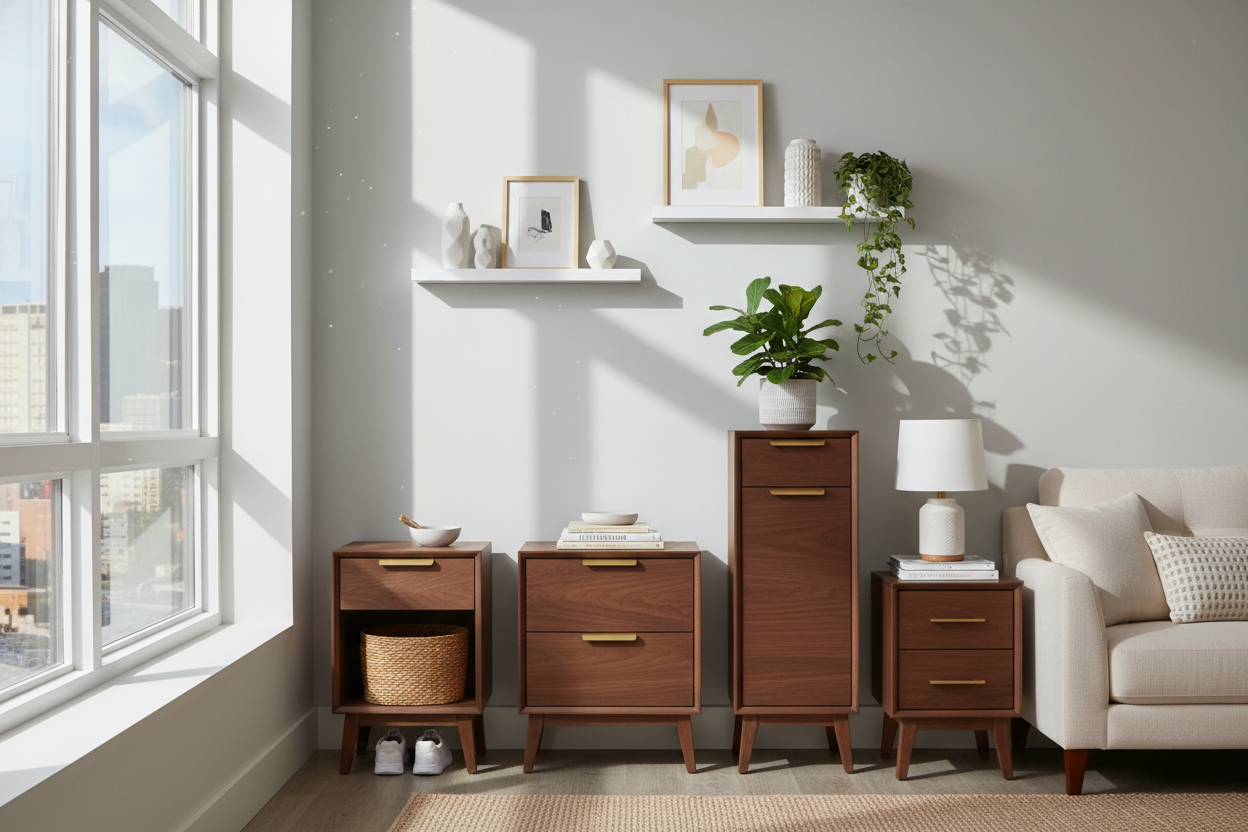
We have been conditioned to think that storage needs to sit on the floor. But bulky, floor-hugging consoles act like anchors—and not the good kind. They trap the eye, create awkward shadows, and make vacuuming a nightmare. When a piece of furniture sits flat on the ground, your brain registers that footprint as 'used space,' which shrinks the perceived size of your lounge.
Traditional wall units storage living room setups usually involve these massive, 24-inch deep behemoths that swallow light. In a formal drawing room, you want sophistication, not a wall of particle board that screams 'I bought this at a big-box store in 2004.' Switching to something elevated changes the geometry of the room. It stops being a storage locker and starts being a design choice.
The Magic of Floating Furniture in Formal Spaces
The smartest trick in the interior design playbook is the 'floating' effect. By using wall mounted lounge cabinets, you expose the floor right up to the wall. This visual continuity tricks your brain into thinking the room is significantly larger because the floor plane is uninterrupted. It is a total mental hack for small or narrow spaces.
When you rethink your living room storage, you start to see walls as functional real estate rather than just places to hang a mirror. A wall cabinet in living room layouts provides all the hidden space you need for router boxes and messy charging cables while keeping the aesthetic light. I prefer units that are about 12 to 15 inches deep—anything deeper starts to feel like a kitchen upper has lost its way.
Please Don't Hang It Too High (The Eye-Level Rule)
The biggest mistake I see with wall hung cabinets living room owners make is hanging them too high. People treat them like kitchen cabinets, mounting them five feet up. Please, don't. In a drawing room, a wall mounted cabinet for living room use should function like a floating credenza. Aim for the top surface to sit around 28 to 32 inches off the ground. This keeps it at a natural height for setting down a drink or displaying a lamp.
What to Hide vs. What to Display
Your wall storage for living room shouldn't be a dumping ground. I follow a 70/30 rule: 70% hidden behind solid doors, 30% on display. Use the hidden sections of your wall cupboard living room for the stuff that kills the mood—extra remotes, board games with tattered boxes, or that stack of magazines you’ll never actually re-read. For the display parts, think 'curated gallery,' not 'souvenir shop.'
If you have massive amounts of stuff, you might be tempted by a large sideboard display buffet. These are great if you have a 30-foot wall to fill, but in most standard drawing rooms, a sleek living room wall storage cabinet looks much more intentional. It says you’ve edited your life down to the things that actually matter.
Going Big: When You Need a Full Wall of Storage
Sometimes a single unit isn't enough. If you’re a book lover or a collector, you might be looking at a full wall of cabinets in living room designs. The key to making large wall cabinets for living room spaces work without feeling oppressive is modularity. Don't buy one giant piece; buy three or four identical units and mount them side-by-side with a two-inch gap between them. It creates a rhythm that feels architectural rather than industrial.
Before you commit to a massive install, consider if a perfect small cabinet for your living room might actually solve your problem. Often, we over-buy storage because we’re lazy about decluttering. I once installed a 12-foot wall storage living room unit only to realize half of it was filled with old HDMI cables and manuals for appliances I didn't even own anymore. Less is usually more.
My Personal Lesson in Gravity
I once tried to mount a 72-inch floating unit using those 'heavy duty' plastic drywall anchors. I figured, 'Hey, the box says they hold 50 pounds each.' Three days later, I came home to find the cabinet hanging at a 45-degree angle, my favorite ceramic vase shattered, and a chunk of drywall missing. Lesson learned: always, always find the studs. If the studs don't line up with your cabinet's mounting points, screw a 3/4-inch plywood cleat into the studs first, then mount the cabinet to the cleat. It adds 30 minutes to the job but saves you a $500 repair bill.
FAQ
Can I mount a wall cabinet on a plaster wall?
Yes, but skip the standard screws. You need toggle bolts that expand behind the lath. Better yet, find the vertical wood studs with a high-end magnet or stud finder; plaster is too brittle to rely on for weight-bearing.
How much weight can a wall mounted cabinet for living room hold?
If it is screwed into three studs with 3-inch cabinet screws, it can easily handle 100-150 pounds. If you're just using drywall anchors, don't put anything heavier than a box of tissues in it.
Will a floating cabinet look weird under a TV?
No, it's actually the best way to hide the 'black hole' effect of a TV. Just make sure the cabinet is at least 10-12 inches wider than the TV on both sides so the proportions don't look top-heavy.


Leave a comment
This site is protected by hCaptcha and the hCaptcha Privacy Policy and Terms of Service apply.