










I spent three hours last Saturday staring at a tangle of black HDMI cables that looked like a nest of snakes behind my media console. It didn't matter how expensive my speakers were; the whole setup looked like a dorm room project gone wrong. If you've ever tried to balance a 40-inch soundbar on a narrow shelf, you know the pain of choosing between high-fidelity audio and a room that doesn't look like a Best Buy clearance aisle.
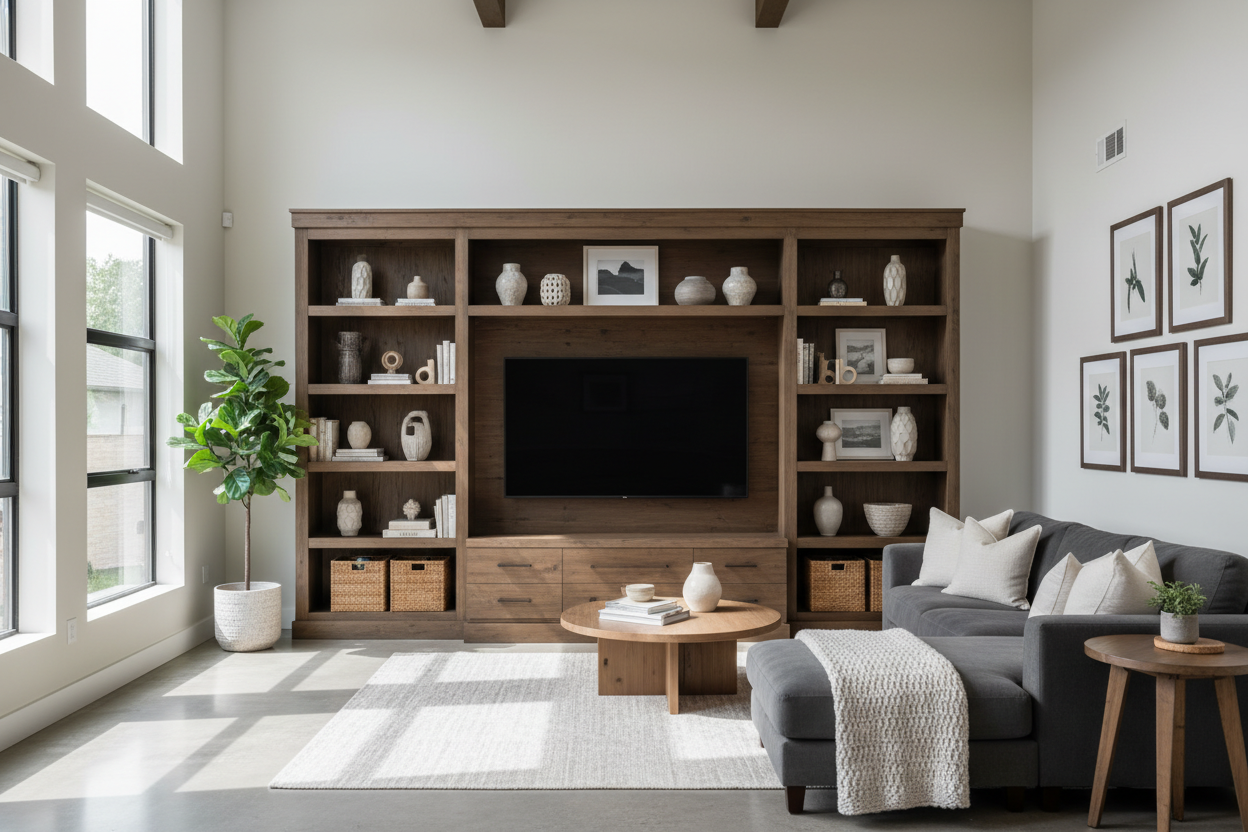
The dream is a sleek modern wall units tv setup where the tech disappears, but the sound still hits. I've bought the wrong cabinets, returned the 'acoustic' mesh that muffled my highs, and finally figured out the math. Here is the reality of hiding your audio gear without killing the vibe.
- Slatted doors are the only way to hide speakers without losing sound quality.
- You need at least 2 inches of 'breathing room' behind a receiver for heat dissipation.
- Always account for the cable bend radius—stiff HDMI cables need more depth than you think.
- IR signals pass through slats, meaning your remote will still work through wood.
The 'Ugly Black Box' Problem
We spend thousands on OLED screens and designer sofas, only to plop a chunky, plastic soundbar right in the middle of the visual field. It’s the 'Ugly Black Box' problem. Most modern living room tv wall units are designed by people who love minimalism but seemingly hate electronics. They give you a beautiful walnut surface and then nowhere to put the actual brain of your home theater.
The struggle is real because audio equipment needs two things that furniture usually hates: airflow and a clear path for sound waves. If you shove a subwoofer into a solid MDF box, it’s going to rattle the doors and sound like a muddy mess. You need a unit that treats your tech as a resident, not an intruder.
Why Open Consoles Are Failing Your Audio Setup
I used to be a proponent of the 'open air' look. I thought basic open TV stands were the move because they stayed cool and didn't block any signals. I was wrong. Within three weeks, every component was coated in a thick layer of grey dust that is a nightmare to clean around delicate ports.
Visual clutter is the other silent killer. Even with the best cable management clips in the world, you can still see the 'guts' of the system from the side. A modern wall unit should act like a magician’s trick—all the performance, none of the visible machinery. Closed storage is the only way to achieve that high-end, architectural look, but you can't just use any old cabinet doors.
The Slatted Door Secret: Acoustic Transparency
This is where the magic happens. To hide a soundbar, you need 'acoustic transparency.' Most people think this means expensive fabric grilles that eventually sag or get clawed by the cat. The better solution I've found is slatted wood doors. These are vertical or horizontal strips of wood with small gaps between them.
Because sound waves (especially high frequencies) can travel through those gaps, the audio quality remains crisp. More importantly, infrared (IR) signals from your remote can also pass through. You can point your remote at a solid-looking wooden cabinet and the volume actually goes up. It feels like living in the future, minus the ugly wires. Just make sure the slats are spaced correctly—too wide and you see the tech, too narrow and you muffle the sound.
Measuring for Clearances (Don't Skip This)
I once bought a gorgeous 70-inch unit only to realize my Denon receiver was 17 inches deep and the cabinet was 16. It sat there with the doors half-open for six months like a constant reminder of my failure. Measure your gear, then add 3 inches. You need that extra space for the 'cable bend.' A high-quality HDMI cable is stiff; if you force it into a 90-degree angle against the back of a cabinet, you’ll eventually ruin the port.
Heat is the other silent killer. If you’re hiding a receiver or a gaming console, you need ventilation. Look for wall units with 'chimney' effects—cutouts at the bottom and top of the back panel that allow hot air to rise and escape. If the unit is flush against the wall, your PS5 will sound like a jet engine within twenty minutes.
How I Finally Achieved a Seamless Look
After years of trying to hide my 5.1 hub behind decorative books (terrible idea, by the way), I finally swapped my TV stand for a wall cabinet that actually understood my needs. I chose a unit with a dedicated soundbar shelf hidden behind a slatted front. It changed everything.
The biggest mistake I made in the past was ignoring the weight of the equipment. A solid wood wall unit is heavy on its own; once you add a 20-pound receiver and a massive soundbar, you need to be sure you're hitting studs or using heavy-duty toggles. My current setup hides a Sonos Arc, a turntable, and a mesh router. It looks like a piece of art, but it sounds like a cinema. No wires, no dust, no regrets.
FAQ
Will my remote work through wooden slats?
Yes, as long as they are traditional IR remotes and the slats have at least a 1/4-inch gap. Bluetooth and RF remotes (like Apple TV or Fire Stick) don't even need the gaps—they work through solid wood.
Does the soundbar vibrate the furniture?
It can. I recommend placing small isolation pads or even just a bit of shelf liner under the soundbar to decouple it from the wood. This prevents that annoying 'buzzing' during action scenes.
Can I put my subwoofer inside a wall unit?
I wouldn't. Subwoofers move a lot of air and create intense vibrations. Even with slats, a sub inside a cabinet usually sounds boomy and makes the doors rattle. Keep the sub on the floor, maybe tucked in a corner.


Leave a comment
This site is protected by hCaptcha and the hCaptcha Privacy Policy and Terms of Service apply.