










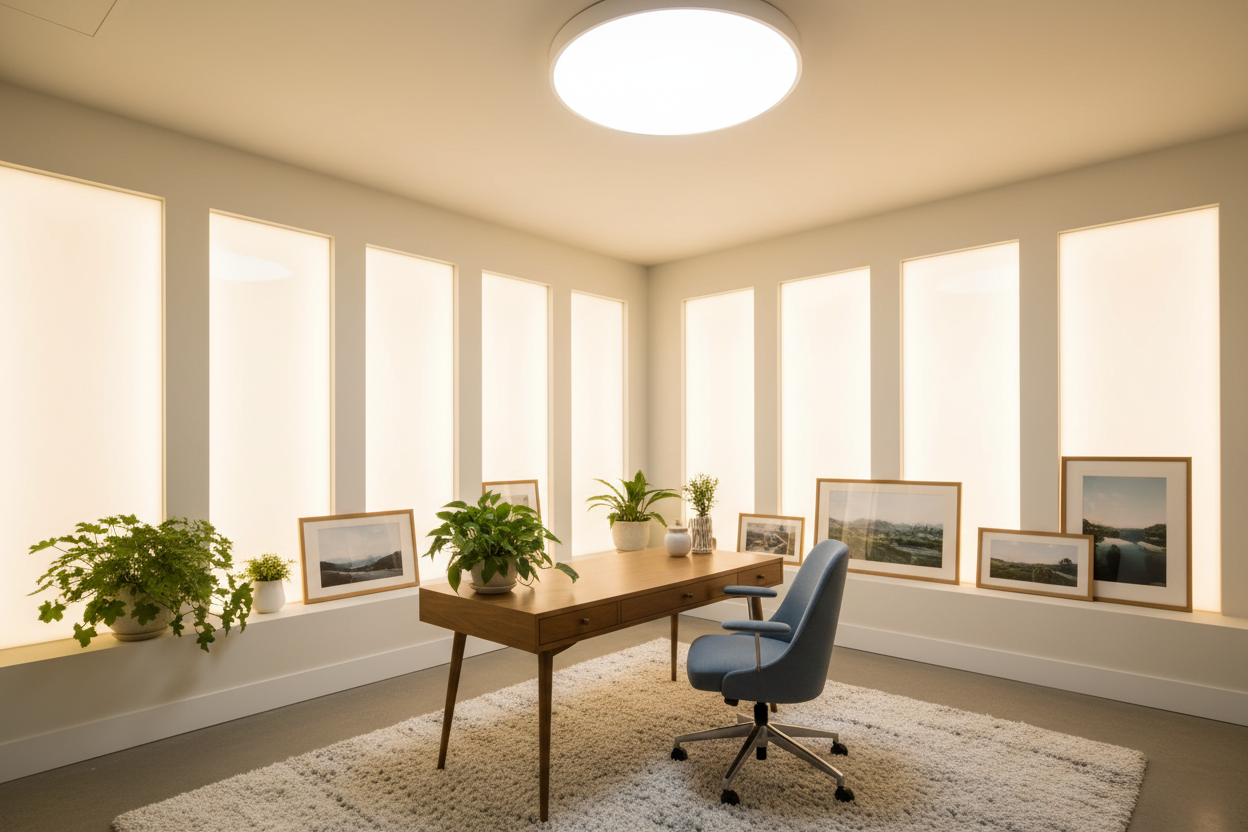
There is a distinct psychological weight to walking into a workspace that lacks natural views. The air feels heavier, and the passage of time becomes a blur. As a designer, my primary goal in these spaces isn't just visibility; it is to manufacture an atmosphere that supports your circadian rhythm and mental clarity. Finding the right light for windowless office layouts is about tricking the brain into perceiving depth and warmth where there is none.
Quick Decision Guide: Key Features to Look For
- Color Temperature (Kelvin): Aim for 4000K to 5000K. This mimics natural daylight without the sterile, blue cast of a hospital.
- Color Rendering Index (CRI): Look for a CRI of 90+. High CRI ensures colors look true and vibrant, preventing that dull, gray "cave" effect.
- Layering Strategy: Never rely on a single overhead source. Combine ambient (overhead), task (desk), and accent (wall/floor) lighting.
- Fixture Flexibility: Choose lamps with adjustable arms or dimmers to control glare and intensity throughout the day.
Mimicking Nature: The Science of Color Temperature
The biggest mistake I see in windowless office lighting is the use of warm, yellow residential bulbs (2700K). While cozy for a living room, they induce drowsiness in a workspace. Conversely, harsh fluorescent tubes can cause migraines. To achieve the best lighting for home office with no windows, you must balance the spectrum.
I recommend sourcing the best light bulbs for office with no windows that sit squarely in the "cool white" range. This spectrum stimulates serotonin production, keeping you alert. If you are sensitive to static lighting, consider smart bulbs that shift from cool blue-white in the morning to a softer warm white by late afternoon, naturally signaling your body that the workday is ending.
Layering: The Antidote to Shadows
In a room with windows, light bounces and diffuses naturally. In a sealed room, single-source lighting creates harsh shadows and high contrast, which leads to eye strain. The solution is creating a "luminous envelope" through layering.
Ambient Lighting (The Base)
This is your general illumination. Avoid recessed downlights directly over your chair, as they create unflattering shadows on your face during video calls. Instead, use a semi-flush mount fixture with a diffuser to scatter light evenly across the ceiling.
Task Lighting (The Function)
The best lamp for office with no windows is an articulated desk lamp with a matte finish. The matte finish is crucial; glossy lamps can reflect the bulb's glare into your eyes. Position the light on the opposite side of your writing hand to eliminate hand shadows.
Accent and Bias Lighting (The Mood)
This is where the design magic happens. Lamps for offices without windows shouldn't just be functional; they should add depth. Place a floor lamp in a dark corner to wash the wall with light. This technique, called wall washing, pushes the visual boundaries of the room out, making the space feel larger. Additionally, adding an LED strip behind your monitor (bias lighting) reduces the contrast between the bright screen and the dark wall, significantly saving your eyesight.
Selecting the Right Fixtures
When choosing a sun lamp for windowless office setups, aesthetics matter. A bulky therapeutic box light might be functional, but it ruins the design cohesion. Look for therapy lamps integrated into sleek, modern desk lamp silhouettes. If space is tight, vertical floor lamps that shoot light upward can simulate the feeling of an open skylight by brightening the ceiling plane.
My Personal Take on light for windowless office
I learned the nuances of lighting the hard way during a basement renovation for a graphic designer. We initially installed high-end, 5000K recessed cans everywhere, thinking "brighter is better." It was a disaster. The client called me a week later saying the room felt like an interrogation cell. It was too uniform, too flat.
The fix wasn't changing the bulbs—it was changing the direction. We killed half the overhead lights and brought in two tall torchiere floor lamps that bounced light off the white ceiling. We also added a small, warm-glow table lamp on a bookshelf. That one small pocket of lower-Kelvin light (around 3000K) gave the eye a place to rest. It broke up the clinical feel. The lesson? Office lighting with no windows needs shadow just as much as it needs light; it’s the contrast that creates the feeling of a three-dimensional, breathable space.
Conclusion
Transforming a windowless room isn't about flooding it with lumens; it is about curating an environment. By carefully selecting high-CRI bulbs, layering your light sources, and mimicking the sun's natural arc, you can turn a dark enclosure into a sanctuary of productivity. Trust the process of layering, and your eyes will thank you.
Frequently Asked Questions
What is the absolute best color temperature for a windowless office?
For most professionals, 4000K is the sweet spot. It is crisp and clean without being overly blue. If you do color-sensitive work (design, photography), bump this up to 5000K to ensure color accuracy.
Are sun lamps actually effective for productivity?
Yes. A dedicated sun lamp for windowless office use can combat Seasonal Affective Disorder (SAD) and regulate energy levels. However, position it to the side of your vision, not directly in front of you, to avoid glare fatigue.
How do I stop my windowless office from feeling like a cave?
The "cave effect" comes from dark corners. Use floor lamps or LED strips to illuminate the corners of the room. When the perimeter is bright, the brain perceives the room as more expansive and open.

Leave a comment
This site is protected by hCaptcha and the hCaptcha Privacy Policy and Terms of Service apply.