










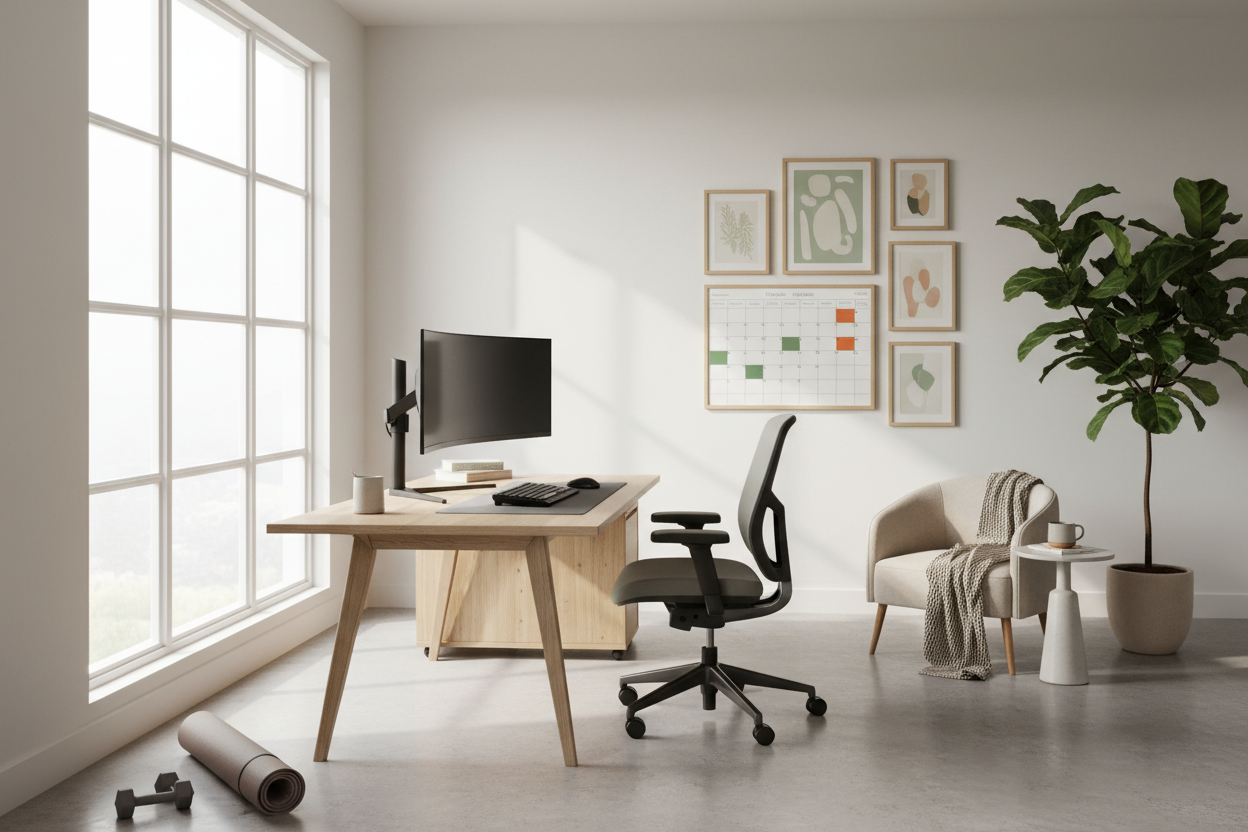
It is a common misconception among clients that productivity is solely a matter of willpower or time-blocking apps. As an interior designer, I argue that your environment dictates your habits. If your chair fatigues your lumbar spine by 11:00 AM, or your lighting induces eye strain by 2:00 PM, no amount of caffeine will save your workday. Establishing the best daily routine for office workers starts not with a schedule, but with a spatial strategy that supports human physiology and workflow.
Core Elements of a Productive Workflow
- Ergonomic Anchoring: Investing in a chair with adjustable lumbar support and seat depth to sustain posture for 4+ hour blocks.
- Lighting Layers: Utilizing adjustable Kelvin temperatures (cool for focus, warm for relaxation) to mimic natural circadian rhythms.
- Material Tactility: Choosing desk surfaces (solid wood vs. laminate) that reduce tactile fatigue and visual glare.
- Spatial Zoning: Creating distinct physical zones for deep work, administrative tasks, and restoration.
The Morning Phase: Ergonomics and The Standing Desk
Your morning routine should begin with ergonomic calibration. Before opening a single email, the physical relationship between your body and your furniture needs to be established. If you utilize a sit-stand desk, start the day standing. This engages the core and prevents the immediate onset of lethargy.
Material Considerations for High-Use Surfaces
When selecting a desk, the material plays a subtle but critical role in your routine. Glass tops, while sleek, are often cold to the touch and reflect overhead lighting, causing subconscious micro-distractions. I often recommend matte-finished walnut or oak veneers. These materials absorb light rather than reflecting it, creating a calmer visual field that supports sustained focus during high-intensity morning tasks.
Mid-Day Transitions: Lighting and Movement
By early afternoon, the natural light in your space shifts, and your office work routine must adapt. This is where 'layered lighting' becomes functional rather than just aesthetic. A high-quality task lamp with adjustable color temperature is essential.
Around 1:00 PM, shift your lighting to a cooler, blue-enriched white light (approx. 4000K–5000K) to combat the post-lunch energy dip. Simultaneously, this is the time to lower your standing desk to a seated position. Ensure your chair’s synchro-tilt mechanism is unlocked, allowing you to recline slightly while maintaining foot contact with the floor. This dynamic sitting encourages blood flow without breaking your concentration.
The Afternoon Reset: Spatial Zoning
One of the most effective ways to refresh your mental state is to physically change your location within the room. In luxury office design, we always include a 'soft seating' element—a lounge chair or a small sofa separate from the main workstation.
Move to this secondary zone for reading reports, taking calls, or creative brainstorming. A change in texture—from the rigid mesh of a task chair to the softness of bouclé or aniline leather—signals to the brain that the mode of work has changed. This tactile shift helps mitigate burnout and segments the day effectively.
My Personal Take on best daily routine for office workers
I learned the hard way that 'aesthetic' does not always equal 'functional' when it comes to daily routines. A few years ago, I designed my home office around a stunning, vintage mid-century modern teak desk. It looked incredible in photos.
However, the desk height was fixed at 28 inches—about an inch too low for my stature—and the drawer clearance was tight. After three months, I developed a nagging pain in my right trapezius because I was subconsciously shrugging my shoulder to type. I also noticed that the vintage lacquer finish became sticky after long hours of contact on humid days, which was a sensory nightmare.
I eventually swapped it for a modern lift desk with a matte linoleum top. The linoleum is soft under the wrist and doesn't show fingerprint oils the way the lacquer did. It wasn't as 'Pinterest-perfect,' but my daily endurance doubled. It taught me that the best routine is one where the furniture disappears because it works so seamlessly.
Conclusion
Curating a high-performance workspace is about more than buying expensive furniture; it is about orchestrating a dialogue between your body and the room. By prioritizing ergonomics, lighting, and zoning, you transform your daily grind into a fluid, sustainable practice. Elevate your standards, and your productivity will follow.
Frequently Asked Questions
How often should I alternate between sitting and standing?
The general consensus in ergonomic design is a 2:1 or 3:1 ratio. For every 45 minutes of sitting, spend 15 minutes standing. However, listen to your body; if you find yourself leaning heavily on the desk while standing, your core is fatigued, and it is time to sit.
Does the color of my office walls affect my routine?
Absolutely. Color psychology is a real component of interior design. Blues and greens are low-wavelength colors that improve efficiency and focus. High-saturation colors like red can increase urgency but may lead to anxiety over a full 8-hour shift.
Is a footrest necessary for a good daily routine?
If your desk height is fixed and your feet dangle when your chair is raised to meet the keyboard, a footrest is non-negotiable. It relieves pressure on the back of the thighs (improving circulation) and helps maintain the natural curve of the lumbar spine.

Leave a comment
This site is protected by hCaptcha and the hCaptcha Privacy Policy and Terms of Service apply.