










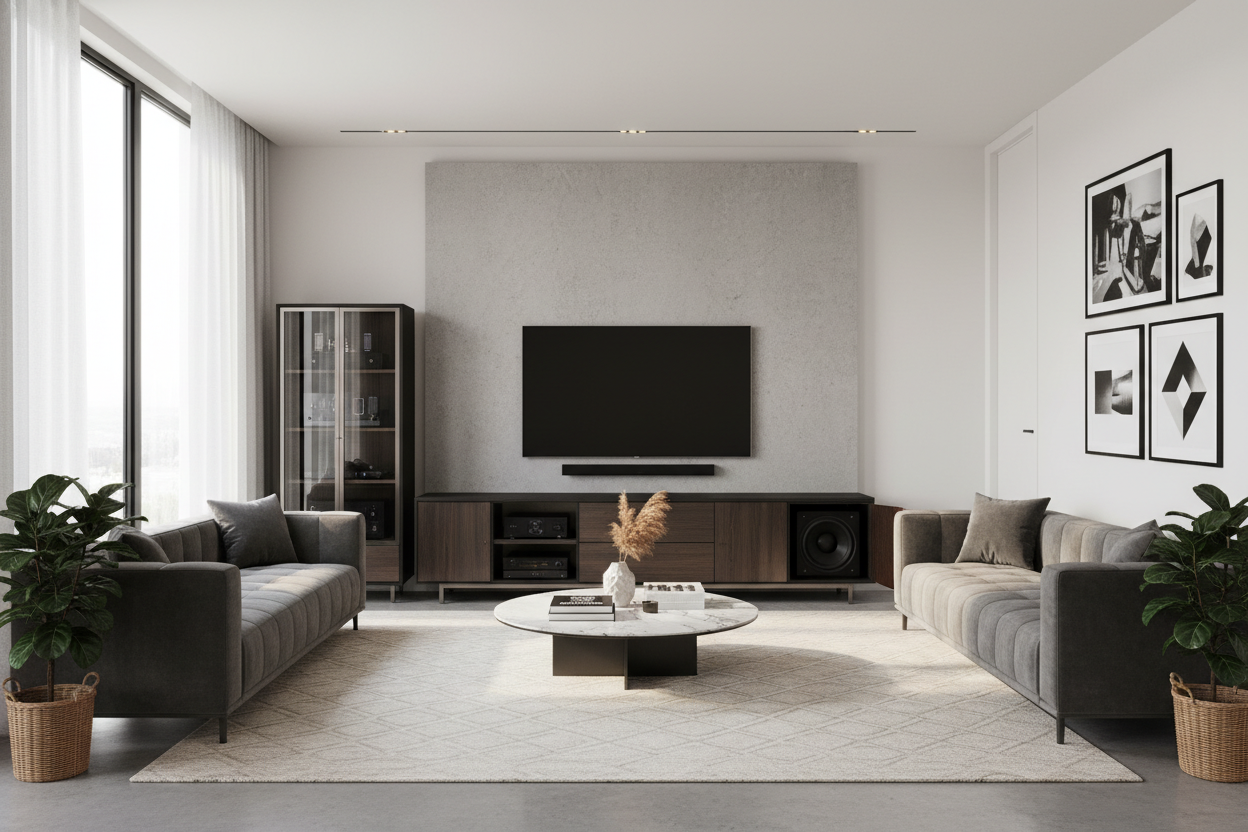
I remember sitting on my living room floor at 2 AM, surrounded by Allen wrenches and a mounting sense of dread. I had just finished assembling a gorgeous mid-century media console, only to realize my SVS subwoofer looked like a giant, industrial carbuncle sitting next to it. It is the ultimate decorator’s dilemma: you want the 20Hz floor-shaking bass for movie night, but you do not want your living room to look like a Best Buy clearance aisle. Finding an entertainment center with space for subwoofer integration should not be this hard, yet here we are.
Quick Takeaways
- Standard closed cabinets will rattle like a bag of nails if you shove a sub inside.
- Look for slatted doors or mesh grilles to let sound waves actually escape.
- Weight capacity is huge; some subs weigh 50+ lbs and will bow a cheap shelf.
- Isolation pads are a non-negotiable $20 investment to stop the furniture from buzzing.
The Giant, Vibrating Elephant in the Living Room
Most furniture designers seem to think we all live with tiny, tinny soundbars. They give us wire management holes the size of a nickel and shelves that could barely support a paperback, let alone a high-excursion driver. When you are hunting for a tv cabinet with woofer compatibility, you are usually met with solid doors that trap heat and muffle sound. It is frustrating because good audio is a priority for me, yet the furniture industry treats subwoofers like an embarrassing secret you should hide behind a potted plant.
Why Most Standard Cabinets Fail the Subwoofer Test
Shoving a sub into a standard box is a recipe for acoustic disaster. I learned this the hard way when my previous wood tv cabinet with glass doors turned my living room into a percussion instrument. Every time an explosion happened on screen, the glass rattled so loudly I could not hear the dialogue. Most cheap MDF backings act like a drumhead, vibrating against the wall and creating a muddy, boomy mess. You need mass and ventilation, or you are just building a very expensive rattle-box that ruins the calibration of your entire system.
The 3 Non-Negotiables for Hiding Heavy Audio Gear
To find a functional tv cabinet with subwoofer space, you need three specific features. First is acoustic transparency. If the door is solid wood, the bass will just stay trapped inside. Second is depth; modern subs are deep, often requiring 18 to 22 inches of clearance. Third is a floor-level opening. A modern tv console cabinet with an adjustable or open-bottom design is often the smartest play. It lets the sub sit directly on the floor—where it belongs for better bass response—while the cabinet 'wraps' around it visually. This prevents the weight of the sub from warping your furniture over time.
The 'Decoupling' Hack That Saves Your Furniture
Even if you find the 'perfect' unit, the physics of bass will try to ruin your life. This is where decoupling comes in. I always use high-density foam blocks or dedicated isolation feet. By separating the vibrating sub from the actual wood of the entertainment center, you stop the energy from transferring into your shelves. It is a cheap fix that makes a massive difference. Without it, your expensive console will eventually develop loose joints and annoying squeaks from the constant micro-vibrations.
When You Just Need to Let the Bass Breathe
Sometimes, the best 'hiding' spot is just a clever layout that does not involve a cabinet at all. I once thought I could hide everything, but switching to a storage cabinet with drawers meant I had zero internal height for a sub. I ended up placing the sub in a corner and using a matching plant stand to camouflage the top. If you cannot find a cabinet that fits the sub, look for asymmetrical designs where one side is open floor space. It looks intentional and modern rather than like a mistake.
FAQ
Can I put a subwoofer in a closed cabinet?
You can, but it will sound terrible. The bass will be muffled, and the cabinet will rattle. If you must, ensure the back of the cabinet is completely removed and the front door has a mesh or slat design.
Does the subwoofer need to be on the floor?
Yes. Putting a heavy, vibrating subwoofer on a wooden shelf is a bad idea for both sound quality and structural integrity. The floor provides the most stable surface for bass frequencies.
What are slatted doors?
These are doors made of horizontal or vertical wood strips with gaps in between. They allow sound waves and infrared remote signals to pass through while still hiding the equipment from view.

Leave a comment
This site is protected by hCaptcha and the hCaptcha Privacy Policy and Terms of Service apply.