





A standard coat closet is 24 inches deep, and 26 to 30 inches is better if you hang bulky winter coats. Below 24 inches, coats on hangers start to rub the back wall or catch on the door, and below about 20 inches hangers no longer fit front to back at all.
Depth is only the first number. This guide covers the full set of coat closet dimensions (depth, closet rod height, shelf height, width per coat and closet door sizes), shows how to lay out an entryway coat closet, and ends with freestanding picks from the FUFU&GAGA entryway furniture collection for homes with no closet by the door.
Standard coat closet dimensions at a glance
| Measurement | Typical | Range or minimum |
|---|---|---|
| Closet depth (inside) | 24 in | 20 in bare minimum; 26 to 30 in for bulky winter coats |
| Closet width | 36 in or more | About 3 in of rod per heavy coat |
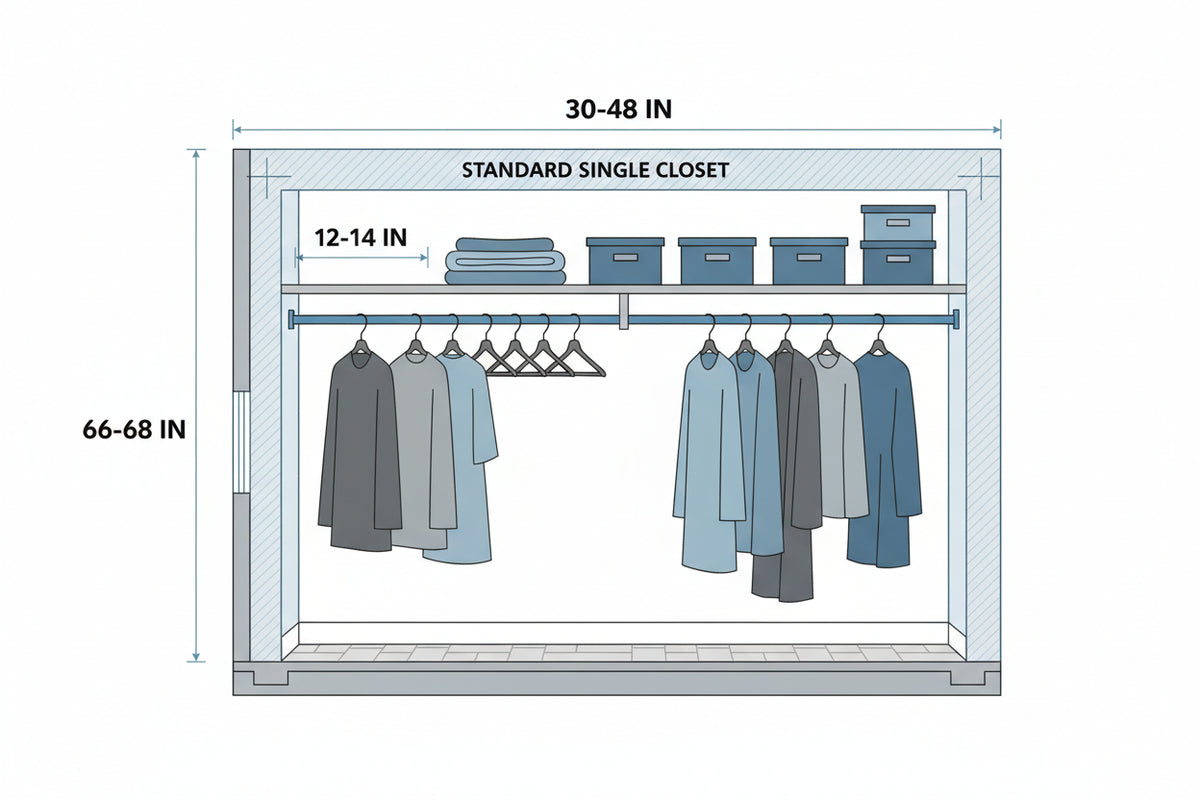
| Rod height (single rod) | 66 to 68 in | Longest coat on its hanger plus 6 in |
| Rod distance from back wall | 12 in | Center of a 24-in closet |
| Shelf above the rod | 2 to 2.5 in gap | Upper shelf about 84 in from the floor |
| Hinged door width | About 30 in | 24 in or less per door when you split the opening |
| Bifold door opening | 24 to 72 in | Folded panels can take 6 to 8 in of depth |
| Sliding door opening | 48 to 72 in (two panels) | Doors can take up to 3 in of depth |
| Walkway in front | 36 in clear | 32 in at short pinch points |
Sources differ by a few inches, so the table gives ranges where they disagree. Each figure is sourced in the sections below.
Key takeaways
- Depth: 24 inches deep is standard; build 26 to 30 inches for a closet that is mostly winter coats.
- Rod: one rod at 66 to 68 inches, 12 inches from the back wall, with a shelf just above it.
- Width: about 3 inches of rod per heavy coat, so a 36-inch rod holds about 12 (36 / 3).
How deep should a coat closet be?
A coat closet should be at least 24 inches deep inside, and 26 to 30 inches deep for heavy coats. That range comes from a clothing storage study by Auburn University's agricultural experiment station, Rod Closets for Southern Farm Homes (Kathryn Philson, 1960). The researchers measured garments on hangers and found many are fully 24 inches wide, and wider still when pressed together on a rod. Their summary: closet depth should never be less than 24 inches, and coat closets should be 26 to 30 inches deep, with 30 inches for coats with large cuffs.
Current references agree on 24 inches as the standard closet depth. Dimensions.com gives 24 inches as the comfortable depth for hangers and 20 inches as the minimum depth. Family Handyman describes a standard coat closet as at least 36 inches wide and 24 inches deep. Hunker says closets for coats or bulky items may need up to 28 inches, and that under 22 inches is too shallow for hanging clothes.
| Closet depth | What it means for coats |
|---|---|
| Under 20 in | Too shallow for hangers facing forward; use hooks, an end-wall rod or shelves |
| 20 to 22 in | Bare minimum; coat shoulders brush the door or back wall |
| 24 in | Standard depth; fine for jackets and most coats |
| 26 to 28 in | Breathing room for parkas and wool overcoats |
| 30 in | Coats with large cuffs; the deepest the Auburn study recommends |
Measure the depth of a closet from the back wall to the inside face of the door, not to the door frame. That small detail matters most with sliding and folding doors (see below).
Is 18 or 20 inches deep enough for a coat closet?
Eighteen inches is not enough for a traditional hanging rod with hangers facing the door, because a coat on a hanger is wider than the space. It still works with face-out hooks, a short rod on the end wall so coats face forward, or shelves for storage bins. Twenty inches is the absolute minimum depth for hangers per Dimensions.com: fine for light jackets, tight for winter coats.
Closet rod height and hanging space
Mount a single closet rod 66 to 68 inches above the floor. Bob Vila recommends 66 inches so long coats hang without folding, and Hunker gives 68 inches for long-hang items such as dresses and coats. Bob Vila also puts the rod at least 12 inches from the back wall, the center line of a 24-inch closet.
The Auburn study gives a rule for any coat: rod height equals the longest garment on its hanger plus about 6 inches of floor clearance. Its average garment lengths, from the top of the rod to the hem:
| Garment | Length from rod to hem | Rod height needed (+ 6 in) |
|---|---|---|
| Jackets | 25 to 40 in | 31 to 46 in |
| Short coats | 31 to 43 in | 37 to 49 in |
| Men's overcoats | 48 to 54 in | 54 to 60 in |
| Women's long coats | 48 to 55 in | 54 to 61 in |
So a rod at 66 inches clears even the longest coat in the study. If shoe racks or a bench sit under the coats, add their height: a coat that hangs 50 inches over a 16-inch boot shelf needs the rod at about 66 inches (50 + 16). Styles have changed since 1960, so measure your own longest coat on its hanger.
Leave at least 2 inches between the rod and the shelf above (Bob Vila; Auburn says about 2 1/2), or hangers are hard to lift off. Hunker places an upper shelf at 84 inches, which is 16 to 18 inches above a 66 to 68 inch rod (84 - 68 = 16; 84 - 66 = 18). That top shelf is the place for hats, gloves and seasonal gear.
How wide should a coat closet be?
Width is set by how many coats you hang. The Auburn researchers hung garments side by side and measured the hanging space each one took:
| Garment | Rod space each | Coats on a 36-in rod |
|---|---|---|
| Heavy jackets and coats | 3 in | 12 |
| Women's winter dress coats | 3 1/2 in | About 10 |
| Topcoats | 2 1/2 in | About 14 |
| Medium jackets and raincoats | 2 in | 18 |
| Light jackets and sweaters | 1 in | 36 |
The right column is plain division (36 / 3 = 12). The garments were measured in 1960, so allow more for bulky modern puffers. A family of four with two or three winter coats each needs about 24 to 36 inches of rod (8 to 12 coats x 3 inches), and the study suggests adding 2 or 3 feet for guests' coats.
Hooks use far more wall. The same study spaced hooks 6 to 12 inches apart, 12 inches for each heavy coat, and noted that 21 items needing about 15 feet of hooks fit on a 3-foot rod. A few hooks on the end wall or door still help with the daily coat, a wet raincoat or a leash.
Closet doors: hinged, bifold or sliding
The closet door decides how much closet space you can reach and how much floor space it needs. According to Designing Idea, the average closet door is 30 inches wide and 80 inches tall, bifold doors cover openings of 24 to 72 inches, and two-panel sliding doors cover 48 to 72 inch openings with panels of 24 to 36 inches.
Each type has a cost, explained in the Auburn bulletin:
- Sliding doors need no swing space but open only half the closet at a time. With thick doors, the inner door can sit up to 3 inches behind the outer one, so a 24-inch closet leaves about 21 inches for hangers (24 - 3).
- Bifold doors open almost the full width, and each leaf swings out about one panel width, roughly half of a single hinged door. But some folding doors are nearly 6 inches thick closed and over 8 inches pushed open, so add that to the depth.
- Swing doors open the whole front and can carry hooks on the back. The study suggests using more than one door, no more than 2 feet wide each, so the swing stays small.
Door clearance in front matters in an entry. The ADA's guide to accessible routes sets a 36-inch minimum clear width for walking surfaces, narrowing to 32 inches at short points such as doorways. Homes don't have to meet it, but 36 inches is a sensible path to keep past an open closet door.
Entryway coat closet layout
A good entry closet design stacks up from the floor. Use this as a checklist for a new closet or a remodel:
- Rod parallel to the back wall, 12 inches out and 66 to 68 inches high, so coats face the door and hang straight.
- Shelf just above the rod with a 2 to 2.5 inch gap, for hats, gloves and storage baskets.
- Upper shelf near 84 inches for seasonal gear.
- Floor zone: a low shoe rack, boot tray or small bench under short coats; keep long coats at one end.
- Hooks on the inside of a hinged door or the end wall for bags and leashes.
- Light: a battery motion light above the door to see the back of the closet.
- Wet gear: let soaked coats and boots dry in the open before they go behind a closed door.
If the closet is deeper than wide, run a short rod on the end wall so coats face out, and use the rest of the depth for shelves. A walk-in coat closet needs about 4 x 4 feet at minimum: Hunker gives at least 4 feet wide by 4 feet deep, with a 24-inch clear passage.
No coat closet? Use freestanding storage with the same numbers
Many homes have no closet by the front door. A freestanding wardrobe or coat cabinet can do the job if it meets the same coat closet dimensions: 20 inches deep or more, a hanging drop longer than your longest coat, and a rod rated for the weight. Our guide to entryway coat closets with doors covers choosing and placing one, so this post doesn't repeat it.
Two checks matter most. Many wardrobes are under 20 inches deep, which is tight for coat hangers, and many put the rod over a shelf or drawers, so the hanging section is far shorter than the cabinet. In a tight hall, subtract the cabinet depth from the hallway width and aim for 36 inches clear; our narrow entryway cabinet guide shows the arithmetic.
Our picks: freestanding coat storage that meets the numbers
Each FUFU&GAGA pick below is at least 20 inches deep with a hanging rod, except the hall tree, which trades the rod for hooks, a bench and a closed cabinet. Hanging drops are approximate, read from each product's diagram.

63" Beige Textured Armoire with Top Cabinets, Glass Doors and Hanging Rod
The pick that comes closest to a built-in coat closet. It is 23.6 inches deep, within half an inch of the 24-inch standard, with two hanging sections: a central one about 47.8 inches tall and a narrow side one about 54.6 inches tall. Hang long coats in the side section; the center one suits jackets and hip-length coats. The rod holds 33 lb, a light strip brightens the interior, and an organizer box sorts gloves and scarves. Width and depth: 63" W x 23.6" D. A tipover restraint is included.
Best for: a family entry or mudroom wall that needs long and short hanging plus shelves.
Skip it if: your ceiling is 8 feet or lower; the listing and its diagram give different overall heights, so confirm the height with us before ordering. The center doors are glass, so coats stay visible.
31.5" Textured Beige Armoire with Pants Rack and Hanging Rod
The narrow pick with real closet depth: 23.6 inches overall, so bulky coats hang square. The hanging section is about 46.4 inches tall over a pull-out pants rack, with a 33 lb rod across a 30.2-inch-wide space, room for about 10 heavy coats (30.2 / 3). Size: 77.1" H x 31.5" W x 23.6" D. A tipover restraint is included.
Best for: jackets, puffers and hip-length coats in a 32-inch gap by the door.
Skip it if: you hang overcoats or long coats; about 46 inches is shorter than the 48 to 55 inches they need, so hems would rest on the pants rack.

63" Modern White Armoire with Hanging Rod and 4 Drawers
A wide white cabinet laid out like a coat closet: one side has a 30-inch removable rod (25 lb) with a hanging drop of about 49.7 inches, the other has shelves 16.2 inches high (30 lb each), and four drawers below take hats and scarves. At 20.6 inches deep it clears the 20-inch hanger minimum. Size: 74.2" H x 63" W x 20.6" D. A tipover restraint is included.
Best for: a wide entry wall that needs hanging, shelves and drawers behind matching doors.
Skip it if: you hang many heavy coats; the rod covers only half the width (about 10 heavy coats), and bulky parkas may press on the doors at 20.6 inches deep.
47.2" Modern 3-Door Wardrobe with Aluminum Hanging Rod and 4 Drawers
One of our most-ordered wardrobes, and a mid-width option. A removable 31-inch aluminum rod sits beside three adjustable shelves; in the diagram the hanging area runs as tall as those three 16.1-inch shelf spaces, roughly 48 inches (3 x 16.1 = 48.3). Four drawers glide on steel ball slides. Size: 74.2" H x 47.2" W x 20.6" D. A tipover restraint is included.
Best for: light jackets, raincoats and a few everyday coats in a 48-inch space.
Skip it if: you hang heavy winter coats; the rod is rated for only 15 lb, the lowest here, so weigh an armful of coats first.
Stilla 59.1" Hall Tree with Storage Bench and Flip-Down Shoe Cabinet
The pick for an entry that needs a seat as well as closed storage. One half has four double hooks, a cushioned bench (19.7 inches high, rated for 200 lb) and a flip-down shoe cabinet; the other is a tall cabinet with doors and shelves for bags, hats and backpacks. The two pieces separate if your wall is short. Size: 70.9" H x 59.1" W x 17.7" D. Wall anchors and a tipover restraint are included. More sizes are in our hall tree buying guide.
Best for: daily coats on hooks, shoes hidden, and a bench to sit on.
Skip it if: you want coats on hangers behind doors; the cabinet holds shelves rather than a rod, and each hook is rated for 6.6 lb.

Compare the picks
| Pick | W x D (in) | Hanging drop | Rod | Best for |
|---|---|---|---|---|
| 63" beige textured | 63 x 23.6 | About 47.8 and 54.6 in | 33 lb | Long and short coats |
| 31.5" beige, pants rack | 31.5 x 23.6 | About 46.4 in | 33 lb | Bulky short coats |
| 63" white, 4 drawers | 63 x 20.6 | About 49.7 in | 25 lb | Hanging plus drawers |
| 47.2" 3-door | 47.2 x 20.6 | About 48 in | 15 lb | Light jackets |
| Stilla 59.1" hall tree | 59.1 x 17.7 | Hooks only | None | Bench and shoes |
For other widths, see our wardrobe dimensions guide or the full entryway collection.
Anchor tall coat storage to the wall
A tall cabinet full of coats can tip if someone pulls an open door or climbs it. The CPSC's Anchor It campaign says anchoring all furniture with drawers, doors and shelves to the wall prevents tip-over injuries and deaths. Wardrobes and armoires are clothing storage: the CPSC clothing storage unit rule (16 CFR part 1261) covers free-standing units at least 27 inches tall, 30 pounds and 3.2 cubic feet of enclosed storage, lists armoires among its examples, and applies to units made after September 1, 2023, which must pass stability tests and come with an anti-tip device. Fix any tall unit to a stud or with anchors rated for your wall; our anchoring guide shows the steps.
FAQ
Is 2 feet deep enough for a coat closet?
Yes. Two feet, or 24 inches deep, is the standard closet depth and fits coats on standard hangers. Bulky parkas and wide-sleeved coats will touch the door in a crowded closet, so build 26 to 30 inches deep if the closet is mainly for winter coats.
Is 3 feet too deep for a closet?
For a reach-in coat closet, 36 inches is more than the sources call for: the deepest the Auburn study recommends is 30 inches. Extra depth helps only if you add hooks or shelves behind the coats, or turn the space into a small walk-in with a rod on the end wall.
How high should the rod be in a coat closet?
Mount it 66 to 68 inches above the floor (Bob Vila, Hunker). To check, measure your longest coat on its hanger and add about 6 inches of floor clearance, plus the height of any shoe rack below it.
What do you call a coat closet?
A coat closet is also called a hall closet, entry closet or front closet: a reach-in closet by the front door for coats, shoes and bags. A freestanding piece that does the same job is usually sold as a wardrobe, armoire or coat cabinet. Our closet dimensions guide covers bedroom and walk-in closets.


Leave a comment
This site is protected by hCaptcha and the hCaptcha Privacy Policy and Terms of Service apply.