










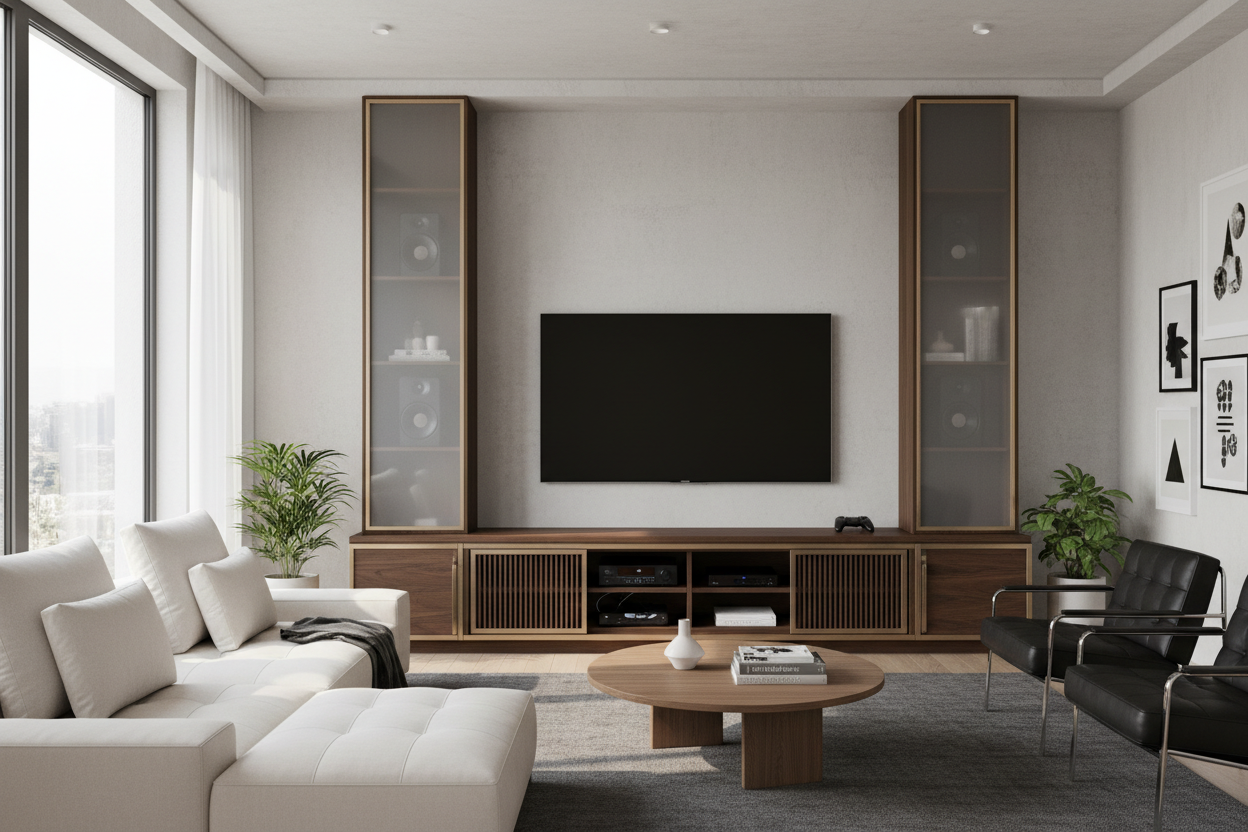
I remember unboxing my first 'real' AV receiver. It was a 40-pound beast of a machine that promised 7.1 surround sound and looked like it belonged in a NASA control room. I tried to place it on a trendy, mid-century modern console I’d bought online, and the front feet were literally dangling off the edge. It was a disaster. Finding a stand for tv receiver gear shouldn't feel like a high-stakes geometry test, but most furniture is designed for a world where electronics are paper-thin.
Quick Takeaways
- Depth is the most common dealbreaker; aim for 18-20 inches of clearance.
- Weight limits are real—don't trust flimsy MDF with a heavy amp.
- Ventilation isn't a luxury; it's a requirement for hardware longevity.
- Cable management needs its own 'buffer zone' of at least 3 inches.
The 'Overhanging Amp' Epidemic in Modern Living Rooms
Most modern media consoles are built for aesthetics first and hardware second. They are designed for a flat-screen TV and maybe a sleek soundbar. But for those of us who still believe in the power of a dedicated receiver, these shallow stands are a nightmare. I’ve seen too many setups where a $1,000 receiver is shoved onto a shelf so narrow that the back panel is smashed against the wall and the front knobs are poking out into the room.
It’s not just about the look; it’s about stability. When your gear doesn't fit the footprint of the furniture, it’s prone to tipping or falling if someone bumps into it. I once saw a beautiful walnut console literally split at the cam-lock joints because the owner tried to center a massive receiver on a shelf that wasn't supported in the middle. We have to stop pretending that 'standard' furniture dimensions work for home theater enthusiasts.
The 3 Non-Negotiable Specs When Buying a TV Stand for AV Receiver
If you're shopping for a tv stand for receiver storage, you need to ignore the 'fits up to 65-inch TVs' marketing and look straight at the spec sheet. First, check the depth. A standard receiver is roughly 15 to 17 inches deep. If your furniture is only 15 inches deep, you're already in trouble. You need a wide tv stand entertainment stand that provides enough physical real estate to let the unit sit comfortably with its feet fully supported.
Second, look at the weight capacity. I’ve seen plenty of 'media centers' made of thin particle board that have a weight limit of 25 pounds per shelf. A high-end receiver can easily exceed 35 or 40 pounds. Look for kiln-dried hardwoods or reinforced metal frames. If the shelf bows even a fraction of an inch, your cabinet doors will stop aligning, and eventually, the whole thing will fail. I personally won't buy anything that doesn't specify a 50-lb+ limit for the internal shelving.
Finally, check for adjustable shelving. Not all receivers are the same height. Some are 'slimline' at 4 inches, while others are 8-inch tall behemoths. Having the ability to move a shelf up or down by an inch can be the difference between a clean fit and having to leave the back panel off the furniture entirely.
Let's Talk About Airflow (Or Why Your Amp Keeps Shutting Off)
Heat is the silent killer of audio gear. If you shove a receiver into a closed wooden box, you’re basically putting it in an oven. I’ve had friends call me complaining that their system keeps cutting out during movie night, and 9 times out of 10, it's because the receiver reached its thermal limit and shut down to prevent itself from melting. You need at least two inches of clearance on the top and sides for passive cooling.
If you insist on a closed-door look, you need furniture with slatted fronts or mesh panels. Solid glass or wood doors are a death sentence for high-performance amps unless you install an aftermarket fan kit. I learned this the hard way after my old Marantz started smelling like toasted silicon because I thought it looked 'cleaner' behind a solid oak door.
The Cord Clearance Crux
Here is the math no one tells you: if your receiver is 15 inches deep, you actually need 18 inches of space. Why? Because those stiff HDMI cables and chunky banana plugs don't bend at 90-degree angles. If you try to force them, you’ll end up damaging the ports on your expensive gear. Always leave a 3-inch 'cabling buffer' behind the unit. This also makes it much easier to swap out components later without having to pull the entire tv stand for av receiver away from the wall.
How to Hide the Tech Without Ruining the Sound
The eternal struggle is making the living room look like a home, not a Best Buy showroom. When choosing the perfect tv stand for style and function, I look for pieces that use 'stealth' design. Slatted wood doors are my favorite—they allow IR signals to pass through so your remote still works, and they provide natural ventilation while hiding the glowing lights and messy wires of the receiver.
Another strategy is to use a modern tv stand with cabinets and drawers to tuck away the things you don't need to see, like game controllers, extra cables, and manuals. This allows you to keep the main receiver on an open shelf where it can breathe, while the 'clutter' stays hidden. It creates a visual balance that satisfies both the audiophile and the interior designer in the house.
Should You Just Buy a Dedicated Audio Rack Instead?
Sometimes, a standard console just isn't enough. If you have a separate power amp, a turntable, and a receiver, you might be better off with a specialized audio tower. These are built with heavy-duty steel and thick tempered glass or solid wood, specifically designed to handle the weight and heat of high-end gear. However, they can look a bit 'industrial' for a cozy living room.
If you're on the fence, I suggest you browse various tv stands that offer a hybrid approach—units that are wider and deeper than average but still look like furniture. I’ve found that a long, low-profile credenza often works better than a traditional 'TV stand' because it provides the depth you need while keeping the screen at a comfortable eye level. Don't be afraid to look at sideboards or buffet tables either; just make sure you’re willing to cut a few holes in the back for cable management.
FAQ
How much space should be above my receiver?
Ideally, you want 2 to 3 inches of open air above the unit. Receivers vent heat through the top, so if you 'sandwich' it between shelves, that heat has nowhere to go but back into the components.
Can I put my receiver in a drawer?
Only if the drawer is open while the unit is on. Keeping a running receiver in a closed drawer will cause it to overheat in minutes. It's much better to use a shelf or a vented cabinet.
Is a metal stand better for heat?
Metal conducts heat better than wood, but the most important factor is airflow, not the material of the shelf itself. An open wood shelf is better than a closed metal box every single time.


Leave a comment
This site is protected by hCaptcha and the hCaptcha Privacy Policy and Terms of Service apply.