










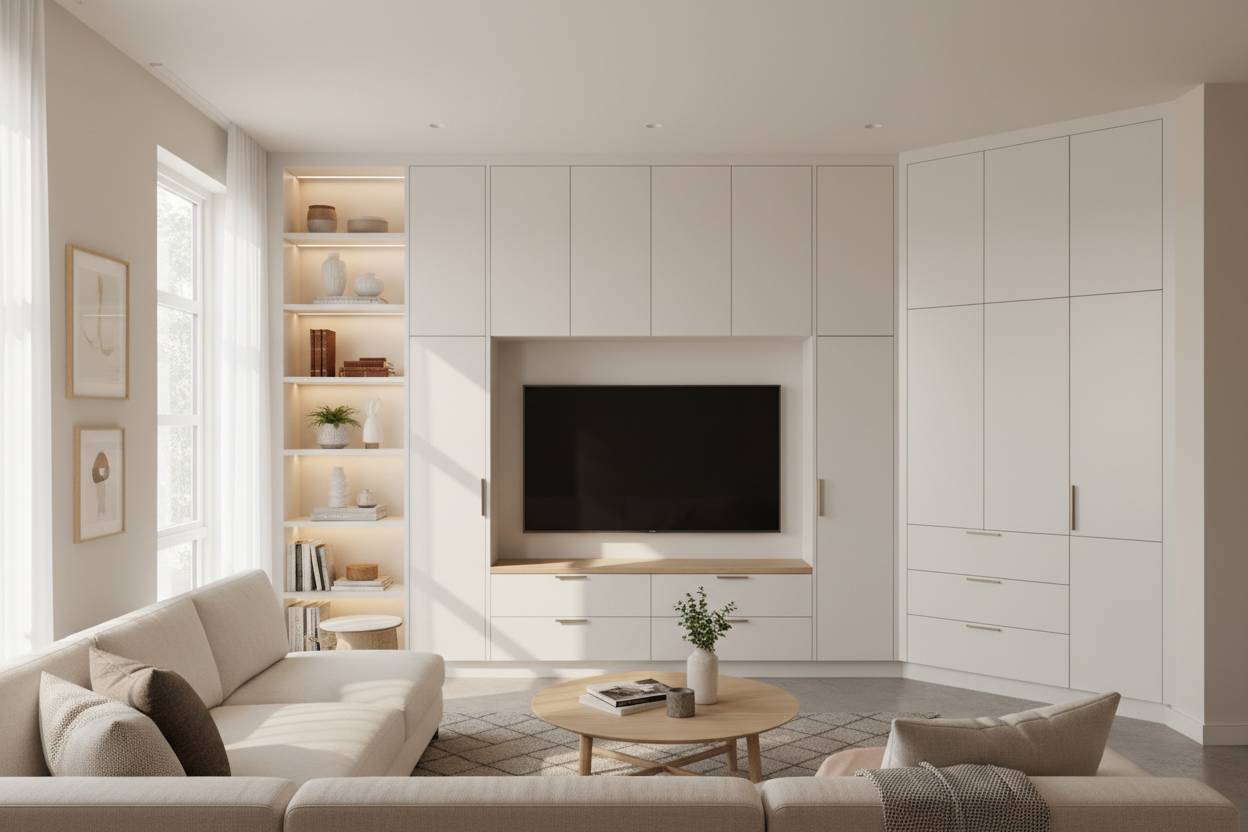
I spent three years staring at a fourteen-inch gap between my chimney breast and the window frame, convinced I could find a 'vintage find' to fill it. I dragged home mid-century sideboards that were two inches too wide and skinny bookcases that looked like toothpicks in a canyon. My house is full of these 'charming' architectural details that are actually just a polite way of saying the walls aren't straight and the floor plan was designed by someone who hated right angles. I finally realized that if I wanted to actually use my square footage, I had to stop buying boxes and start looking at custom wall storage.
- Precision Fit: Custom units eliminate the 'dust-trap' gaps where cat toys and mail go to die.
- Visual Peace: One continuous unit makes a room look larger than three mismatched cabinets.
- Vertical Real Estate: Most standard furniture stops at 72 inches; custom storage goes to the ceiling.
- Resale Value: High-quality built-ins are often viewed as permanent upgrades rather than just furniture.
The Problem With 'Charming' Architectural Quirks
We all fall for the 'character' of old houses—the slanted ceilings in the attic, the deep alcoves flanking the fireplace, the weird little recesses in the hallway. But living with them is a different story. These spots quickly become dead zones where clutter accumulates because there is no logical way to organize them. In my guest room, a slanted ceiling cut the usable wall height down to 40 inches on one side. A standard dresser looked ridiculous, leaving a massive, unusable triangle of air above it.
These quirks are essentially stolen space. You are paying for the square footage, but you cannot put a bed there, and you cannot fit a desk there. Without a tailored solution, you end up with a house that feels cramped despite having plenty of floor area. It is the ultimate design paradox: the more 'features' your walls have, the harder it is to actually live between them.
Why Standard Furniture Failed Me Miserably
I am a habitual buyer of freestanding storage cabinets, but they are built for a world of 90-degree angles and flat floors. When I tried to wedge a beautiful, kiln-dried oak cabinet into my living room nook, I discovered the wall was bowed. I was left with a 1-inch gap at the bottom and a 3-inch gap at the top. It looked like the furniture was trying to escape the house.
Standard furniture also forces you to compromise on depth. You either get a cabinet that sticks out past the door frame or one that is so shallow it won't hold a standard-sized dinner plate. Then there is the dust. Any gap between a cabinet and a wall is a magnet for hair, dust, and lost pens. After the third time I had to move a 200-pound wardrobe just to vacuum behind it, I realized that 'standard' was costing me too much in labor and frustration.
Why I Finally Bit the Bullet on Custom Wall Storage Systems
The turning point was when I saw a friend’s place where they had installed custom wall storage systems across an entire uneven wall. It wasn't just a shelf; it was a transformation. By committing to a single giant wall storage unit, they had effectively pushed the wall back. The room felt ten feet wider because the visual 'noise' of separate furniture pieces was gone.
I decided to stop patching the problem with small fixes. Custom storage allows you to scribe the wood directly to your wonky baseboards and wonkier ceilings. It creates a seamless look that makes the storage feel like it was born with the house. Yes, it is more expensive than a flat-pack box, but you are reclaiming feet of space that were previously dead to the world. It is the difference between wearing a suit off the rack and getting one tailored; the measurements make the man, and the measurements make the room.
3 Awkward Spaces That Beg for Built-Ins
Not every wall needs a custom solution, but there are three specific offenders where anything else is a waste of time. If you have these, stop looking at catalogs and start calling a carpenter or a custom modular company.
The Slanted Under-Stairs Void
The space under a staircase is usually a dark abyss of holiday decorations. By using custom made wall cabinets that follow the exact pitch of the stairs, you can turn that void into a high-capacity pantry or a pull-out shoe closet. I’ve seen 80-inch deep drawers on heavy-duty runners that utilize every single inch of that triangle. You can't do that with a rectangular shelf from a big-box store.
The Useless Hallway Nook
My hallway had a recess that was 28 inches wide and 12 inches deep—too small for a chair, too big to leave empty. I used some wall makeup storage ideas to turn it into a 'drop zone' vanity. By mounting shallow custom cabinets from floor to ceiling, I created a spot for keys, mail, and a quick mirror check without blocking the walkway. It turned a hallway into a functional room.
The Off-Center Fireplace Alcove
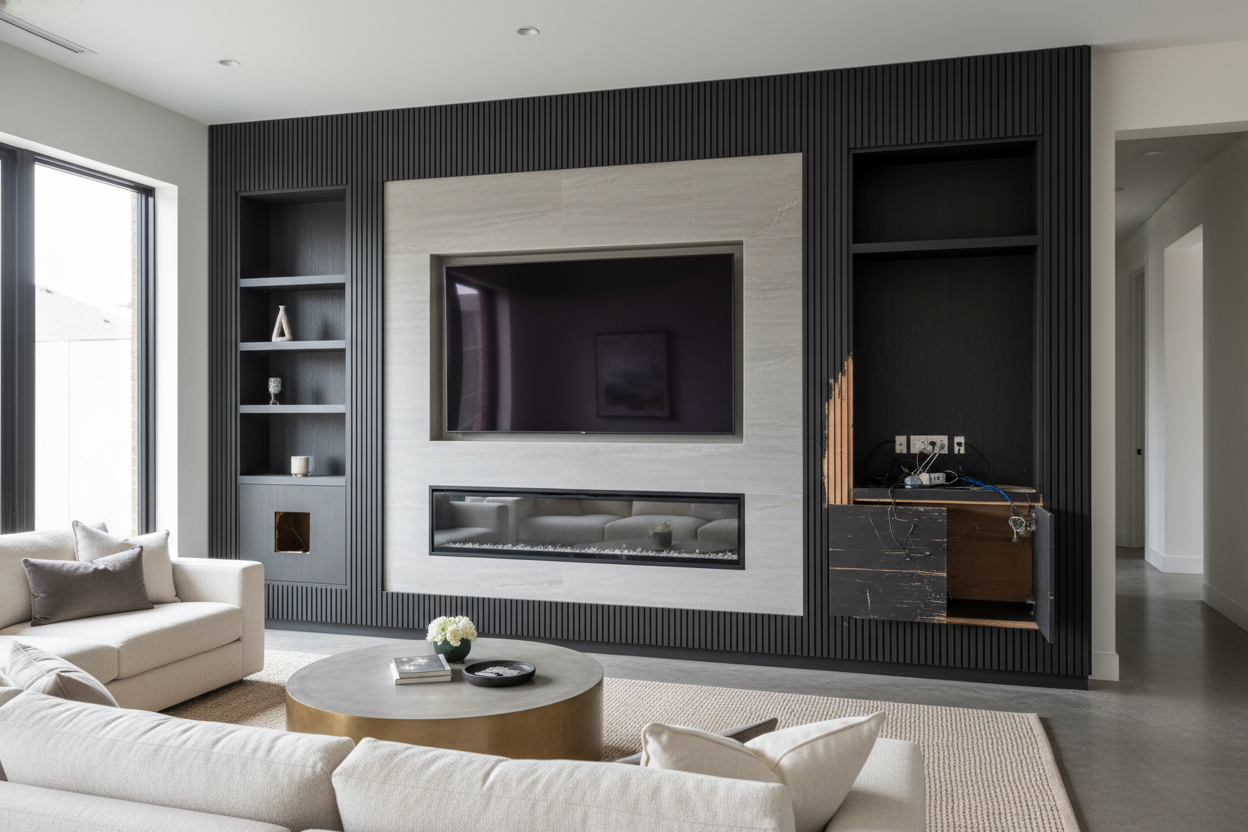
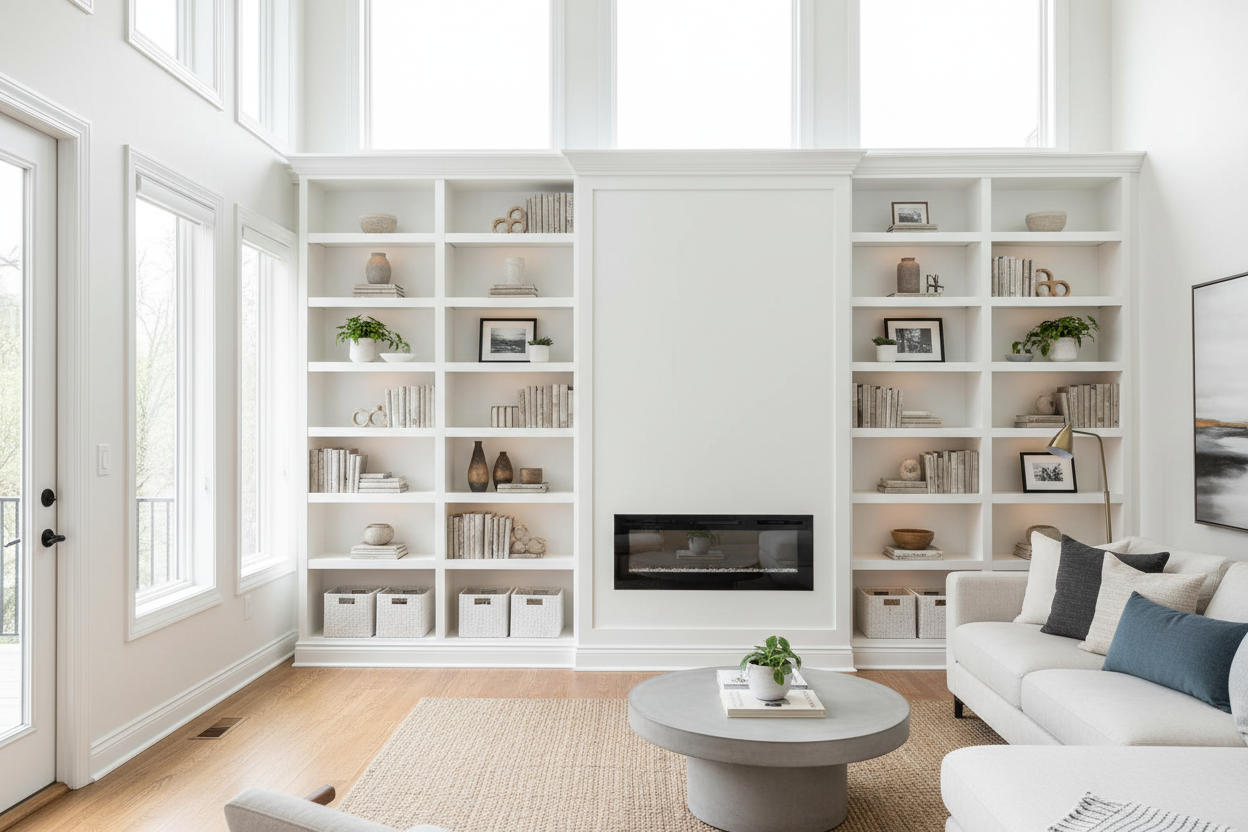
Asymmetrical fireplaces are the bane of my existence. One side is 4 feet wide, the other is 6 feet. Using custom wall storage cabinets allows you to balance the visual weight. You can build a deeper unit on the narrow side to hold electronics and a shallower, open-shelf unit on the wide side for books. If your alcove happens to be a standard size, you might get away with a large entertainment center with storage cabinets, but usually, the custom route is the only way to make the asymmetry look intentional rather than like a mistake.
Is the Price Tag Actually Worth It?
I’ll be honest: custom storage is an investment. You are going to pay for the materials and the expertise required to measure a room that isn't square. But here is the math I used: if custom cabinets cost $4,000 but they make a 'dead' 20-square-foot nook usable, you’ve essentially just added 20 square feet of living space to your home. In most cities, 20 square feet of real estate costs way more than $4,000.
Beyond the money, there is the daily sanity. There is a specific kind of peace that comes from having a designated spot for the vacuum, the printer, and the winter coats that doesn't involve shoving them into a corner and hoping guests don't notice. Custom storage didn't just fix my house's weird nooks; it fixed the way I feel when I walk through the front door.
FAQ
Does custom storage have to be permanent?
Most built-ins are anchored to the studs, making them permanent. However, many modern modular systems allow you to create a custom 'look' that can be disassembled, though you'll likely have some holes to patch in the drywall.
How do I handle baseboards with wall cabinets?
A professional installer will 'scribe' the bottom of the cabinet to fit over your baseboard, or you can remove the baseboard section and run it around the toe-kick of the cabinet for a true built-in look.
What is the best material for custom cabinets?
For a painted look, high-quality MDF is actually better than solid wood because it won't warp with temperature changes. If you want a wood grain look, go for plywood with a thick veneer rather than particle board.

Leave a comment
This site is protected by hCaptcha and the hCaptcha Privacy Policy and Terms of Service apply.