










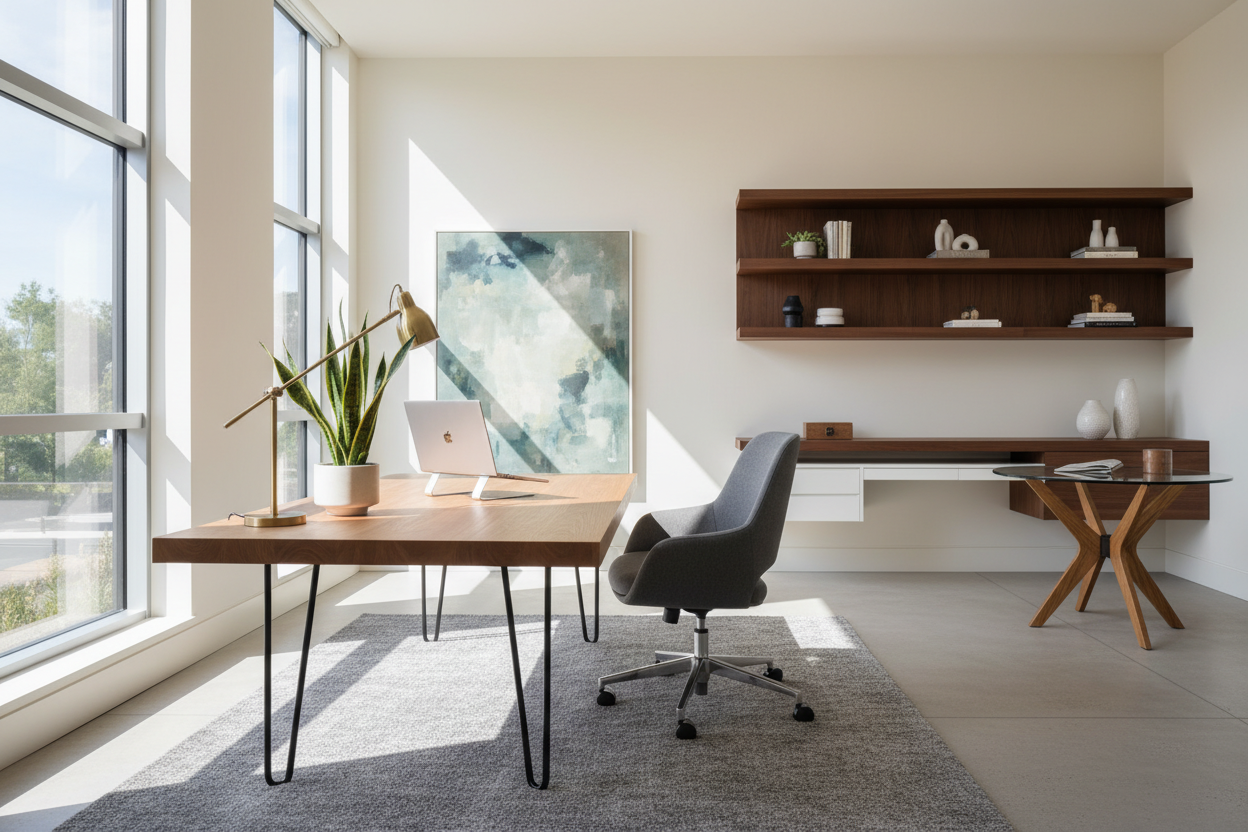
We have all experienced the fatigue that comes from working at a makeshift setup—the dining table that is slightly too high, or the improvised corner that lacks intentionality. As an interior designer, I often tell clients that the anchor of your productivity is your home office furniture desk. It is not merely a surface for your laptop; it is the architectural focal point of your workspace and the foundation of your daily comfort. Choosing the right piece requires balancing visual weight with ergonomic necessity.
Key Features to Prioritize
Before falling in love with a silhouette, consider these non-negotiable elements to ensure your investment holds its value:
- Material Integrity: Prioritize solid wood or high-grade architectural veneers over hollow-core laminates for longevity.
- Ergonomic Clearance: Ensure at least 24–30 inches of leg width and sufficient knee depth to prevent cramping.
- Surface Area: Account for monitor arms, task lighting, and analog tools; a depth of 30 inches is ideal for multi-screen setups.
- Cable Management: Look for integrated grommets or hidden channels to maintain visual calm.
Assessing Material and Build Quality
When browsing home office design desks, the tactile experience is just as critical as the aesthetic. In the showroom, I advise clients to run their hands along the underside of the desktop. A rough or unfinished underside often signals cost-cutting elsewhere. For a luxury look that endures, solid hardwoods like walnut or white oak offer warmth and can be refinished over time. If you prefer a modern, sleek aesthetic, tempered glass or stone looks stunning but keep in mind they are cold to the touch—a factor that becomes noticeable during long winter work sessions.
Balancing Scale and Visual Weight
One of the most common errors in residential design is selecting furniture that overwhelms the room. Desks designs for a home office must respect the room's flow. If your office is a shared space or a smaller nook, consider a desk with 'legs' rather than a full block pedestal. This open silhouette allows light to pass through, reducing the piece's visual weight and making the room feel larger.
Positioning for Command
Never push a beautiful desk strictly against a wall if you have the square footage. Floating the desk in the center of the room, facing the door, creates a 'command position.' This layout not only looks more executive but also drastically improves the video call background, placing the focus on you and your designed space rather than a blank wall.
My Personal Take on the Home Office Furniture Desk
I learned a hard lesson early in my career regarding desk construction that specifications sheets rarely mention. I once specified a stunning, thick-top desk for a client that looked like solid reclaimed timber. It was visually perfect. However, six months later, the client called me regarding a monitor arm they tried to install. Because the desk was actually a 'honeycomb' hollow core structure wrapped in a convincing veneer, the clamp of the monitor arm crushed the desktop surface the moment they tightened it.
Since then, I always perform the 'knock test.' If it sounds hollow, it cannot support heavy clamp-mount accessories. Real luxury is density. Now, I always warn clients: if you plan on using articulated arms or heavy equipment, you need a substrate that is solid MDF or real wood, not just a pretty façade.
Conclusion
Your workspace is a reflection of your professional identity. By investing in a desk that offers both structural integrity and ergonomic support, you are investing in your own efficiency. Don't settle for the temporary; curate a space that invites you to do your best work.
Frequently Asked Questions
What is the ideal desk height for a home office?
The standard industry height is between 29 and 30 inches. However, if you are under 5'4", you may need a keyboard tray or an adjustable chair to ensure your elbows remain at a 90-degree angle while typing.
How do I protect a wood desk from scratches and water rings?
I recommend using a high-quality leather or felt desk pad. It defines the 'active' work zone, improves mouse tracking, and provides a barrier against heat and moisture without hiding the beauty of the wood perimeter.
Can a writing desk work for a computer setup?
Yes, but be mindful of depth. Writing desks are often shallower (around 20-24 inches). If you use a desktop computer, this places the screen too close to your eyes. Writing desks are best suited for laptop users or those who dock their devices elsewhere.

Leave a comment
This site is protected by hCaptcha and the hCaptcha Privacy Policy and Terms of Service apply.