










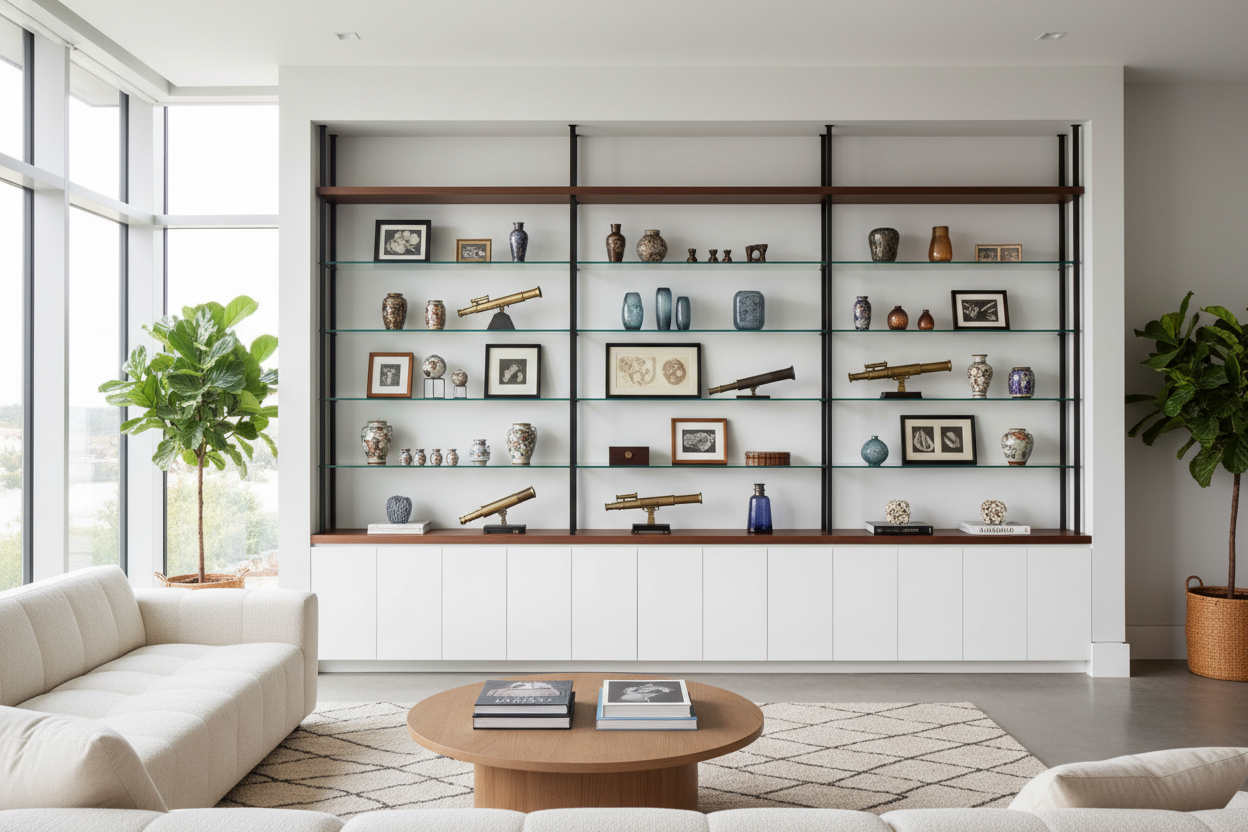
I spent years telling myself that my collection of vintage cameras and rare vinyl figures looked 'eclectic' scattered across my apartment. In reality, it looked like a yard sale exploded in my living room. I had a 1960s Leica sitting next to a pile of mail, and a limited-edition figurine practically hiding behind a lamp. It wasn't a vibe; it was a mess. That is when I realized I didn't need more stuff—I needed a dedicated collectibles display shelf to actually show off what I had.
The shift from 'clutter' to 'curated' happened the moment I stopped treating my finds like afterthoughts. When you give your objects a specific home, they stop being dust-collectors and start being conversation pieces. I have tested enough flimsy particle-board units to know what works and what just sags under the weight of a few lead-heavy die-cast cars. Here is the honest truth about getting your collection out of the shadows and into the spotlight.
- Depth matters: Avoid deep bookshelves; they create dark 'dead zones' where small items disappear.
- Dust is the enemy: Glass doors are worth the extra cost if you hate cleaning tiny crevices with Q-tips.
- Lighting is non-negotiable: Even a cheap shelf looks high-end with the right LED placement.
- Negative space: If every inch is packed, nothing stands out. Leave room for the eye to rest.
The 'Flea Market' Trap (And Why We All Fall Into It)
We have all been there. You find a gorgeous mid-century vase or a quirky 1980s action figure, and you just plop it on the nearest flat surface. A week later, it is joined by a stack of coasters, a stray charging cable, and a half-dead succulent. This 'windowsill graveyard' is where good collections go to die. Instead of highlighting the item, you have created visual noise that makes your whole room feel smaller and more chaotic. I realized that my memorabilia shelves were actually just horizontal junk drawers because I hadn't committed to a real display strategy.
Grouping is the secret sauce. When you scatter items, they look like accidents. When you group them on a dedicated collector display shelf, they look like a choice. I learned this the hard way after my partner asked why I had 'random toys' on the dining table. They weren't random; they were rare! But without the right framing, they just looked like I forgot to clean up. Focusing on styling a proper trinket shelf can fix this by forcing you to categorize and prioritize. It turns a pile of plastic or ceramic into a narrative about what you love.
Why a Standard Bookcase Just Doesn't Cut It
Most people grab a standard 12-inch deep bookcase and call it a day. That is a mistake. Standard bookshelves are designed for vertical paperbacks, not a small display shelf for collectibles. When you put a three-inch figurine on a foot-deep shelf, it gets swallowed by shadows. You end up with a 'black hole' effect where you can only see the items at the very front edge. I once tried to display a set of vintage glass bottles on a deep shelf, and they looked like they were in storage, not on display. It was depressing.
You need shallow depths or tiered risers to make a display shelf for figurines actually work. This is also where height becomes a pain. Some of my model display shelves need to accommodate a tall robot one day and a short stack of coins the next. If your shelves are fixed, you are stuck with awkward gaps or items that won't fit. I always look for adjustable shelf storage solutions now. Being able to move a shelf by just two inches can be the difference between a cramped mess and a professional-looking gallery. Don't settle for fixed heights unless you enjoy the frustration of items that are just 1/4 inch too tall for the space.
Glass Doors vs. Open Backs: Picking Your Vibe
This is the great debate in the collecting world. Open shelving, like a simple wall shelf for collectibles, feels modern and accessible. It’s easy to grab something, move it around, or add to it. However, the dust is relentless. I once spent three hours cleaning a collection of model cars on an open shelf, and by the next week, they were gray again. If you have high-value items or things with intricate details (looking at you, LEGO sets), you want a cabinet. A tall display cabinet for books and collectibles with glass doors is a lifesaver. It keeps the air out and the 'museum' feel in.
On the flip side, some spaces feel too heavy with big glass cabinets. If you want a more casual, airy look—maybe for a plant-heavy room or a craft space—an open shelf free standing bookcase is the way to go. It doesn't box in the room. Just be prepared for the maintenance. I use open wall shelves for collectibles in my office for things I touch frequently, like reference books or sturdy wood display shelves for collectibles that don't mind a quick wipe. For the delicate stuff, the 'holy grail' items, keep them behind glass. Your future self will thank you when you aren't dusting for the tenth time this month.
The Negative Space Rule for Curating
The biggest mistake I see (and I’ve made it myself) is the 'sardine effect.' You have twenty items, so you cram twenty items onto one shelf. Stop doing that. A great collection shelf needs breathing room. Think of it like a high-end boutique. They don't put every shirt they own on one rack; they show you three and keep the rest in the back. I started rotating my collection every few months. I keep my absolute favorites on my collectors display shelf and tuck the others away in storage bins. It makes the room feel fresh and gives the eye a place to land.
Try the 'Rule of Three.' Group three items of varying heights together, then leave a few inches of empty space before the next group. This works wonders on a wall mounted display shelves for collectibles setup where space is limited. If you are using a bookcase for collectibles, use books as pedestals to create different levels. This 'negative space' makes each individual piece feel more important. When everything is crowded, nothing is special. When there is space around a model display shelf, that model becomes a focal point.
The Cheap Lighting Trick That Changes Everything
You can buy the most expensive memorabilia display shelf in the world, but if it is dark, it will look cheap. Lighting is the divider between 'guy who has a lot of stuff' and 'serious collector.' You don't need to hire an electrician, either. I discovered battery-operated LED puck lights and thin LED strips a few years ago, and they are a total game-changer for a collectible wall shelf. Mounting a light under the top of each shelf level illuminates the items below and eliminates those 'black hole' shadows I mentioned earlier.
Go for 'warm white' rather than 'cool white' LEDs. Cool white can make your living room feel like a hospital or a gas station. Warm light makes wood display shelves for collectibles look rich and inviting. If you are using a wall shelf for collectibles, a small battery-powered spotlight aimed at your favorite piece can make it look like a million bucks. It is the cheapest way to make a $50 shelf look like a custom-built gallery piece. Trust me, once you add lights, you’ll never go back to dark shelves again.
FAQ
How deep should a collectibles shelf be?
For most figurines and small items, 6 to 10 inches is the sweet spot. Anything deeper than 12 inches usually requires risers so the items in the back don't get lost in the shadows.
Are floating shelves safe for heavy collectibles?
Only if you hit the studs. I’ve seen too many 'floating' shelves sag or rip out of drywall. If you’re displaying heavy die-cast models or thick glass, use a shelf with visible, sturdy brackets or a floor-standing unit.
How do I stop my display from looking cluttered?
Use the 60/40 rule: fill 60% of the shelf with items and leave 40% as empty space. Also, group items by color or material to create a sense of cohesion rather than a random jumble.

Leave a comment
This site is protected by hCaptcha and the hCaptcha Privacy Policy and Terms of Service apply.