










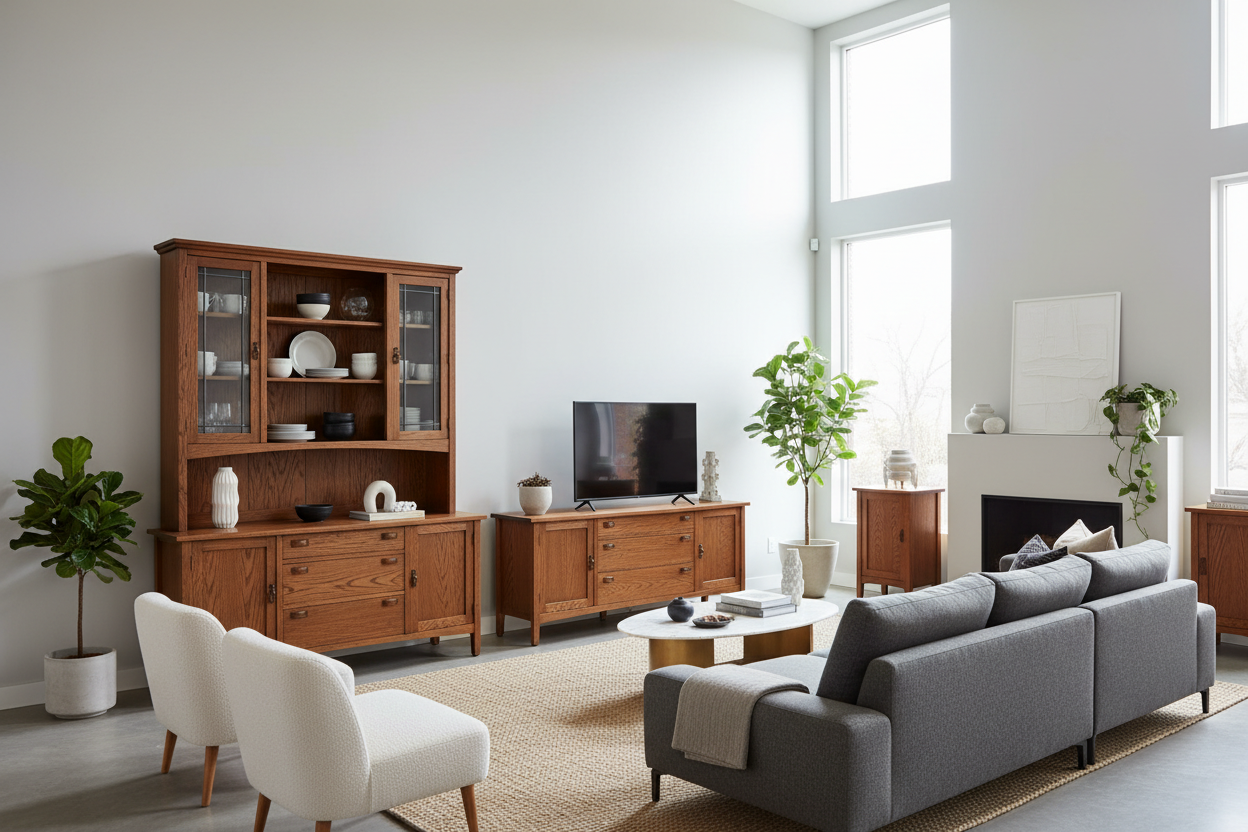
I stood in my dining room staring at a 300-pound beast of quartersawn oak that had just been unloaded from a U-Haul. My aunt meant well, but this massive hunk of stickley cabinets history felt like it belonged in a 1910 bungalow, not my rental with white walls and a modular sofa. I spent three nights convinced I’d have to sell it on Craigslist for a fraction of its value just to get my floor space back.
Instead, I leaned into the challenge. These pieces aren't just furniture; they are built with mortise-and-tenon joinery that will outlast your mortgage. If you have inherited a piece or found a steal at an estate sale, don't panic. You don't have to live in a museum to make this work. You just need to break a few of the traditional 'Mission style' rules.
Quick Takeaways
- Ditch the formal china; use the cabinet for books, barware, or oddities.
- Use battery-powered LED puck lights to kill the 'dark cave' vibe.
- Contrast the heavy wood with light, neutral wall colors.
- Pair the rigid lines with rounded, modern furniture to soften the room.
The Blessing (and Curse) of Quartersawn Oak
Let’s be honest: quartersawn white oak is a lot of look. It’s famous for those beautiful 'ray flakes' in the grain, but when you’re looking at a piece that stands six feet tall and four feet wide, that grain can start to feel overwhelming. When my stickley cabinets arrived, the dark 'Onondaga' finish felt like a black hole in the corner of the room. It absorbed every bit of light and made my 12x15 dining area feel like a closet.
The curse of this furniture is its sheer presence. It’s not a spindly mid-century modern credenza that disappears against a wall. It’s thick, 1-inch solid wood that demands your attention. I realized quickly that the reason it looked 'old' wasn't the cabinet itself, but the way I was expecting it to behave. I was treating it like a sacred relic instead of a functional piece of storage. Once I accepted that the oak was a permanent architectural element rather than just a 'cupboard,' the styling became much easier.
The weight is another factor. You aren't moving this thing once it's set. I made the mistake of placing it too close to a door frame initially, and moving it three inches to the left required two friends and a set of heavy-duty furniture sliders. Plan your layout before the delivery guys leave, because that solid oak frame doesn't budge.
Rule 1: Stop Treating It Like a Stickley China Cabinet
The fastest way to make your house look like your grandmother’s is to fill a stickley china cabinet with a 12-piece setting of floral porcelain. Nothing dates a room faster than a wall of plates no one ever uses. If you want to modernize the look, you have to change the contents. I took out the traditional plate grooves and turned mine into a high-end dry bar and library hybrid.
I mixed oversized art books on the bottom shelves with a curated selection of glassware and decanters at eye level. The heavy wood provides a masculine, sturdy backdrop for clear glass and metallic accents. It turns the piece from a 'dish holder' into a focal point for entertaining. If you’re struggling with the transition, take a look at how professional designers display china in a china cabinet—they rarely just stack plates; they use layers, height, and varied textures to break up the monotony.
I also recommend removing a few of the adjustable shelves if your model allows it. Creating more vertical 'white space' inside the cabinet makes the whole unit feel less dense. I left one shelf extra-high to accommodate a tall architectural vase. That single change made the entire cabinet feel like a modern gallery piece rather than a storage locker for heirlooms.
How to Lighten Up a Massive Stickley Hutch
Stickley pieces are notorious for being dark inside. The thick wood frames and heavy shelving create shadows that hide whatever you’re trying to display. To modernize my stickley hutch, I installed recessed LED strip lighting along the inside front edge of the cabinet. Suddenly, the interior popped. The light hit the copper hardware and the oak grain, making it look warm and inviting rather than dusty and forgotten.
Wall color is your next weapon. Do not put a dark Mission piece against a dark green or burgundy wall unless you want to live in a library from 1904. I painted the surrounding walls in a crisp, cool white with just a hint of grey. The contrast makes the wood look like a deliberate choice rather than a default. It lets the craftsmanship stand out without the room feeling heavy.
Finally, consider the 'negative space' around the piece. Don't crowd a massive hutch with other small furniture. Give it at least two feet of breathing room on either side. If you jam a chair or a floor lamp right up against it, the whole wall will look cluttered. Stickley needs room to breathe to look modern.
Mixing Mission Style with Contemporary Pieces
The biggest mistake people make is thinking they need a whole room of Mission furniture to match their stickley display cabinet. Please, don't do that. A room full of matching quartersawn oak looks like a showroom, not a home. The key to a modern aesthetic is 'high-contrast' styling. I paired my rigid, linear cabinet with a plush, curved velvet sofa and a round marble coffee table.
The juxtaposition of the sharp, masculine angles of the Stickley piece with the soft, feminine curves of contemporary furniture creates a balanced room. If everything is square, the room feels stiff. If you’re looking to expand your collection, you can find other display cabinets that offer a lighter profile to mix in with your heavier heritage pieces. I added a slim metal bookcase on the opposite wall to balance the visual weight of the oak without competing with it.
Don't be afraid to mix metals, either. Stickley often features dark hammered copper or brass hardware. I brought in polished chrome accents through floor lamps and picture frames to pull the room into the current decade. It sounds wrong, but the mix of 'old world' craft and 'new world' finish is exactly what makes a space feel curated.
The Clutter Paradox in a Stickley Curio Cabinet
When you have a stickley curio cabinet, the temptation is to fill every square inch of those glass-fronted shelves. Resist that urge. Because the wood mullions on the doors are so thick and prominent, they already add a lot of visual 'noise.' If you fill the inside with tiny knick-knacks, the whole thing just looks like a mess from five feet away.
I follow the 'Rule of Three.' On each shelf, I place three distinct groupings of items with plenty of empty space between them. For example: a stack of two books, a single large ceramic bowl, and a small framed photo. This allows the eye to rest. You have to learn to display your treasures without the clutter if you want the piece to feel sophisticated.
I actually had a major 'fail' early on where I tried to display my entire collection of vintage cameras in the cabinet. It looked like a pawn shop window. I ended up taking out 70% of the cameras and leaving just the three most visually interesting ones. The difference was night and day. The cabinet went from being a 'storage problem' to a 'design feature' instantly.
FAQ
Is Stickley furniture still worth the money?
Yes, if you value longevity. You’re paying for solid wood construction and hand-fitted joints. Unlike 'fast furniture' that ends up in a landfill in five years, these pieces appreciate in value and can be refinished indefinitely. It’s an investment in a piece that will literally last a century.
Can I paint my Stickley cabinet?
Technically, yes, but I wouldn't. The value of Stickley is in the quartersawn oak grain and the specific finishes. If you paint it, you kill the resale value and the 'soul' of the piece. If you hate the dark wood, try changing your lighting and wall color first. You’d be surprised how much better it looks against a bright white backdrop.
How do I tell if my cabinet is an original Stickley?
Look for the 'shop mark.' It’s usually a brand or a decal inside a drawer or on the back of the piece. Modern pieces have a brass plaque. Also, check the joinery—if you see staples or plastic corner brackets, it’s not a real Stickley.

Leave a comment
This site is protected by hCaptcha and the hCaptcha Privacy Policy and Terms of Service apply.