










I spent three months obsessing over the perfect shade of 'greige' for my living room walls. I bought a hand-knotted wool rug that cost more than my first car and spent way too many late nights hunting for vintage brass lamps. But the second I mounted that 65-inch screen, the whole vibe died. It wasn't a cozy sanctuary anymore; it was a tech shrine.
We’ve all been there. You put in the work to make a room feel intentional, only to have a massive black rectangle dominate the visual field. It's time to stop pretending that a thin bezel makes a TV 'art.' If you want your room back, you need a tv wall cabinet with doors to hide tv.
- Reclaim the Focus: Stop letting the TV be the only thing people see when they walk in.
- Dust Protection: Doors keep that static-loving screen cleaner for longer.
- Intentional Viewing: You'll actually watch less mindless TV when you have to physically open a cabinet to see the screen.
- Design Flexibility: A cabinet looks like furniture, not an appliance.
The 'Giant Black Box' Problem (And Why We Just Accepted It)
For some reason, we collectively decided that it was okay for our homes to look like the local Buffalo Wild Wings. We spend thousands on sofas and lighting, then point everything at a plastic rectangle. It’s a design surrender. When the screen is off, it’s just a dead, dark hole on the wall that absorbs light and kills the mood.
I realized my mistake when I hosted a dinner party and found everyone staring at the blank screen instead of talking. It cured my sports bar living room syndrome the moment I finally boxed that thing in. Suddenly, the room felt like a place for people again, not just a place for content consumption. Residential spaces should feel layered and warm, but an exposed 75-inch screen has all the warmth of a hospital waiting room.
The Glorious Return of the Hidden TV Wall Cabinet With Doors
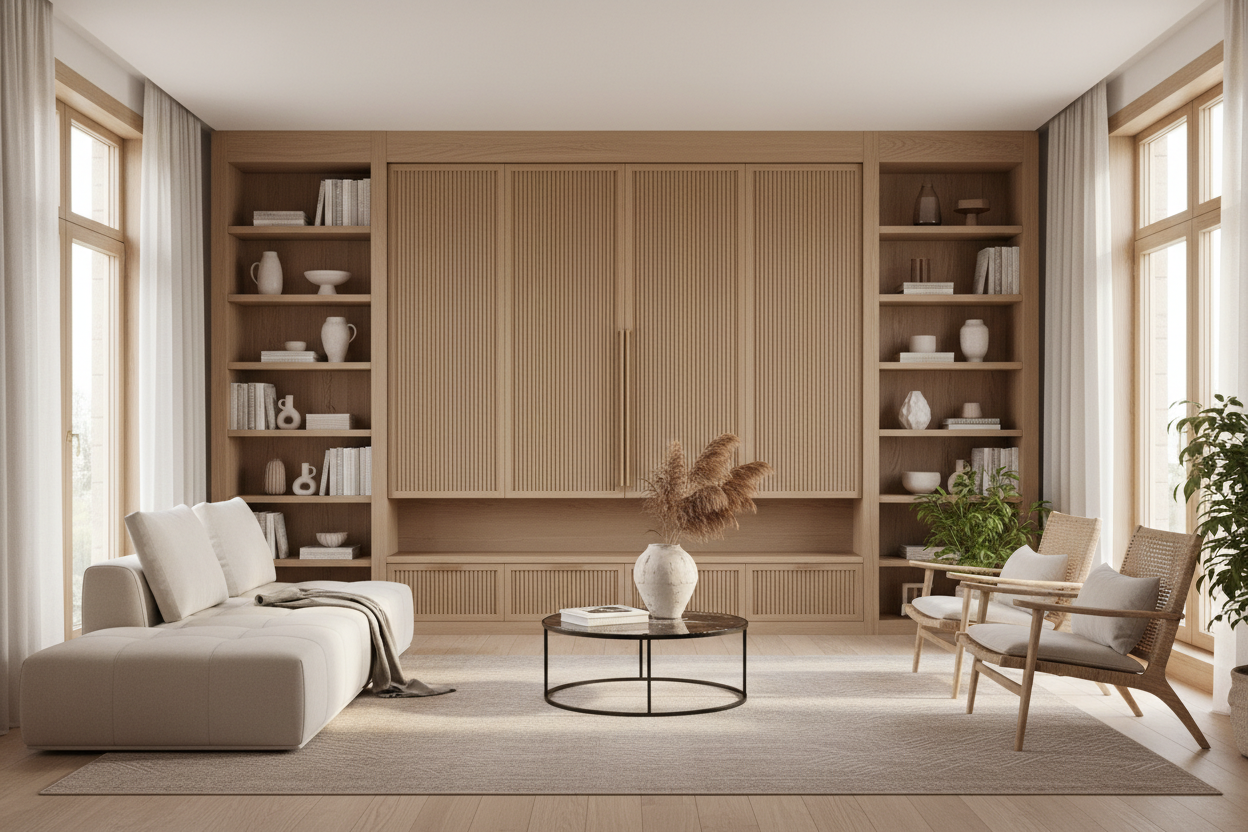
The modern hidden tv wall cabinet with doors isn't your grandma's heavy oak behemoth. We are seeing a massive resurgence in sleek, architectural pieces that blend into the wall. Think fluted wood panels, matte finishes, and slim profiles that only stick out 10 or 12 inches. It’s about creating a 'furniture moment' that happens to house your tech.
I'm currently seeing a lot of white oak and walnut finishes that use vertical slats to add texture. This isn't just about hiding a screen; it's about adding a high-end design element to your wall. When the doors are closed, you have a beautiful piece of carpentry. When they're open, it's movie night. It’s a boundary that our digital-heavy lives desperately need.
Bifold vs. Pocket Doors: The Mechanics of Hiding Tech
Don't just buy the first cabinet you see. The door style is everything. Standard swinging doors are a nightmare—they stick out into the room and block your path like open oven doors. Bifold doors are better because they fold back on themselves, but they still take up some peripheral space. If you have the budget, pocket doors are the holy grail; they slide back into the sides of the cabinet and completely disappear.
If you're feeling fancy and want to skip the manual labor of opening doors, you might even look into a hidden TV mechanism with remote control. These motorized lifts can hide the TV inside a console or even lower it from the ceiling. But for most of us, a well-built wall cabinet with high-quality hinges does the trick without the need for an electrician.
Wait, Won't It Look Like a Chunky 1990s Armoire?
This is the biggest fear people have. They remember those massive, floor-to-ceiling units that took up half the room and weighed three tons. Modern design has fixed this. We’re now seeing 'floating' cabinets that mount directly to the wall studs, leaving the floor clear. This keeps the room feeling airy and large, rather than cramped by a heavy piece of furniture.
If wood feels too heavy for your aesthetic, you can find metal frames or even a black cabinet with glass doors (using fluted or smoked glass) to keep things feeling contemporary. The goal is a slim depth—just enough to clear the TV and a low-profile mount. Most modern LEDs are so thin that your cabinet doesn't need to be more than 6-8 inches deep to get the job done.
The Ultimate Decor Flex: Reclaiming Your Living Space
Once you install your cabinet, the fun part starts: styling the rest of the wall. Since the TV is no longer the 'star,' you can flank the cabinet with sconces, artwork, or floating shelves. It turns the entire wall into a curated gallery. I like to keep the top of the cabinet clear or add one long, low piece of pottery to draw the eye horizontally.
Closing those doors at the end of the night is a psychological win. It signals that the day is over and the 'screen time' is done. Using a wall TV cabinet with doors that enclose TV is the ultimate decor flex because it shows you value your home's aesthetic more than a piece of hardware. It’s about living in a home, not a home theater.
Personal Experience: My Hinged Disaster
I tried to DIY a hidden TV cabinet once using some old shutters and a prayer. It was a disaster. I didn't account for the weight of the wood, and within a week, the doors were sagging and scraping the top of my console. If you're going the cabinet route, do not skimp on the hardware. Use heavy-duty, adjustable European-style hinges. Also, make sure you have ventilation. I almost fried my soundbar because I didn't leave enough gap for the heat to escape. Learn from my scorched electronics: airflow is non-negotiable.
FAQ
Will my remote still work if the doors are closed?
Most modern remotes use Bluetooth or RF (Radio Frequency), which works through wood. If you have an older IR (Infrared) remote, you'll need a tiny IR repeater kit, which costs about $20 and hides the receiver under the cabinet.
How do I prevent the TV from overheating?
Make sure there is at least an inch of clearance around the edges of the TV and consider drilling a few 2-inch 'speed holes' in the top and bottom of the cabinet backplate to allow for natural convection.
Can I mount a soundbar inside the cabinet?
Yes, but it's tricky. If the doors are solid wood, the sound will be muffled when closed. Most people mount the soundbar just below the TV inside the cabinet so it's hidden when the doors are shut but clear when you're actually watching something.

Leave a comment
This site is protected by hCaptcha and the hCaptcha Privacy Policy and Terms of Service apply.