










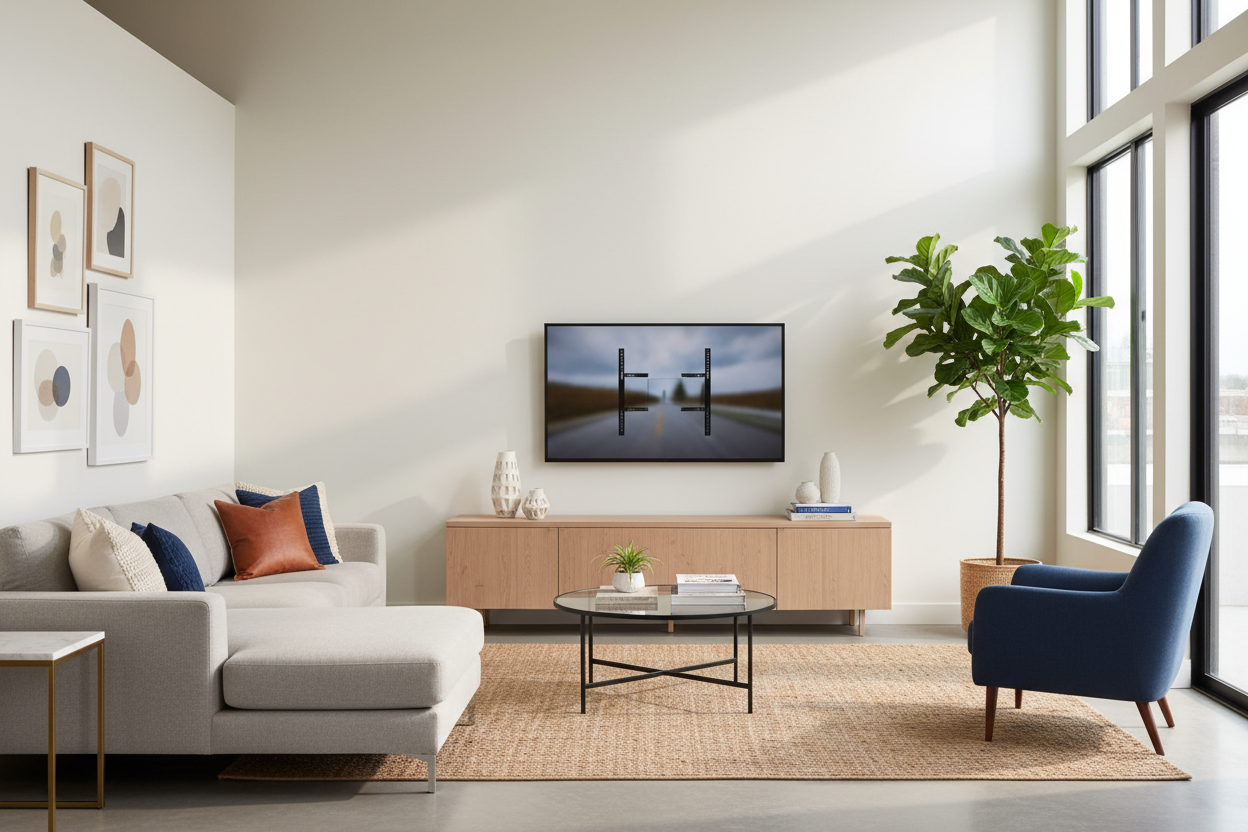
I spent three hours trying to find a stud in my 1920s living room before I realized the wall was basically made of compressed dust and hope. By the time I stopped drilling, I had a hole the size of a fist and a very expensive TV still sitting in its box. That was the day I gave up on wall brackets and started looking for tv stands with built in mount.
The dream was a floating screen, but the reality of my architecture was a crumbling mess of lath and plaster. If you have ever lived in a house built before the invention of the drywall screw, you know the pain. You do not just drill a hole; you trigger a minor structural event.
- Plaster and lath are notoriously brittle and often cannot support modern 65-inch OLEDs.
- Integrated mounts provide the 'floating' aesthetic without a single hole in the wall.
- Cable management is significantly easier when the spine is part of the furniture.
- These units are the ultimate loophole for renters or historic home owners.
The Day My Living Room Wall Literally Crumbled
I remember the sound most of all. It was a dry, crunching noise—the sound of 100-year-old lime plaster giving up the ghost. I was using a high-end drill bit, but it did not matter. As soon as I applied pressure, a plume of fine white dust exploded across my hardwood floors, and the toggle bolt I was trying to install simply vanished into the void behind the wall.
I realized then that my 'simple' Saturday project was now a 'call a professional plasterer' project. My walls were not built for the weight of a heavy-duty articulating arm. Traditional mounting requires a level of structural integrity that my house simply did not have. I stood there, covered in white dust, staring at a hole that looked like a gunshot wound in my parlor, and accepted defeat.
The 'Aha' Moment: Discovering the Hybrid Solution
After the plaster disaster, I spent a week exploring different tv stands that might hide the hole I had made. That is when I stumbled upon the integrated mount tv stand. It felt like a cheat code. It is essentially a piece of furniture with a heavy-duty steel spine bolted to the back, which then holds a VESA-compliant mounting bracket.
It solves the two biggest problems of old-home living: structural weakness and lack of floor space. You get the TV up at eye level, freeing up the top of the cabinet for a soundbar or actual decor, but the weight is distributed down through the furniture's legs to the floor. No more worrying about the wall falling down in the middle of a movie. It is the stability of a console with the visual lightness of a wall mount.
Why I Didn't Just Put It on a Regular Console
I know what you are thinking. Why not just buy a nice modern tv console cabinet and use the plastic feet the TV came with? I tried that. The problem is height. Most standard consoles are built low—around 18 to 22 inches. If you have a deep sofa, your neck is going to be angled downward, which is a recipe for a physical therapy appointment.
A media cabinet with tv mount allows you to adjust the height of the screen independently of the furniture height. I managed to get my screen exactly 42 inches from the floor (the sweet spot for eye-level viewing) while still having a low-profile cabinet underneath. Plus, those plastic TV legs are usually spaced so far apart that they barely fit on standard furniture tops. The mount eliminates that footprint entirely.
Hiding the Cords Without Drywall Surgery
In a modern home, you can just fish your HDMI cables behind the drywall. In my house, that would involve cutting through horizontal wood lath, which is basically a weekend-long nightmare. The beauty of these stands is the hollow central column. I fed my power strip, my PS5 cables, and my Apple TV wire right down the 'spine' of the mount.
It looks incredibly clean. If you are faking a custom media wall, this is the only way to do it without calling an electrician. Everything is contained within the footprint of the furniture. When I sit on my couch now, I do not see a single dangling cord. It looks like a high-end, professionally installed system, but I did it all with an Allen wrench in about 45 minutes.
Three Things to Check Before You Buy One
Before you pull the trigger, you need to check the VESA pattern on the back of your TV. Most stands are universal, but if you have a massive 85-inch beast, some smaller mounts won't have the reach. Also, check the weight limit. A lot of these stands are rated for 100-110 lbs, which is plenty for most LEDs, but older plasmas or ultra-large screens might push the limit.
Lastly, look at the base. If you have thick carpet, you want a wide, heavy base to prevent any wobbling. This is especially true if your landlord banned drilling and you are relying entirely on the furniture for stability. My unit has a heavy tempered glass base that weighs a ton, and it does not budge even when my dog decides to do zoomies through the living room. It is the peace of mind I never had with my DIY wall-mounting attempts.
FAQ
Do these stands swivel?
Most of them do! That is actually a huge perk over a fixed wall mount. Mine swivels about 30 degrees in either direction, which is perfect for when I am cooking in the kitchen and want to see the screen from a weird angle.
Is assembly difficult?
It is usually a two-person job once you get to the stage of actually hanging the TV onto the bracket. The furniture part is easy, but do not try to lift a 65-inch screen onto the mount by yourself unless you want to end up back at the repair shop.
Will it work with a soundbar?
Yes, but check the clearance. Because the TV is mounted to the spine, you usually have several inches of space between the bottom of the screen and the top of the cabinet. It is the perfect spot to tuck a soundbar without blocking the IR sensor on your TV.


Leave a comment
This site is protected by hCaptcha and the hCaptcha Privacy Policy and Terms of Service apply.