










I remember the exact moment I realized my furniture wasn't up to the task of housing my art. I had just bought a heavy marble bust of a greyhound—a 40-pound beast—and placed it on a standard bookshelf. Three hours later, I heard a sickening creak that sounded like a tree limb snapping. That is the reality of hunting for the best display cases for statues; you aren't just looking for a shelf, you are looking for structural integrity that doesn't make your living room look like a sterile gift shop.
- Always prioritize weight capacity over aesthetics; stone and bronze are deceptively heavy.
- Tempered glass is a non-negotiable safety feature for any enclosure.
- Directional lighting is the difference between a masterpiece and a shadow.
- Utilize corners to ground large pieces without eating up floor space.
Why Most Standard Cabinets Fail Miserably at Holding Statues
Most flat-pack furniture is designed for 'evenly distributed loads,' which is a fancy way of saying books and folded sweaters. A statue is a concentrated point of weight. When you put a 30-pound bronze figure in the center of a flimsy shelf, you're basically waiting for a disaster. I've seen high-end 'display' units bow within weeks because they weren't built for the density of art.
Finding a proper glass statue display case is about more than just visibility. It is about the proportions. Most cabinets are too shallow, leaving your art looking cramped or, worse, pressing against the glass. You need depth and height that allows the piece to exist in its own space rather than feeling like it's in a glass coffin.
The Weight Capacity Reality Check
Let's talk numbers. A solid wood or stone statue can easily exceed 50 pounds. If your shelf is held up by those tiny plastic pegs, you're asking for trouble. I always look for cabinets with bolted metal supports or thick, tempered glass that is rated for high-stress loads. Don't Cut Any Glass Without Solid Plans for a Display Case because if you try to DIY a solution without understanding the structural requirements of glass, you'll end up with a pile of shards and a broken sculpture.
I personally prefer frames made of steel or solid hardwood. Particle board is the enemy of heavy art. It swells, it sags, and eventually, it gives up. If you can't find a weight rating in the product description, move on. It’s not worth the risk of your collection ending up on the floor.
Squeezing Big Art Into Awkward Room Layouts
One of the biggest mistakes I see is people putting a massive display case right in the middle of a high-traffic wall. It makes the room feel small and the art feel looming. I found that tucking larger pieces into the perimeter of the room makes them feel like part of the architecture rather than an obstacle. A Corner Display Case is my favorite hack for this. It uses that dead space in the corner of the room to provide a sturdy, protected home for a tall statue without making the room feel like a maze.
Lighting is Everything (Seriously, Don't Skip It)
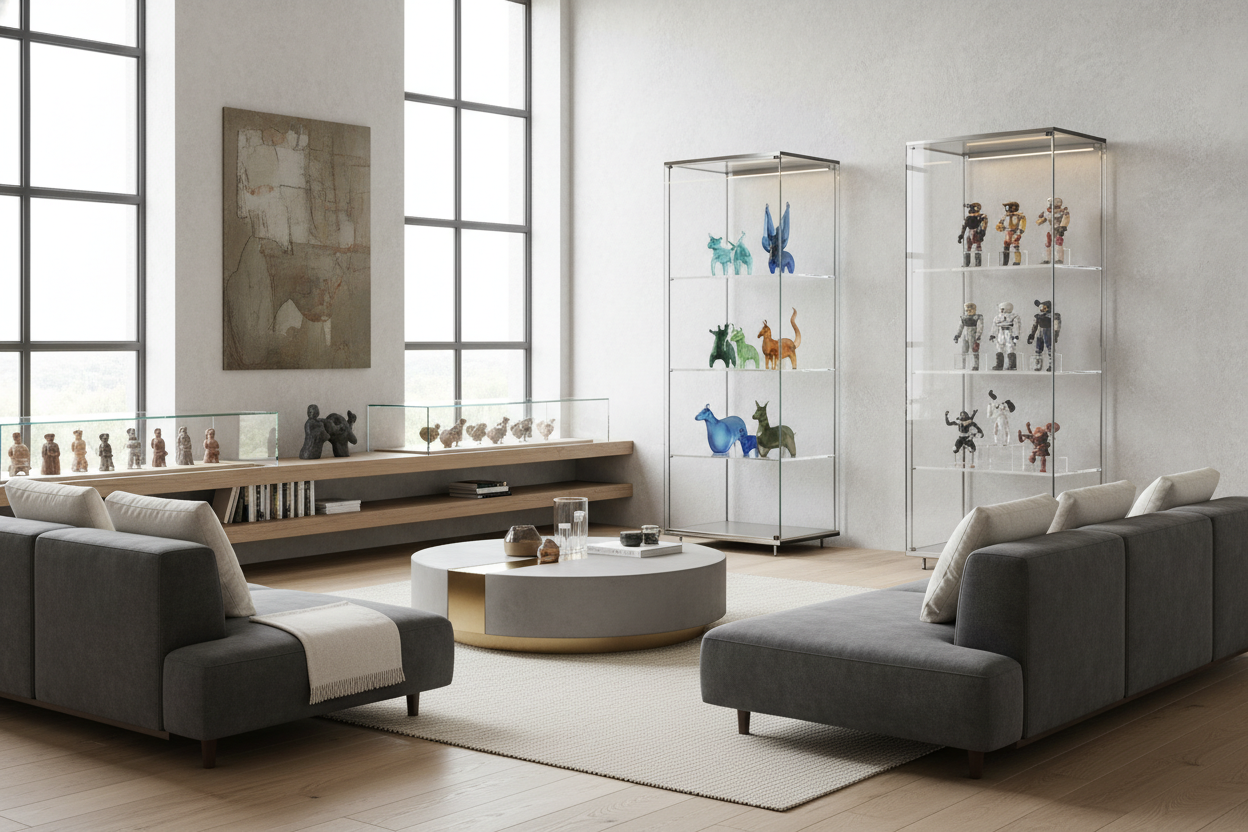
If you don't light your statues, you might as well not display them. Flat, overhead room light kills the texture and depth of a sculpture. You want directional light that creates subtle shadows in the crevices of the piece. I used to use those cheap battery-powered puck lights, but I spent more time changing batteries than looking at my art. Integrated systems, like a 4 Layer Glass Door Display Case With Led Light, provide consistent, even illumination that highlights the form of the statue from top to bottom.
What About Smaller Sculptures and Art Figures?
Not everything in a collection is a heavy bronze bust. If you are into designer art toys or delicate porcelain, a glass toy display case is often the better move. These usually have more shelves with tighter spacing, which prevents smaller items from looking lost in a giant void. For a more traditional vibe that can hold a variety of smaller pieces, a 62 2 H Tall China Curio Cabinet White Display Case With Glass Doors works beautifully. It keeps the dust off—which is a nightmare to clean off intricate sculptures—while keeping everything visible at eye level.
My Final Verdict on Styling Statues at Home
The goal is to make your home feel curated, not cluttered. Give your statues room to breathe. If you have five pieces, don't shove them all into one cabinet. Pick your two favorites for the main display and rotate the others. When you arrange them, think about the 'sight lines.' You want to be able to see the profile of the statue from where you usually sit. Avoid the 'museum look' by mixing in a few books or a small plant nearby to ground the display in the reality of a lived-in home.
FAQ
How thick should the glass be for a statue case?
For heavy statues, look for at least 5mm to 8mm tempered glass. Anything thinner is risky for heavy stone or metal pieces.
Can I put a statue on a floating shelf?
Only if you've anchored that shelf into a wall stud with heavy-duty brackets. Drywall anchors will eventually pull out under the constant weight of a statue.
How do I prevent my statues from tipping inside the case?
Use museum wax (also called quake wax) on the base. It’s a clear adhesive that keeps the piece stable but can be removed without damaging the finish.


Leave a comment
This site is protected by hCaptcha and the hCaptcha Privacy Policy and Terms of Service apply.