










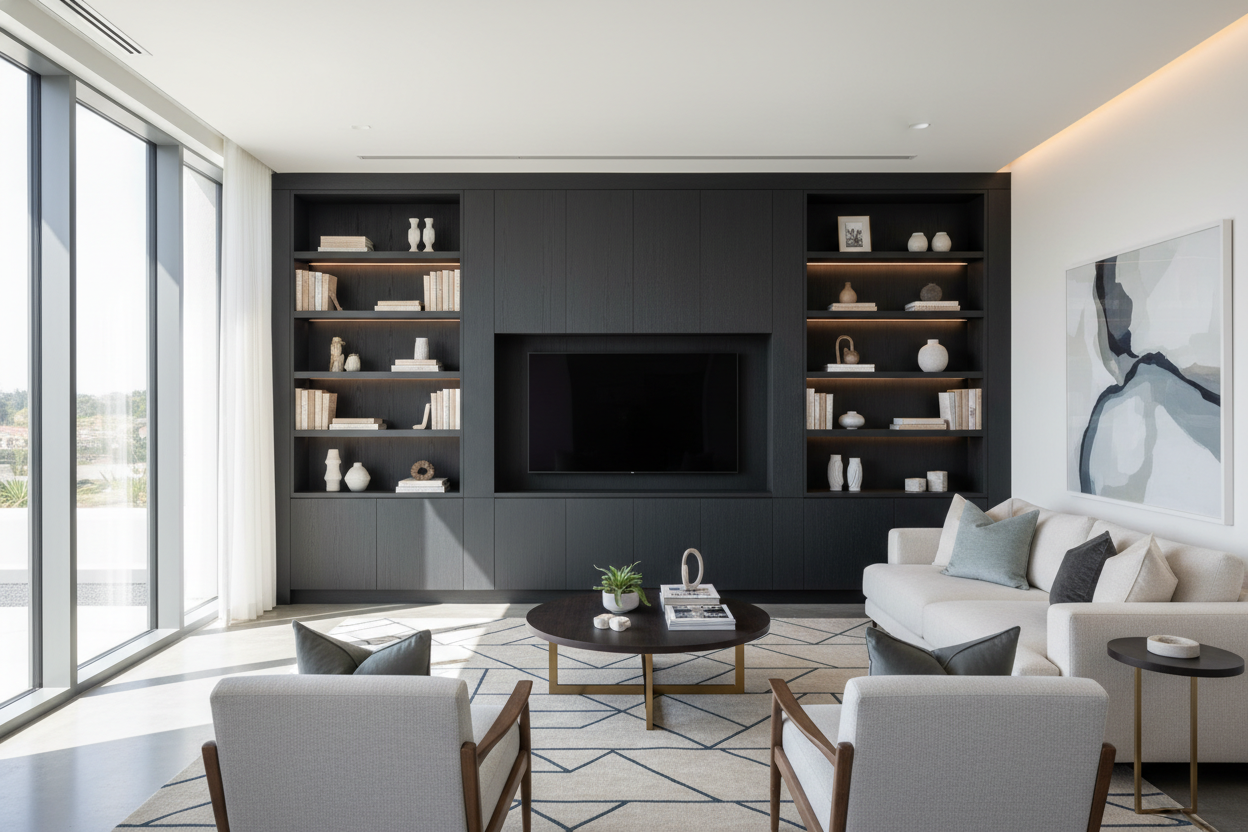
I remember staring at my living room wall—a 12x15 foot box of white paint—and thinking that if I added anything darker than a cloud, the room would suffocate. I had spent months looking at dark entertainment unit options online, only to chicken out and buy a pale birch console that looked like it belonged in a college dorm. It felt safe, but my living room felt unfinished, like a sketch that nobody bothered to color in.
After three years of living with a 'safe' room that had zero personality, I finally hauled that flimsy birch stand to the curb and went for the moody, deep-toned piece I’d been eyeing. I was terrified it would turn my apartment into a cave. Instead, the room actually felt bigger, more intentional, and—for the first time—expensive.
- Dark furniture recedes visually, which can actually make a small room feel deeper.
- A moody console camouflages the 'black hole' effect of a large TV screen.
- Contrast is the key: pair dark units with light rugs and brass hardware.
- Matte finishes are modern, but wood grains add necessary warmth.
The 'Light and Airy' Trap We All Fell Into
For the last decade, we have been told that white, cream, and 'millennial grey' are the only ways to make a small space feel livable. We bought into the idea that if we just kept everything light, our 600-square-foot apartments would magically feel like airy lofts. But here is the problem: when everything is light, nothing has weight. Your furniture looks like it is floating in a sea of beige, and the room never feels grounded.
I realized my living room felt 'cheap' because there was no visual anchor. Every time I looked at my TV area, my eyes just slid right past it. There was no depth, no drama, and certainly no style. By sticking to the light-and-airy script, I was actually making my room feel smaller because the boundaries of the space were so undefined. A room needs a focal point, and trying to hide your furniture by making it the same color as your walls just results in a space that feels like a waiting room.
Why a Dark Entertainment Unit Actually Creates Depth
It sounds counterintuitive, but dark colors don't always shrink a space. In fact, deep charcoal, navy, and black tend to recede from the eye. Think about the night sky—it feels infinite because it is dark. When you place a sleek black TV stand against a wall, it creates a sense of shadow and depth that wasn't there before. It pushes the wall back visually, making the room feel like it has more 'breath' than it did with a pale piece of furniture.
I noticed this immediately in my own place. The dark unit anchored the entire wall, drawing the eye forward and creating a clear sense of purpose for that corner of the room. It stopped the walls from looking like flat, boring surfaces. Instead of a cramped corner, I suddenly had a sophisticated media zone. The weight of the piece made the rest of my furniture—the cream sofa, the light oak coffee table—actually look like they belonged there. It provided the necessary contrast that made the lighter elements pop.
The Magic of Camouflaging Your Giant Screen
Let’s be honest: a 65-inch TV is an eyesore when it is turned off. It is a giant, lifeless black rectangle that dominates your wall. If you put that TV on a white or light wood stand, the contrast is jarring. You end up with a 'black hole' effect where the TV is the only thing you see. It screams 'I live here for Netflix and nothing else.'
By choosing a dark entertainment center, you solve this problem instantly. The dark frame of the TV bleeds into the dark tones of the furniture. The screen becomes part of the design rather than a distraction from it. When the TV is off, it almost disappears into the unit, allowing your decor, books, and plants to take center stage. It is the easiest way to make a tech-heavy room feel like a curated living space instead of a sports bar.
Mixing Moody Tones With Your Existing Lighter Furniture
The biggest mistake people make when going dark is thinking they have to go 'full goth.' You don't need to paint your walls black or buy a velvet sofa to make this work. In fact, a dark unit looks best when it is surrounded by lighter textures. I paired my deep-toned console with a high-pile cream rug and some brass floor lamps. The mix of the 'heavy' furniture with 'light' accessories is what creates that high-end, designer look.
If you are worried about the piece feeling like a giant monolith in the room, consider a modern entertainment center wall unit. These setups often include shelving or cabinetry that breaks up the solid dark mass. By styling the shelves with white ceramic vases, light-colored books, or trailing greenery, you pull the dark tones into the rest of the room's palette. It balances the visual weight and ensures the unit feels like a deliberate part of the architecture rather than a heavy box dropped in the middle of the floor.
Matte Black vs. Deep Wood: Choosing the Right Finish
Not all dark units are created equal. If you want a sharp, architectural look, a matte black painted finish is the way to go. It feels very 'New York loft' and works incredibly well with industrial or ultra-modern decor. However, matte black is a magnet for fingerprints and dust—I learned that the hard way. You will be wiping it down twice a week if you're a perfectionist.
On the other hand, if you want something that feels a bit more timeless and 'expensive,' look at deep wood grains. An oak entertainment center wall unit finished in a dark espresso or charcoal stain offers a texture that paint just can't match. You get the depth of the dark color, but you can still see the organic movement of the wood grain underneath. This adds warmth to the room and is much more forgiving when it comes to everyday wear and tear. It bridges the gap between 'moody modern' and 'classic comfort.'
Personal Experience: The Dust Dilemma
I finally settled on a 72-inch matte black unit with gold hardware. I love it. It makes my cheap IKEA sofa look like a designer piece. But here is the honest truth: I didn't realize how much dust my house had until I bought this thing. Every speck shows up like a spotlight. If you are the type of person who only cleans once a month, go with a dark wood grain instead of a flat black paint. The grain hides the 'lived-in' reality of a home much better than a flat finish does.
FAQ
Will a dark unit make my low ceilings look lower?
Actually, no. If you choose a low-profile dark unit, it draws the eye down and creates more 'white space' above it, which can actually make your ceilings feel higher by comparison.
What color rug goes best with a dark console?
Go for something with high contrast. A light grey, cream, or even a faded jute rug will prevent the room from feeling too heavy and will make the dark furniture stand out as a design choice.
Do I need to change my wall color?
You don't have to, but dark furniture looks incredible against a mid-tone wall (like a sage green or a dusty blue). If you have stark white walls, just make sure to add some art or shelving to bridge the gap between the white and the black.

Leave a comment
This site is protected by hCaptcha and the hCaptcha Privacy Policy and Terms of Service apply.