










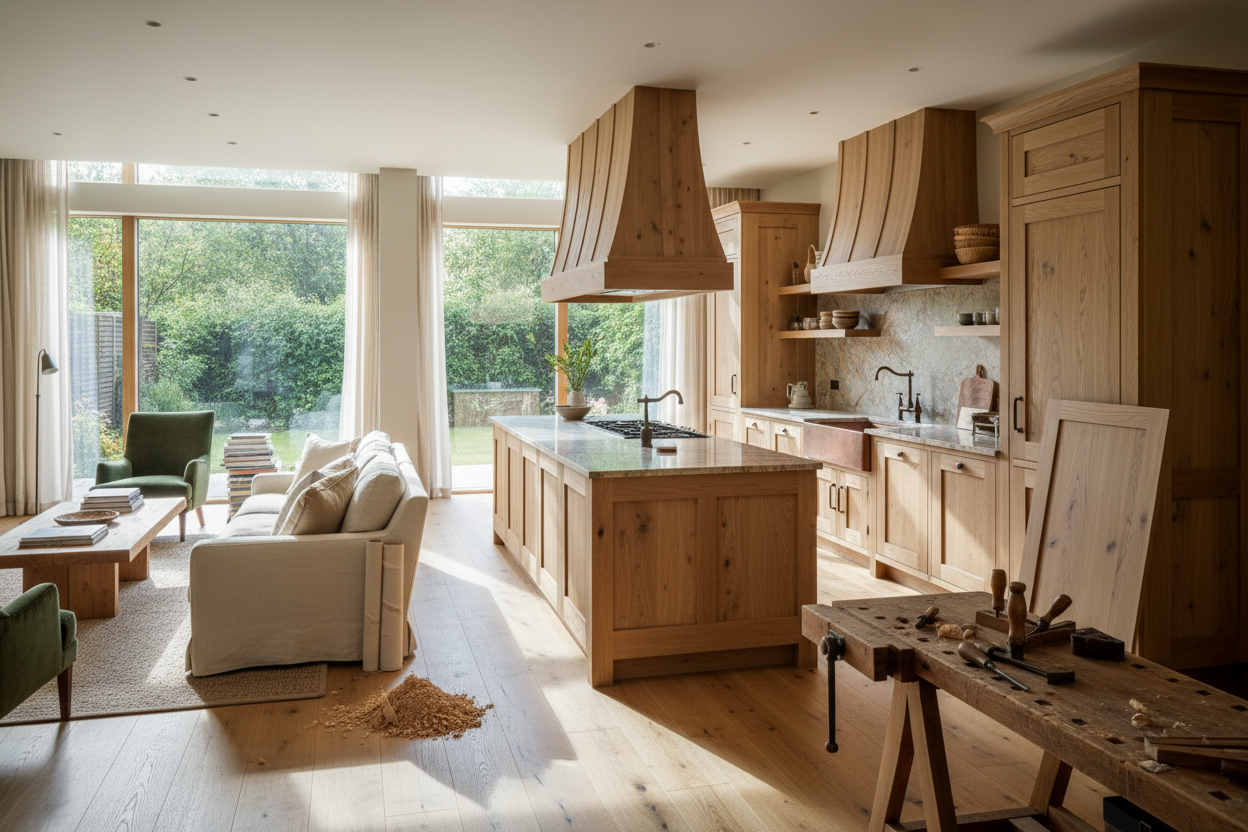
I remember staring at my old builder-grade kitchen, the one where the laminate was peeling like a sunburned tourist and the drawers groaned every time I reached for a spatula. I spent six months scrolling through bespoke cabinet makers on Instagram, convinced that a hand crafted kitchen would solve my existential dread. I didn't realize it would also involve me eating cereal over a bathtub for twelve weeks while a man named Silas meticulously hand-planed white oak in my driveway.
- Expect to pay 2x to 3x more than high-end modular brands.
- Lead times are measured in seasons, not weeks.
- Solid wood construction means your kitchen will actually outlast your mortgage.
- The dust is real—it will find its way into your sealed Tupperware.
The Romantic Idea vs. The Sawdust Reality
Hiring a local artisan sounds like a dream from a Nancy Meyers movie. You imagine yourself sipping tea while a craftsman quietly whistles in the background. The reality is much louder. A bespoke build isn't just delivered in boxes; it is often birthed in your home. My living room became an active woodshop, and the smell of sawdust replaced the scent of my expensive candles for three months.
Factory cabinets are built to a standard tolerance. Artisans build to your walls, which are never actually straight. Watching Silas scribe a back panel to fit the wonky curve of my 1920s plaster wall was a masterclass in patience. It’s messy, it’s invasive, and you will find wood shavings in your socks for a year. If you can't handle a contractor seeing you in your pajamas at 7 AM, stick to the big box stores.
Why Handcrafted Kitchens Take So Damn Long
The timeline for handcrafted kitchens is the biggest hurdle for most homeowners. You aren't just waiting for a shipping container; you're waiting for wood to acclimate. Real lumber needs to sit in your home's specific humidity for days before it’s even cut, otherwise, those expensive doors will warp by winter. This isn't a fast-food renovation.
During my build, the kitchen was a total dead zone for nearly ten weeks. I had to move my entire pantry into the dining room, relying on a few pieces of Kitchen Dining Storage to keep my sanity. When every joint is a hand-cut dovetail and every finish is hand-rubbed oil rather than a sprayed-on plastic lacquer, you simply cannot rush the process. If a carpenter tells you they can do a full custom build in fourteen days, they’re lying to you.
The 3 Details Factory Boxes Just Can't Replicate
People ask me if the price jump is visible to the naked eye. It is, but only if you know where to look. First, there's grain matching. In a factory, they grab whatever door is next on the pile. In a bespoke kitchen, the craftsman selects a single slab of walnut or oak so the wood grain flows seamlessly across three different drawer fronts. It looks like a piece of art, not a jigsaw puzzle.
Second, let’s talk about the 'flush inset.' Most cheap cabinets have doors that sit on top of the frame. In a high-end build, the doors sit perfectly inside the frame with a consistent 1/8-inch gap all around. It requires terrifying precision. Finally, there's the weight. A 3/4-inch solid maple drawer box feels substantial. It doesn't rattle or shimmy when you slam it; it just glides with a muffled, expensive-sounding 'thunk.'
Surviving the Wait (And Where to Prep Your Food)
You will lose your mind if you don't set up a 'Camp Kitchen.' I moved my toaster oven and an electric kettle to the laundry room. To keep from losing my mind, I used two portable Kitchen Islands as my primary prep stations in the hallway. One held the 'coffee station' and the other was for making sandwiches that I eventually grew to hate.
Don't try to cook real meals. This is the time for rotisserie chickens and paper plates. The goal is to minimize the amount of washing you have to do in the bathroom sink. Also, buy a high-quality HEPA air purifier and run it 24/7 near the construction zone. Your lungs will thank you when the fine sanding begins on those cabinet faces.
The Final Verdict: Would I Do It Again?
Six months later, the dust has settled and the check has cleared. Every time I run my hand over the silken finish of the island, I know I made the right choice. A factory kitchen is a product; a bespoke kitchen is a permanent part of the architecture. It feels permanent. It feels like it was grown there rather than screwed into the drywall.
If you have the budget and the patience for a long-term investment, go custom. To really tie the room together, I made sure to Transform Your Space With The Perfect Kitchen Island that acted as the anchor for the whole artisanal look. It’s the difference between wearing a suit off the rack and having one measured to your shoulders. One just fits; the other makes you feel like a different person.
FAQ
Is a handcrafted kitchen more durable?
Yes, because they don't use particle board or 'furniture board' which swells if it gets wet. They use solid hardwoods and high-grade plywood that can handle a leaky sink without disintegrating.
How much more does it cost?
Generally, expect to pay at least $1,000 to $1,500 per linear foot. A standard factory kitchen might cost $15,000, while the artisanal version will easily hit $40,000 or more depending on the wood species.
Can I paint a handcrafted kitchen?
You can, but it’s almost a crime to cover up high-grade wood grain with thick paint. Most people go the 'bespoke' route specifically to see the wood. If you want a flat matte color, you might be better off with high-end semi-custom cabinets.


Leave a comment
This site is protected by hCaptcha and the hCaptcha Privacy Policy and Terms of Service apply.