










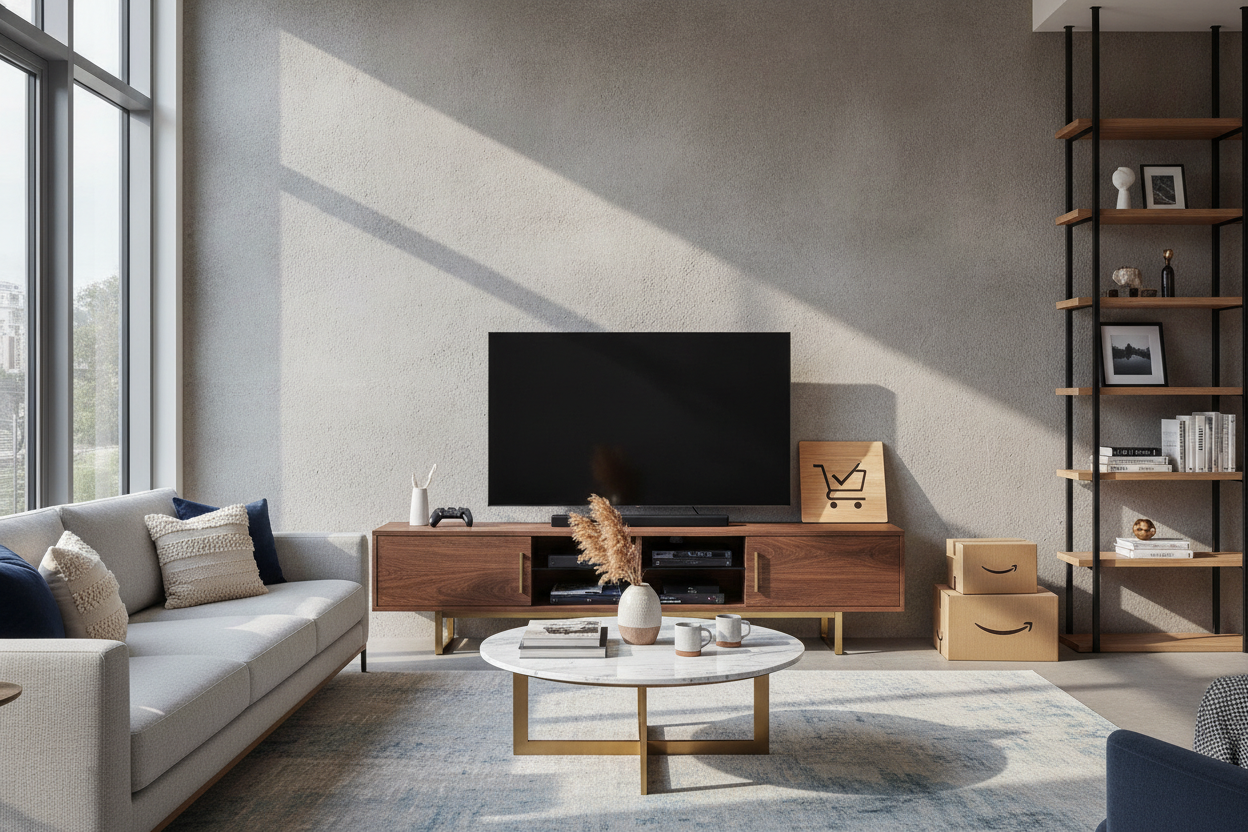
I spent three months hunting for the perfect olive velvet sofa and a vintage rug that didn't smell like a basement. But the moment I set everything up, I realized my living room didn't feel like a sanctuary—it felt like a Best Buy showroom. No matter how many candles I lit or how many expensive coffee table books I stacked, that 75-inch black rectangle on the wall sucked the soul right out of the room. That's when I realized a tv cabinet cover isn't just a luxury; it's the only way to reclaim your home from the screens.
Quick Takeaways
- TVs are visual dead zones that break the flow of a well-designed room.
- Covers range from simple sliding wood panels to motorized lifts.
- Hiding the screen encourages more conversation and less mindless scrolling.
- Retrofitting an existing stand is often a weekend project involving basic hardware.
The 'Big Black Box' Problem in Modern Living Rooms
We’ve been conditioned to think that the TV should be the focal point of the room. We point all our furniture at it like it’s an altar. But let’s be honest: when the screen is off, it’s just a giant, dusty void. It’s the aesthetic equivalent of hanging a piece of charcoal in the middle of a gallery wall. It’s heavy, it’s industrial, and it clashes with almost everything that makes a room feel cozy or sophisticated.
Leaving a massive screen totally exposed is one of those mistakes what designers actually think ruins the balance of a space. Designers often talk about 'visual weight.' A large TV has immense visual weight, but it’s 'dead weight' because it offers no texture, color, or interest when it’s not in use. It makes the room feel like it’s waiting for something to happen rather than being a place where life is already happening.
What Exactly Is a TV Cabinet Cover?
When I talk about a cover, I’m not suggesting you throw a lace doily over your flat screen like your grandmother’s old CRT. A modern cover is a functional design element. At its simplest, it’s a set of sliding barn doors or bi-fold panels that live on the front of your media console. You slide them shut, and suddenly your tech disappears behind white oak or walnut slats.
If you want to go the high-tech route, you look into motorized solutions. An electric vertical lift tv cabinet is the ultimate move here. The TV literally lives inside the furniture and rises up only when you’re ready for a movie. It’s seamless, it’s quiet, and it allows you to place your TV in front of a window or in the middle of a room without blocking the view permanently. For those of us who live in smaller apartments where wall space is at a premium, this kind of hidden mechanism is a total lifesaver.
3 Brilliant TV Stand Cover Ideas I Actually Love
If you’re looking for tv stand cover ideas that don’t look like a DIY disaster, start with slatted wood panels. Slats are great because they add texture and depth to the room, and they allow infrared signals from your remote to pass through even when closed. It’s a very 'Scandi-modern' look that feels intentional rather than like you’re hiding something shameful.
Another favorite of mine is the pull-down artwork cover. You can mount a canvas on a spring-loaded roller or a sliding track. When the TV is off, you’re looking at a landscape or an abstract piece; when it’s on, the art tucks away. It’s a bit more involved to install, but the payoff is huge. While a black cabinet with glass doors is great for showing off your ceramics or books, it doesn't solve the screen problem. You need something opaque to truly break the 'tech' spell.
Lastly, don't sleep on folding fabric screens. A high-quality linen or grasscloth screen can be mounted to the unit. It adds a soft, organic texture to the room that balances out the hard lines of your electronics. It’s a softer approach that works beautifully in bedrooms where you want to minimize blue light and tech vibes before sleep.
How to Retrofit an Entertainment Center Cover
You don’t have to go out and buy a $3,000 custom built-in to get this look. You can take a sturdy, well-made base like a black tv stand entertainment center and modify it. The key is the hardware. I’ve seen people use simple bypass door tracks—the kind used for closets—mounted to the top and bottom of an existing unit. You just need two lightweight panels (think 1/4-inch plywood or even framed cane webbing) to slide back and forth.
When you’re building an entertainment center cover, remember to account for ventilation. Electronics get hot. If you’re enclosing the TV, make sure the back of the cabinet is open or that you’ve drilled a few 2-inch holes for airflow. I once made the mistake of sealing a cable box in a tight wooden drawer without vents; it lasted about three hours before it smelled like burning plastic. Learn from my fail: airflow is non-negotiable.
The Verdict: Is Hiding Your Screen Worth the Effort?
Is it an extra step to slide open a door before you watch the news? Yes. But the psychological shift is worth it. When the TV is hidden, the room feels quieter. You find yourself reaching for a book or actually talking to the person sitting across from you instead of defaulting to the 'Netflix scroll.' It turns the living room back into a place for living, not just consuming.
I’ve found that my guests stay longer and the vibe is much more relaxed when there isn't a giant black mirror staring at us from the wall. It’s a small design change that has a massive impact on how you actually use your home. If you want a space that feels curated and 'grown-up,' hiding the tech is the easiest way to get there.
FAQ
Will my remote still work through a cover?
If you use slatted wood or mesh, yes. If you use solid wood, you'll need an inexpensive IR repeater. It’s a tiny sensor that sits outside the cabinet and passes the signal to the devices inside.
Does a TV cover cause overheating?
It can if there’s no airflow. Always ensure the back of your cabinet is partially open or has vent holes. If you're using a motorized lift, the TV is usually out in the open while running, so heat isn't an issue.
Can I hide a wall-mounted TV?
Absolutely. Sliding 'barn door' style art or a motorized canvas cover are the best options for wall-mounted units. It keeps the profile slim while still concealing the screen.


Leave a comment
This site is protected by hCaptcha and the hCaptcha Privacy Policy and Terms of Service apply.