










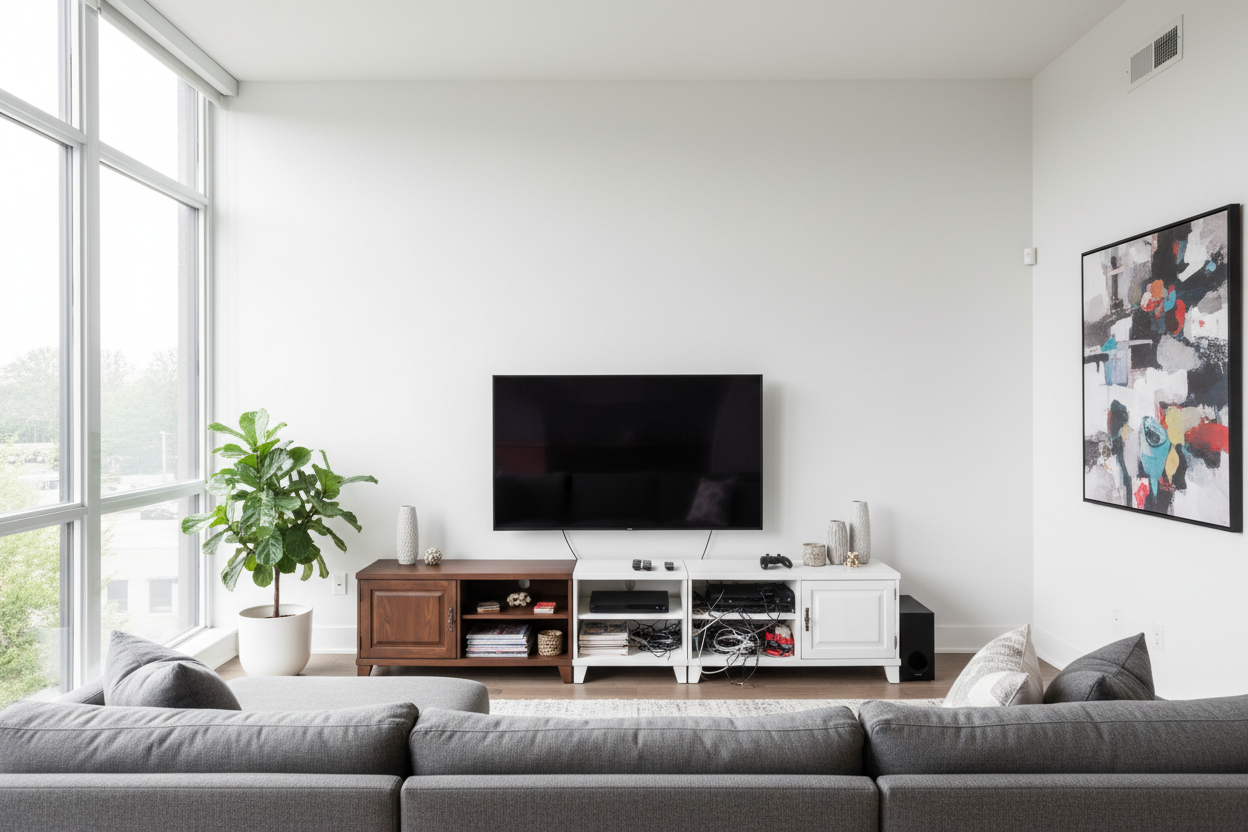
The living room dilemma is universal: you buy a beautiful flatscreen, mount it, and suddenly a tangle of cords and gaming consoles ruins the aesthetic beneath it. Finding the right tv stand and cabinet is rarely just about holding the television anymore. It is about anchoring the room's visual weight, establishing a focal point, and hiding the daily tech clutter that accumulates in modern North American homes.
Whether you are outfitting an open-concept suburban great room or a narrow urban apartment, choosing the wrong console can make your space feel cramped or disjointed. By the end of this guide, you will know exactly how to size, style, and select a piece that actually works for your lifestyle.
Quick Decision Guide
- Always choose a console at least 6 to 8 inches wider than your television on both sides to prevent a visually top-heavy look.
- Prioritize closed storage if you own multiple gaming consoles, routers, or bulky smart home hubs.
- Check the back panel for built-in wire management; pre-drilled routing holes are non-negotiable for a clean setup.
- Ensure ergonomic viewing height—the center of your screen should sit right at eye level when you are seated on your sofa.
Space Planning: Getting the Proportions Right
One of the most common mistakes I see in residential layouts is a television that dwarfs the furniture beneath it. A massive screen hovering over a tiny console creates an uneasy, top-heavy silhouette that throws off the entire room's balance.
The Width and Placement Rule
When pairing a television with a tv unit and cabinet, the furniture should extend noticeably past the edges of the screen. If you have a 65-inch television (which is measured diagonally and is about 57 inches wide), your console should be an absolute minimum of 70 inches wide. This negative space on either side gives the eye a place to rest and provides room for styling elements like a structural vase or a stack of design books.
Storage Strategy: Hiding the Chaos
Open shelving looks fantastic in styled catalog photos, but it is notoriously difficult to maintain in a real household. If you have kids, pets, or a serious gaming habit, open shelves quickly become a dusty graveyard of controllers and tangled wires.
Open vs. Closed Layouts
This is why I almost always steer clients toward tv stands with cabinet doors. Solid doors hide the flashing LED lights of routers and cable boxes, instantly calming the room's visual noise. If you need infrared remotes to reach your devices, look for doors with acoustic mesh, frosted glass, or slatted wood designs that allow signals to pass through while obscuring the mess behind them.
Material Realities in North American Homes
The material you choose dictates both the longevity and the maintenance of your furniture. While solid wood is the gold standard for durability, it is heavy and expensive. High-quality wood veneers over MDF (medium-density fiberboard) are often a more practical choice for tv stand cabinets, offering the look of solid oak or walnut without the risk of warping from indoor heating and cooling cycles.
However, beware of cheap paper laminates. If a piece feels unusually light or the wood grain looks pixelated up close, it will likely peel or chip within a year of regular vacuuming and dusting.
Designer's Honest Take
A few years ago, I sourced a stunning, deep-profile matte black console for a client's narrow townhouse living room. In the showroom, the piece had incredible presence. But once we placed it in the room, I realized my mistake. The 22-inch depth ate up crucial walkway space between the sofa and the television. Every time someone walked past, they had to turn sideways slightly.
I learned the hard way that depth matters just as much as width. Most modern televisions and soundbars only need about 14 to 16 inches of depth. Buying a deeper cabinet just creates a cavernous dark space inside where things get lost, while needlessly shrinking your floor plan. Always tape out the footprint on your floor before hitting the checkout button.
Frequently Asked Questions
How wide should my console be compared to my TV?
Your console should be at least 20 percent wider than your television. If your TV is 50 inches wide (side-to-side, not diagonally), aim for a cabinet that is at least 60 inches wide to maintain proper visual proportion.
Are open shelves or closed doors better?
When deciding between open tv stands or cabinets with doors, closed storage is almost always better for living rooms. It hides cords, protects electronics from dust, and keeps the room looking intentional rather than cluttered.
What is the ideal height for a media console?
For most standard sofas (which have a seat height around 17 to 18 inches), a console height of 20 to 24 inches works best. This ensures the center of the television screen remains at eye level, preventing neck strain during movie nights.

Leave a comment
This site is protected by hCaptcha and the hCaptcha Privacy Policy and Terms of Service apply.