










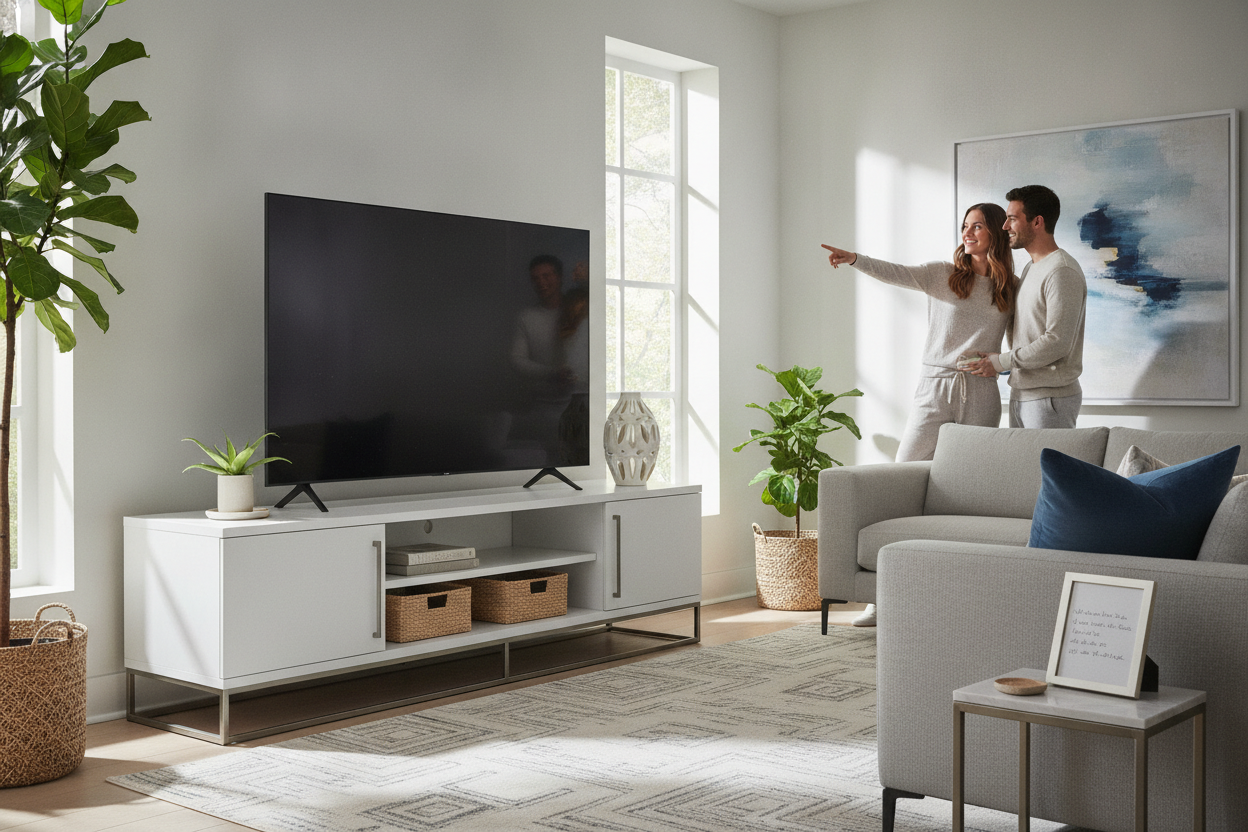
I stood in the living room doorway and felt the air leave my lungs. My partner had finally done it. The 80-inch 'beast' had arrived, and it looked like a literal billboard in our 12x15 space. I spent three years curating vintage rugs and linen curtains, and suddenly my home felt like a Buffalo Wild Wings on a Sunday afternoon.
The problem wasn't just the screen; it was the physics of the thing. A screen that size weighs a ton and commands every photon of light in the room. I realized immediately that my delicate mid-century console was about to be crushed, both literally and stylistically. I needed a white tv stand for 80 inch tv that could actually anchor the space without making the room feel like a tech graveyard.
- Go wider than the screen: If your stand is the same width as the TV, it looks like a mushroom. Aim for at least 6-10 inches of overhang on each side.
- Choose matte over high-gloss: High-gloss white reflects the glare of the screen, which is incredibly distracting during movie night.
- Prioritize depth: Large TVs have wide feet. Make sure the console is at least 15-18 inches deep so the TV doesn't sit on the very edge.
- Ventilation is non-negotiable: Big TVs and the consoles that power them (PS5, receivers) run hot. Look for slatted doors or open backs.
The 'Sports Bar' Dilemma: When a Giant Screen Appears
When that box arrived, it was nearly six feet long. Seeing an 80-inch television in a residential living room is a visceral experience. It’s not just a TV; it’s a piece of architecture. My first instinct was to hide it, but you can’t hide a screen that takes up half a zip code. The immediate realization was that our existing furniture looked like dollhouse accessories next to it.
A flimsy, cheap media console makes a large TV look dangerous. You start imagining the whole thing tipping over if someone sneezes too hard. I knew I needed something with a heavy footprint and a low profile. If the TV is high, and the stand is high, you're basically sitting in the front row of an IMAX theater, straining your neck. The goal was to find a base that felt permanent and intentional, rather than a temporary landing pad for a piece of tech.
Why I Avoided Wood Tones and Went Straight to White
Most people default to walnut or oak when they buy 'nice' furniture. I get it; wood is warm. But when you have a massive black rectangle on the wall, a dark wood console creates a giant 'black hole' effect. It sucks the energy right out of the room. I wanted the base to disappear into my white walls, creating a floating effect for the screen rather than a heavy, dark block of visual weight.
I remember when I Trusted My 80 Inch Tv To The Grindle Solid Wood Tv Stand in my last place, and while the craftsmanship was incredible, the dark grain made the 80-inch setup feel oppressive. By switching to a crisp white finish, the room felt five feet wider. White reflects the natural light from the windows, balancing out the light-absorbing properties of the glass screen. It’s the ultimate design cheat code for small-to-medium rooms with oversized tech.
The Golden Ratio: Sizing Your Console for a Massive TV
Here is the mistake everyone makes: they buy a 70-inch stand for a 70-inch-wide TV (which is roughly the width of an 80-inch screen). This is a disaster. It makes the TV look like it’s balancing on a toothpick. To get the 'Golden Ratio' right, your white tv stand 80 inch setup needs to be significantly wider than the screen itself. Ideally, you want a console that is 85 to 90 inches long.
This extra width provides 'visual breathing room.' It allows you to place a lamp or a small ceramic vase on the ends of the console, which helps integrate the TV into the room's decor. If you're struggling with the layout, I highly recommend reading about a Mid Century Modern Tv Stand 80 Inch How To Master The Layout to understand how to balance those proportions. Without that extra width, the TV just looks like a giant head on a tiny body.
Hiding the Chaos: Cables, Consoles, and Soundbars
An 80-inch TV usually comes with a small army of peripherals. You’ve got the soundbar, the gaming consoles, the streaming boxes, and the inevitable 'spaghetti monster' of HDMI cables. A white console is a godsend here, but only if it has closed storage. I’ve seen people use open shelving for these giant setups, and it looks like a server room in a basement. It’s chaotic and messy.
I looked for a unit with cord management cutouts and enough internal depth to hold a modern receiver. Pro tip: If your soundbar is white, it will blend seamlessly into the top of the unit. If it’s black, try to find a console with a recessed shelf so the bar doesn't break the clean line of the white surface. My current setup uses a series of internal Velcro ties to keep the white power cables pinned to the back legs of the stand—if you use black cables against a white stand, they will stick out like a sore thumb.
The Final Verdict on Living With the Giant Screen
I’ll be honest: I still think the TV is too big. But with the right white console, I don't wake up and want to move houses anymore. It transformed a point of relationship tension into a functional, surprisingly chic focal point. The white finish keeps the room feeling airy, and the massive scale of the stand makes the TV look like a deliberate choice rather than an accidental intrusion. If you're currently staring at a giant box in your hallway, take a breath and start browsing Tv Stands that actually have the width to handle it. Your living room—and your sanity—will thank you.
How high should a stand be for an 80-inch TV?
Keep it low. Your eyes should be level with the middle of the screen when seated. For a screen this size, a console height of 18 to 22 inches is usually the sweet spot to avoid neck strain.
Can I use two smaller white cabinets side-by-side?
Absolutely. It’s often easier (and cheaper) to buy two 45-inch white media units and push them together to create a seamless 90-inch look. Just make sure they have flat sides so there isn't a weird gap in the middle.
Is a white TV stand hard to keep clean?
Not really. Dust shows up less on white than it does on dark wood or black glass. Just avoid high-gloss finishes if you have kids or pets, as fingerprints will become your new full-time job.

Leave a comment
This site is protected by hCaptcha and the hCaptcha Privacy Policy and Terms of Service apply.