










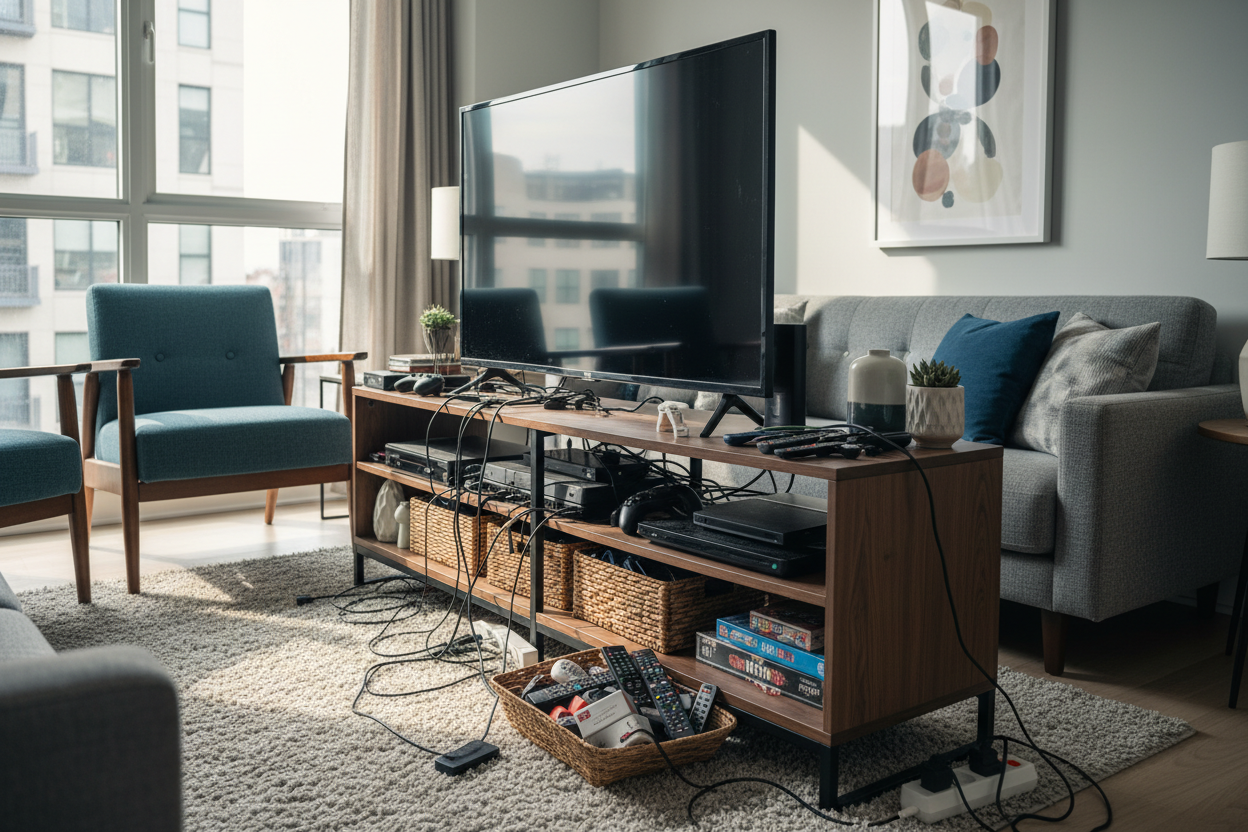
I spent three hours last night trying to untangle a literal bird's nest of HDMI cables behind my console, and I realized I have been lied to by every interior design magazine I have ever read. We have all seen the Pinterest boards where a tv stand for small space is just a couple of planks of reclaimed wood with a vintage record player and a single, perfectly manicured succulent. It looks 'airy.' It looks 'intentional.' In reality? It looks like a tech landfill within forty-eight hours.
Quick Takeaways
- Open shelving creates visual noise that makes small rooms feel more cramped.
- Closed cabinets hide the 'cable gore' of routers, power strips, and gaming consoles.
- Look for tapered legs or floating designs to keep a solid cabinet from feeling bulky.
- Always prioritize cord management holes and depth measurements over aesthetics.
The 'Airy Furniture' Lie We Have All Been Told
Usually, the standard advice for tiny apartments is to buy leggy, backless, or glass-fronted furniture. The theory is that if you can see through the piece to the wall or floor, the room feels larger. While this works for a coffee table or a dining chair, it is a total disaster for a small room tv stand. Why? Because your TV is not an island. It is a hub for a router, a soundbar, a Playstation, and a power strip that probably looks like a fire hazard.
When you put all that gear on a small simple tv stand with open shelves, you aren't creating 'airiness.' You are creating a frame for your clutter. In a 12x14 living room, your eye is naturally drawn to the darkest, busiest spot in the room. If that spot is a tangled mess of black plastic wires against a white wall, your entire room feels chaotic, no matter how many 'minimalist' candles you light on the coffee table.
Why Open Shelving Turns Into Immediate Visual Noise
Every cable, blinking LED light, and dusty remote is a piece of 'visual noise' that your brain has to process. In a tight environment, that noise is deafening. A small space entertainment center should not just be a platform for your screen; it should act as a shield. If you are looking for a genuine small space solution, it needs to actively hide your mess rather than putting it on display.
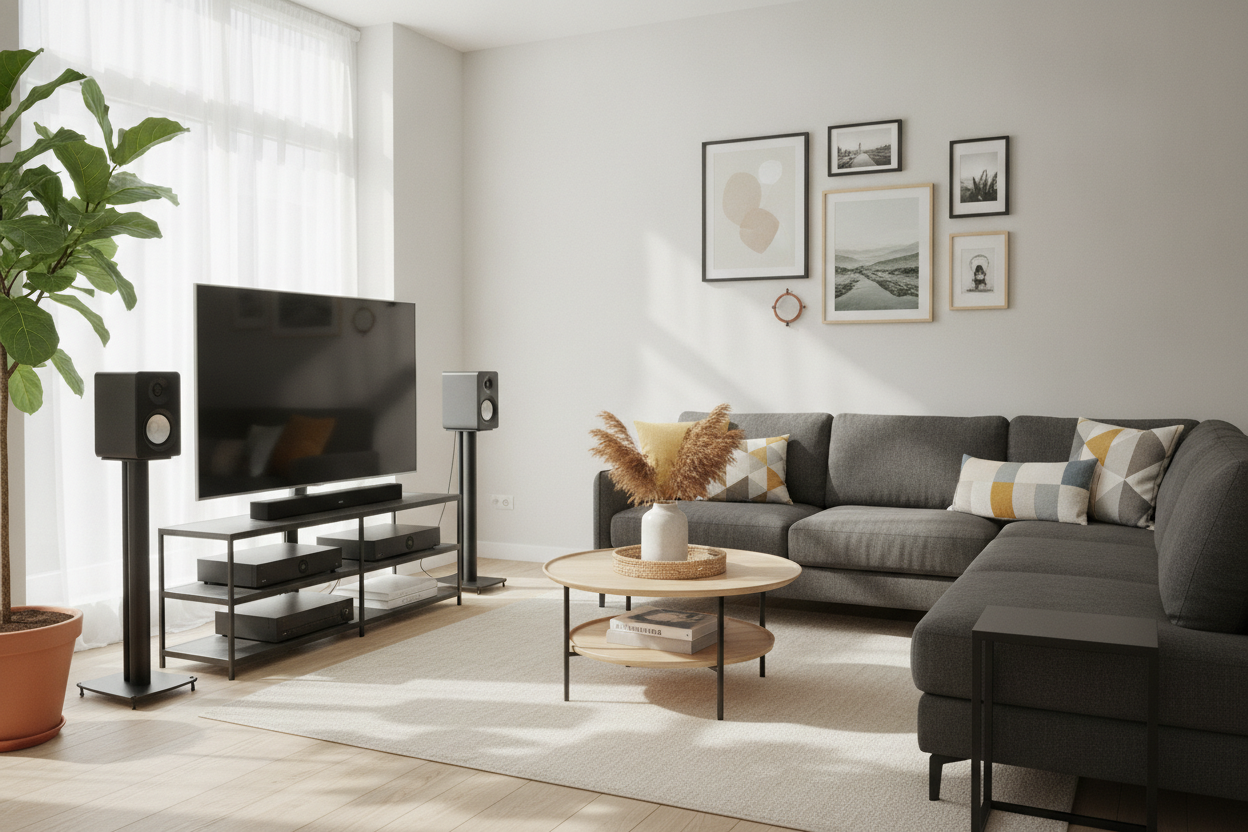
I have tested those 'airy' industrial metal racks that are popular for small apartment tv stand setups. Within a week, the dust build-up on the black glass was unbearable, and the sight of my orange extension cord ruined the vibe of the whole room. When you use a small living room entertainment center with open backs, you are essentially inviting the 'backstage' of your technology to be the main event. It makes the wall look busy and the floor look dirty, even if you just vacuumed.
The Magic of the 'Black Hole' Closed Cabinet
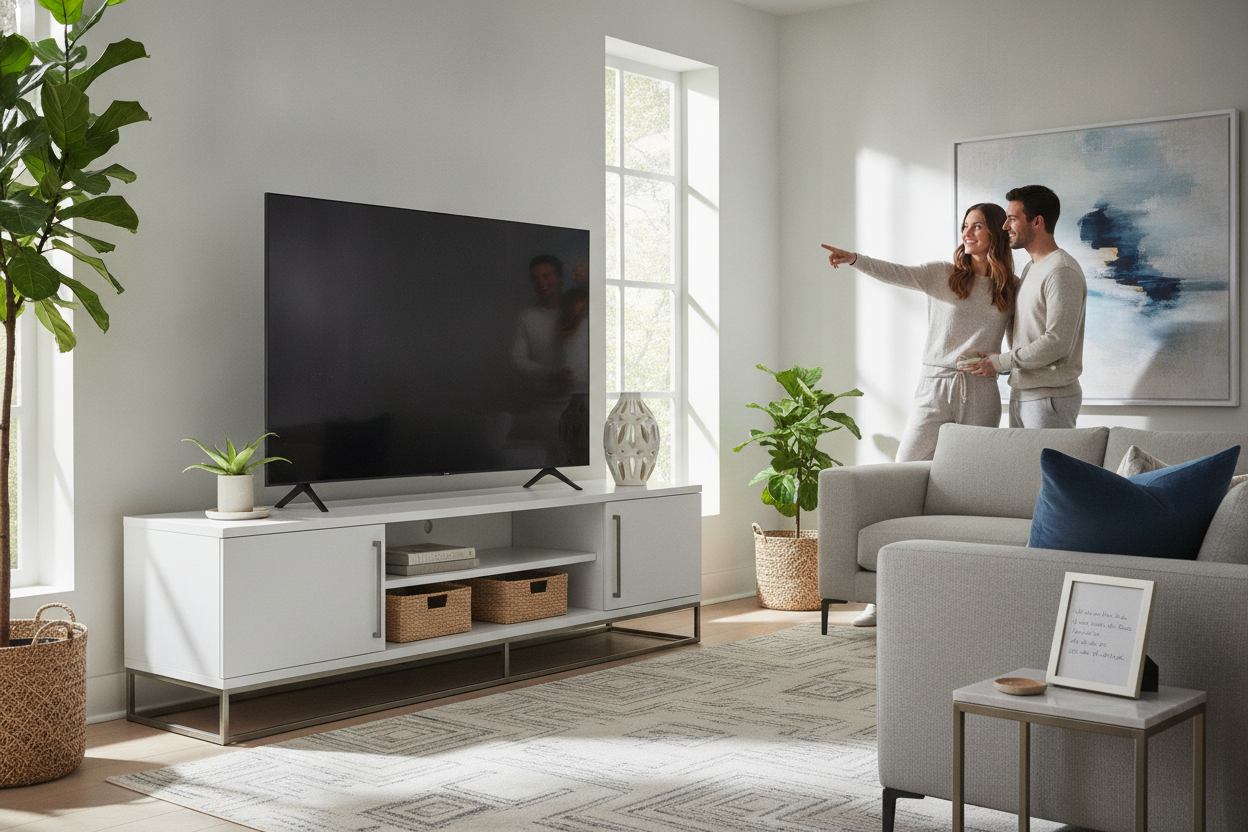
I eventually swapped my open metal rack for a solid cabinet, and the psychological relief was instant. A media console for small spaces with solid doors is basically a beautiful black hole where bad aesthetics go to die. You can have a chaotic mess of controllers and tangled chargers inside, but once those doors click shut, your living room looks like a professional designed it. It anchors the room without demanding you stare at its contents.
I found this out the hard way when I realized a small TV stand for bedroom corners worked significantly better than my expensive 'designer' open shelf because it actually swallowed the clutter. By choosing a small furniture stands approach that prioritizes hidden storage, you allow the rest of your decor to breathe. You want people to notice your art or your rug, not the dusty blinking lights of your modem.
Wait, Won't Solid Doors Make the Room Feel Heavy?
This is the number one fear people have when ditching open shelving for a small living room tv stand. They worry a solid block of wood will look like a literal boulder in their studio. The trick isn't to go back to open shelves; it is to focus on the 'lift.' Look for a small modern entertainment center with 6-inch tapered legs. If you can see the floor underneath the unit, the piece 'floats' in your visual field, and the room remains open—even if the cabinet itself is a solid, clutter-hiding block.
3 Non-Negotiables for Buying a Closed Media Unit
First, never buy a unit without pre-drilled cord management holes. If you have to drill them yourself into MDF, you're going to have a bad time. Second, look for slatted or 'louvred' doors. Solid wood blocks IR signals from your remotes; slats let the signal through so you don't have to keep the doors open while you're actually watching a movie. Third, measure your depth. Most standard consoles are 18 inches deep, but for an entertainment center small space setup, you can often find slim-profile units that are only 14 or 15 inches deep.
If you have a bit more horizontal wall space but still need a slim profile, an adjustable TV stand for living room with sliding panels offers the flexibility to fit your exact wall dimensions while keeping the 'guts' of your tech hidden. Avoid the 'minimalist' open shelf trap—your sanity (and your dusty router) will thank you.
FAQ
Do I need a TV stand if I wall-mount my TV?
Yes, usually. Even if the TV is on the wall, you still need a place for the cable box, gaming consoles, and to hide the wires trailing down. A slim console underneath 'grounds' the TV so it doesn't look like it's just floating aimlessly on the wall.
What is the best material for a small TV stand?
If you can swing it, go for kiln-dried solid wood or high-quality plywood. Cheap particle board (MDF) tends to sag under the weight of a TV over time, especially if the stand is narrow. A 1-inch thick top is the gold standard for durability.
How wide should my TV stand be compared to the TV?
Your stand should be at least 3-6 inches wider than your TV on both sides. If the TV overhangs the edges of the stand, it looks top-heavy and makes the room feel unbalanced and smaller than it actually is.

Leave a comment
This site is protected by hCaptcha and the hCaptcha Privacy Policy and Terms of Service apply.