










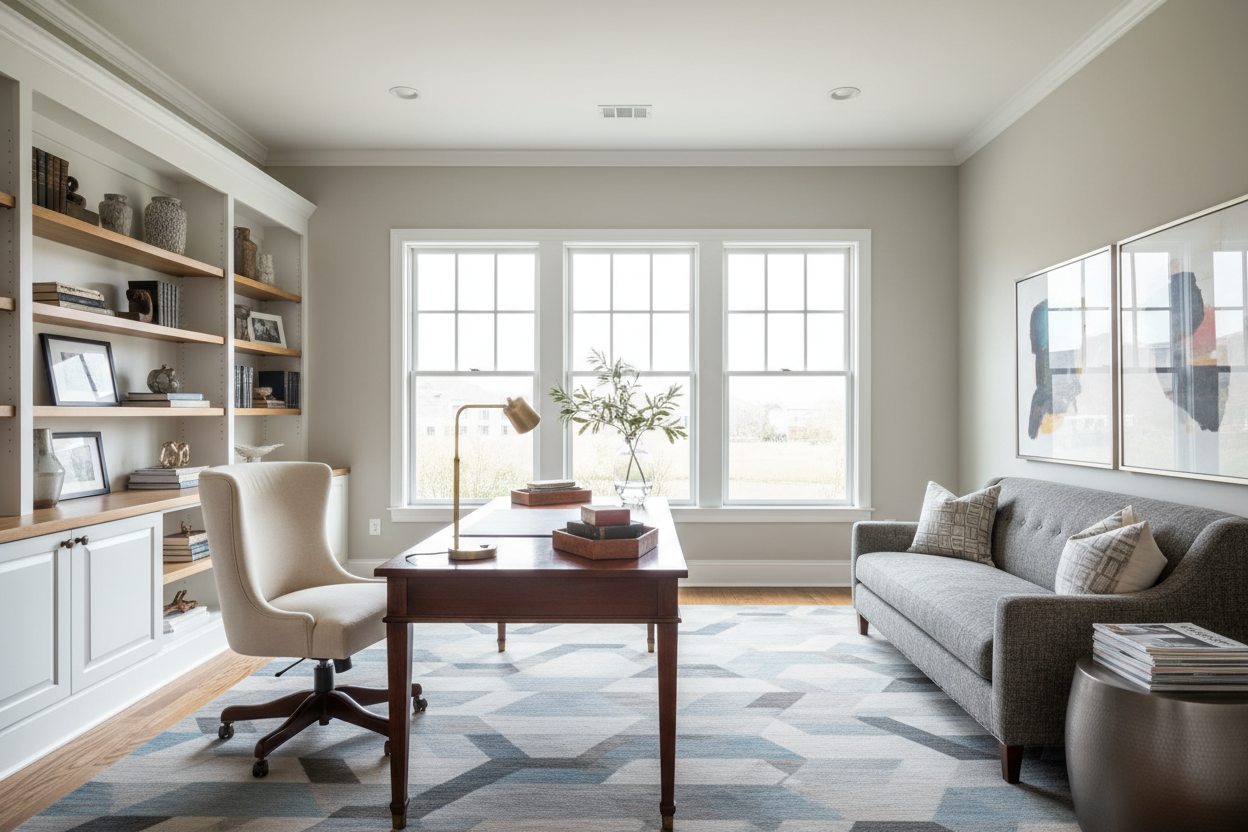
Many of my clients find themselves paralyzed when selecting a design direction for their workspace. They fear traditional styles will feel stuffy and dated, yet they find modern minimalism too cold and sterile. The solution lies in the balance. A transitional office bridges this gap, offering a sophisticated middle ground that marries the warmth of heritage design with the clean profiles of contemporary living. It is not just about mixing old and new; it is about curating a space that feels established yet current.
Quick Decision Guide: The Essentials
If you are looking to source furniture or plan a layout immediately, keep these core pillars of transitional design in mind to ensure visual harmony.
- The Palette: Stick to tone-on-tone neutrals (greige, taupe, warm white) with deep accents like navy or charcoal.
- The Silhouette: Look for furniture with straight lines that are softened by curved details or tapered legs.
- The Materials: Combine organic elements (wood, stone, rattan) with industrial accents (glass, steel, brass).
- The Textile: Prioritize tactile fabrics like linen, velvet, or leather to add depth without visual clutter.
Defining the Transitional Aesthetic
To successfully execute a transitional home office design, you must understand the architecture of the furniture. We are moving away from the heavy, ornate carvings of the past, but avoiding the sharp, high-gloss edges of ultra-modernism. Think of a classic shaker-style desk but finished in a matte black or a bleached oak rather than a glossy mahogany. The goal is to create a transitional style office that feels airy but grounded.
Furniture Selection: Form Meets Function
The desk is the anchor of your transitional home office. When I walk a client through a showroom, I steer them toward pieces that have substantial visual weight but simple hardware. A heavy timber desk with sleek brass handles is a quintessential example.
Material Quality and Durability
For a transitional office design that lasts, prioritize solid wood or high-grade veneers over particle board. In a transitional space, the grain of the wood often serves as the primary "pattern." If you opt for a veneer, ensure it is thick enough to withstand daily wear. I often recommend a cerused oak finish—the white pigment in the wood grain highlights the natural texture while keeping the overall look light and modern.
The Seating Equation
Your chair is where ergonomics clashes with aesthetics. For transitional home office ideas, avoid the race-car style gaming chairs. Instead, look for high-back executive chairs upholstered in cognac leather or a performance linen blend. The mechanism should be modern (tilt, swivel, gas lift), but the form should be classic.
Textiles and Transitional Office Decor
Restraint is key when selecting transitional office decor. Unlike eclectic styles where "more is more," transitional spaces rely on negative space to let the furniture breathe. However, this doesn't mean the room should be bare.
Window treatments are a critical element often overlooked in transitional office design ideas. I prefer floor-to-ceiling drapes in a neutral linen, hung on a simple iron rod. This adds verticality and softness to the room, counteracting the hard surfaces of desks and shelving units. Rugs should be low-pile; a vintage-washed Oushak or a subtle geometric wool rug anchors the space effectively.
Lighting: The Jewel of the Room
In a transitional style home office, lighting acts as the "jewelry." A large, architectural pendant light or a chandelier with clean lines can serve as a stunning focal point. Avoid overly crystal-heavy fixtures; instead, opt for lantern styles or linear fixtures in brushed nickel or aged brass. Task lighting should be functional but sculptural—an articulating brass lamp adds a touch of library sophistication without feeling antiquated.
My Personal Take on Transitional Workspaces
I learned a valuable lesson about transitional office functionality during a project for a finance executive in Boston. We designed a stunning custom desk that perfectly nailed the aesthetic—a rich walnut top with a sleek, polished nickel base. It looked incredible in photos.
However, six months later, the client called me with a specific grievance: wire management. Because we leaned too heavily into the "traditional" aspect of the wood top, we hadn't integrated modern grommets or channels, assuming we could hide cords behind the legs. In a transitional space, you cannot sacrifice modern utility for a vintage look. The sleek nickel base offered nowhere to hide the surge protector. We ended up having to retrofit a cable tray that compromised the clean silhouette I loved. Now, I always insist that even the most classic-looking transitional desks have integrated power solutions hidden within the design. It’s a detail you don't see in the brochure, but you feel it every day you work.
Conclusion
Creating a transitional workspace is about editing. It requires the discipline to mix eras without letting one dominate the other. By investing in quality materials, prioritizing a neutral but textured palette, and ensuring your modern technology integrates seamlessly with classic forms, you can build a workspace that remains stylish for decades. It is time to elevate your productivity in a room that truly reflects a balanced life.
Frequently Asked Questions
What is the main difference between contemporary and transitional office design?
Contemporary design is strictly "of the moment" and can feel stark or trendy. Transitional design is a blend, anchoring the space with traditional lines while using contemporary finishes and colors to keep it fresh. It is generally warmer and more welcoming than pure contemporary styles.
Can I use bold colors in a transitional home office?
While the base palette should remain neutral (creams, grays, taupes), you can absolutely use bold colors as accents. Deep navy, forest green, or charcoal work beautifully for cabinetry or an accent wall, provided the furniture remains balanced and not overly ornate.
How do I fit a transitional style into a small room?
For smaller spaces, focus on "leggy" furniture. Desks and chairs with exposed legs rather than solid bases allow light to pass through, making the room feel larger. Use a large mirror with a simple frame to reflect light and double the visual space.

Leave a comment
This site is protected by hCaptcha and the hCaptcha Privacy Policy and Terms of Service apply.