










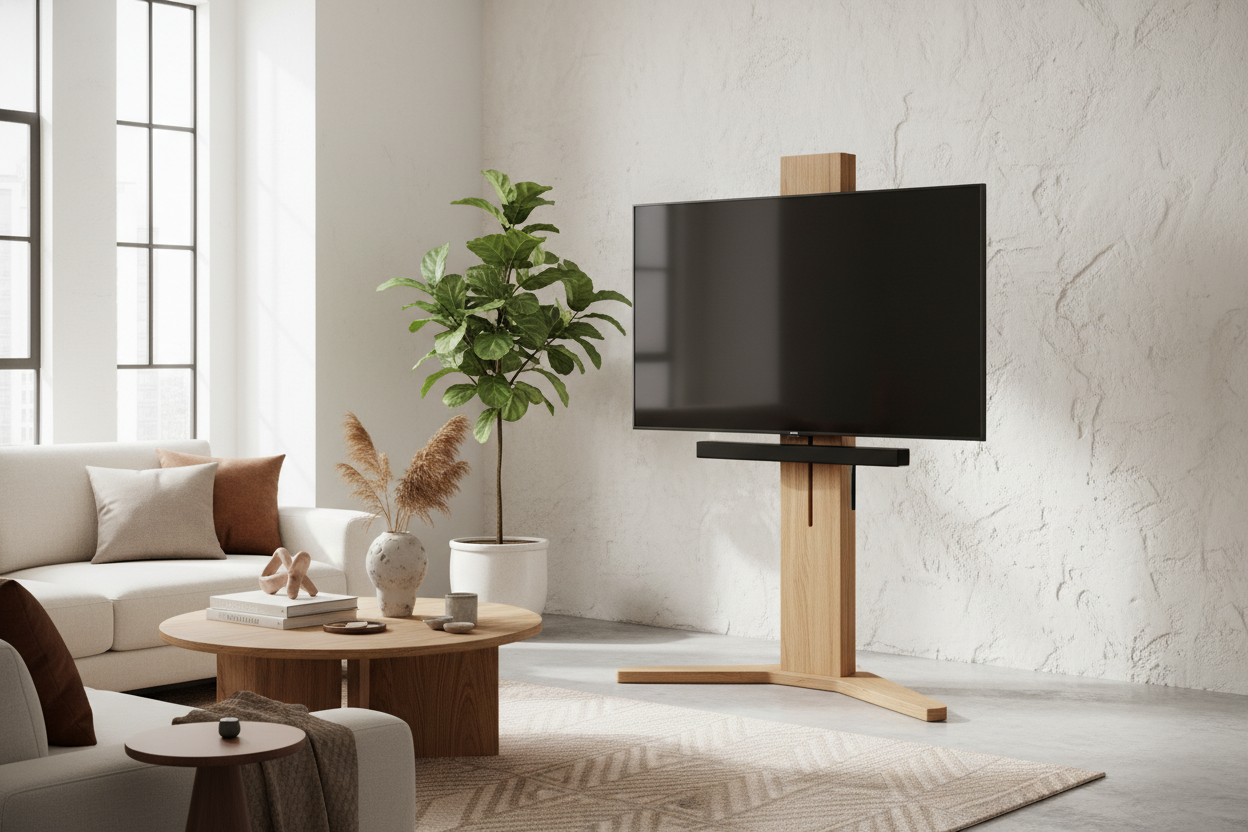
I stood there with a drill in one hand and a vacuum in the other, staring at a hole in my living room wall that was definitely not supposed to be there. My 1920s bungalow has 'character,' which is code for plaster walls that crumble into gray sugar the second you try to hang anything heavier than a calendar. I eventually gave up on the wall and bought a wood tv mount stand because I finally accepted that my walls simply weren't built for heavy-duty steel brackets.
- Plaster and lath are notoriously brittle and often fail under the weight of cantilevered TV mounts.
- A freestanding wooden stand provides the 'floating' aesthetic without structural risk.
- Minimalist easel stands offer a significantly smaller footprint than bulky media consoles.
- Cable management is the only real hurdle, but it is easily solved with a few velcro ties.
The Crumbling Plaster Incident That Broke Me
The dream was a sleek wooden wall mount for tv setup. I spent three hours measuring, leveling, and sweating, convinced I had found the studs. But when the toggle bolts hit the lath behind the plaster, everything went sideways. The wall literally started to crack and bulge. In these older homes, 'studs' are often just suggestions, and the plaster itself is too brittle to handle the tension of a 55-inch screen.
Traditional metal brackets are heavy enough on their own; once you add the TV, you're asking a lot from a wall that was built before the invention of the television. I realized I didn't want a wood tv wall mount badly enough to risk my security deposit or my sanity. I needed a solution that stood on its own two feet, literally. After cleaning up a pound of white dust, I started looking for a wall mount tv stand wood alternative that required zero drilling.
Enter the Easel: What Is a Freestanding Mount?
I ended up with what looks like a high-end artist’s easel. It’s a wood tv mount that supports the screen on a slim, tripod-style base. It’s essentially a wall mount tv stand wooden solution that mimics the height and angle of a wall installation without ever touching the drywall. The weight is distributed directly down to the floor, which is much better at handling loads than my 100-year-old lath.
Most of these stands use solid ash or walnut legs and a VESA-compatible steel plate. It feels sturdy and intentional, not like a temporary fix. It’s a massive upgrade from the 'TV on a dresser' look, and it feels much more sophisticated than a cheap plastic pedestal.
Does It Actually Save Space Compared to a Console?
Before this, I was looking at a massive 3-piece entertainment center. It would have covered half the wall and made my 12x14 living room feel like a closet. Even traditional tv stands take up a lot of floor space because they sit low and wide to prevent tipping.
The wood wall mount tv stand has a remarkably tiny footprint. I can actually see the baseboards and the floorboards behind the stand, which makes the whole room feel twice as large. It’s about visual 'air.' If you’re living in a small apartment or a historic house with weird layouts, being able to tuck the TV into a corner at an angle is a lifesaver that you just can't get with a flat wall mount.
The Cord Problem: How I Hid the Wires on an Open Frame
The biggest trade-off is the lack of storage. There is no wood wall mounted tv cabinet to hide your router, your gaming console, and that tangled mess of power strips. You have to be intentional about what you actually need connected to the screen.
I used black velcro ties to run my HDMI and power cables down the back of the rear wooden leg. When you're styling a black wood tv stand, the dark finish helps the cords blend in naturally. For my lighter oak stand, I tucked a small woven basket at the base to hold the power brick and a small streaming device. It looks like a decor choice rather than a tech necessity.
When to Actually Risk the Wall Installation
If you have modern drywall and 16-inch on-center studs, a wooden wall mount tv unit is still a great choice. It’s the ultimate clean look, and modern walls can handle it with ease. If I lived in a new build, installing a wood wall mounted tv unit would likely be my first move for a permanent media room.
But for those of us in rentals or 'charming' older homes, the wood tv wall stand is the smarter play. It’s a tv mount wood solution that moves with you when you leave and doesn't require a patch-and-paint job on your way out. It’s the first time my TV setup has felt like actual furniture rather than just a piece of hardware bolted to the room.
Is a tripod stand stable with pets?
Most easel-style stands come with a thin safety tether. If you have a 70-pound dog who likes to zoom through the living room, use the tether. It’s one tiny screw in the wall versus four massive lag bolts, and it provides total peace of mind.
Can I adjust the height of the screen?
Yes, most of these stands have multiple mounting positions on the back plate. I set mine so the middle of the screen is exactly at my eye level when I'm sitting on the sofa—no more neck strain from a 'TV over the fireplace' situation.
Will it hold a large 75-inch TV?
You have to check the weight rating, but many solid wood stands can handle up to 80 or 90 pounds. Most modern 75-inch LED screens are surprisingly light, so they usually work fine as long as you don't exceed the VESA pattern limits.


Leave a comment
This site is protected by hCaptcha and the hCaptcha Privacy Policy and Terms of Service apply.