










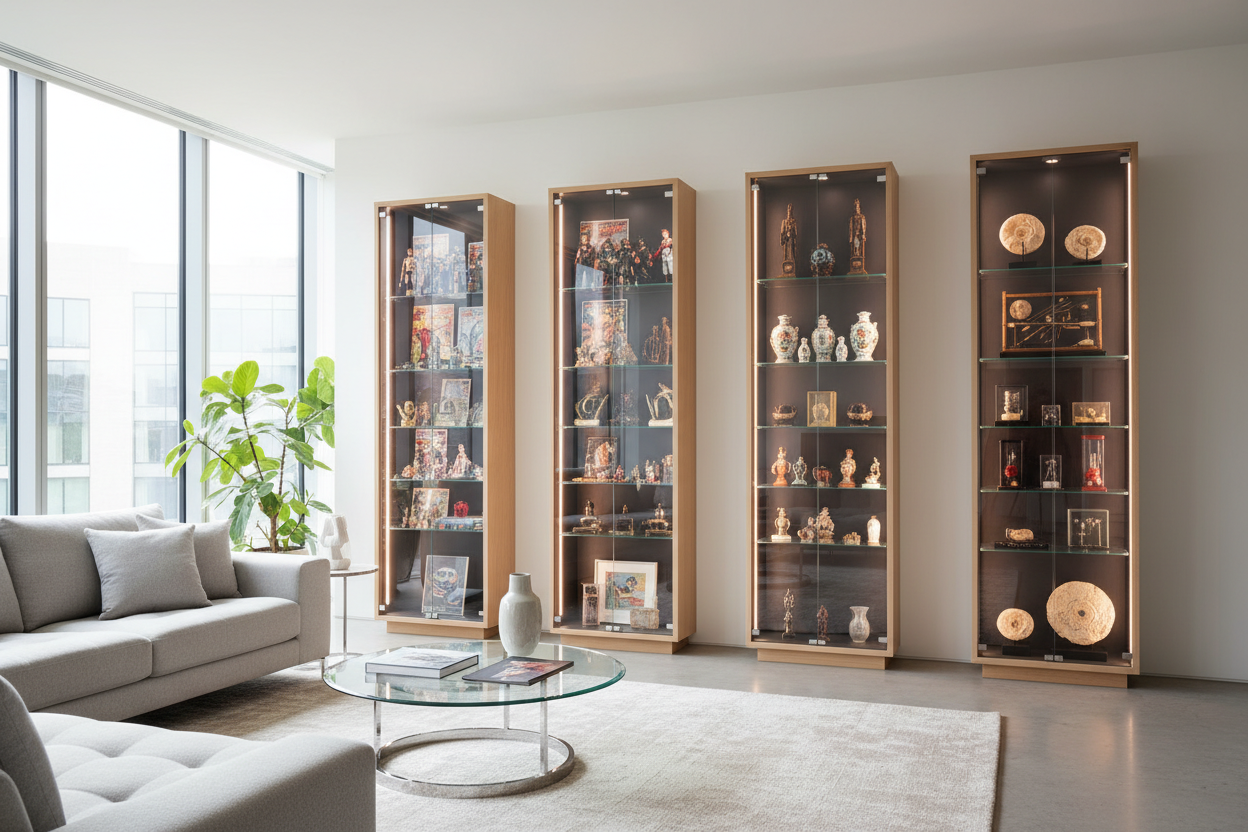
I spent three years staring at a $400 resin statue that looked like a gray blob because it was tucked into the corner of a standard laminate bookshelf. It was depressing. I had spent more on the figure than the shelf, yet the shelf was winning the battle for my attention by hiding every sculpted detail in a thick layer of shadow. I realized then that the best display cases aren't just about holding stuff; they are about curation.
Finding the right unit isn't about finding the most square footage for your money. If you just wanted storage, you would buy a plastic bin. You want a gallery. After three moves and a lot of shattered glass, I have learned that the difference between a collection and clutter usually comes down to how much light hits the bottom shelf.
Quick Takeaways
- Integrated lighting is the only way to see details on lower shelves without annoying room glare.
- Dust seals are mandatory unless you enjoy cleaning intricate pieces with a toothbrush every Sunday.
- Adjustable shelving prevents the awkward four-inch gap above shorter items that makes a case look unfinished.
- Negative space is your friend; if every inch is covered, nothing stands out.
Why I Finally Ditched My Standard Bookshelves
I used to think a shelf was just a shelf. I bought the cheapest white laminate units I could find because I figured the money was better spent on the things I was putting on them. I was wrong. My collection looked like a messy garage sale. The lack of depth and the way the top shelves blocked the ceiling light created these deep, cavernous shadows that swallowed every detail.
By swapping cluttered bookcases for display cases, I realized that the furniture itself is the frame. If the frame is bad, the art looks cheap. I had thousands of dollars worth of collectibles looking like ten-dollar toys. The moment I moved them into a dedicated case with glass sides, the ambient light alone made a massive difference. I finally stopped treating my home like a warehouse and started treating it like a space I actually wanted to live in.
The True Secret to the Best Display Cases
If you take nothing else away from this, remember: overhead room lighting is the enemy of a good display. Unless you live in a surgical suite, your ceiling lights are going to cast long, ugly shadows on anything below the top shelf. This is why integrated lighting is the single most important feature you can pay for. It is the difference between a dark hole in the corner of your room and a glowing focal point.
When you are shopping for best display cases for collectibles, look for vertical LED strips rather than just a single puck light at the top. Puck lights are great for the first six inches, but they leave the bottom half of your cabinet in total darkness. I personally prefer best display cabinets for collectibles that use recessed channels so you aren't staring directly at the LED diodes. If you are looking for a professional setup, glass door display cases with adjustable lighting allow you to dim the brightness depending on the time of day, which is a life-saver for late-night movie sessions where you don't want a lighthouse in the corner of your eye.
Adjustable Shelving Changes Everything for Oddly Sized Pieces
Fixed shelves are the enemy of growth. One year you are collecting standard six-inch figures, and the next you have a 24-inch statue that requires its own zip code. If your shelves are fixed, you end up with one shelf that is over-crammed and another that has a massive, wasteful gap of empty air. It looks amateur. The best display cases offer increments of at least every two inches for shelf placement.
I once bought a beautiful vintage cabinet that had fixed 12-inch heights. I ended up having to lay my tallest pieces on their sides like they were taking a nap. It was embarrassing. Now, I only buy units where the glass is tempered and the brackets are heavy-duty steel. If you are putting a 15-pound polystone statue on a glass shelf, you want to know those pins aren't going to shear off in the middle of the night.
Why the Best Display Cabinets for Collectibles Need Real Dust Seals
Let's talk about the chore no one mentions: dusting. If you buy a cheap cabinet with a half-inch gap around the door, you aren't buying a display case; you are buying a very expensive dust trap. I once spent four hours with a makeup brush cleaning the nooks and crannies of a single model ship because my 'sealed' cabinet wasn't actually sealed. It is infuriating.
Here is what furniture stores won't tell you: most 'display' furniture is just a modified bookshelf with a glass door slapped on the front. They don't include foam or rubber gaskets. Look for cabinets that have overlapping glass doors or magnetic seals. It sounds like a small detail until you realize it saves you from having to handle your delicate items every month. Handling is when things break. The less you touch them, the longer they last.
Stop Cramming: Embracing Negative Space
The biggest mistake I see—and one I made for years—is the 'sardine' method. If your items are touching each other, you have too many items or too little shelf. You need 'breathing room' around each piece to let the eye rest. This is what designers call negative space, and it is what makes a room feel high-end rather than chaotic.
When you start browsing bookcases and display cabinets, try to visualize your three favorite pieces on one shelf. If you can't see the back of the cabinet, it is too full. I actually started rotating my collection, keeping some pieces in storage and only displaying the best of the best. It made my living room feel like a museum instead of a storage unit. Quality over quantity, every single time.
FAQ
Is glass or acrylic better for display cases?
Glass is almost always better. It doesn't scratch as easily as acrylic and it won't yellow over time. Just make sure it is tempered glass for safety—if it breaks, it turns into pebbles instead of dangerous shards.
Do LED lights inside a case damage collectibles?
Modern LEDs produce very little heat and almost no UV radiation, so they are generally safe. However, I still wouldn't leave them on 24/7 if you have rare paper items or extremely old plastics that are prone to fading.
How do I hide the wires for the internal lighting?
The best cases have pre-drilled holes or channels in the corners. If yours doesn't, you can use adhesive cable clips that match the color of the frame to run the wires down the back corners where they are hidden by the frame's vertical supports.


Leave a comment
This site is protected by hCaptcha and the hCaptcha Privacy Policy and Terms of Service apply.