










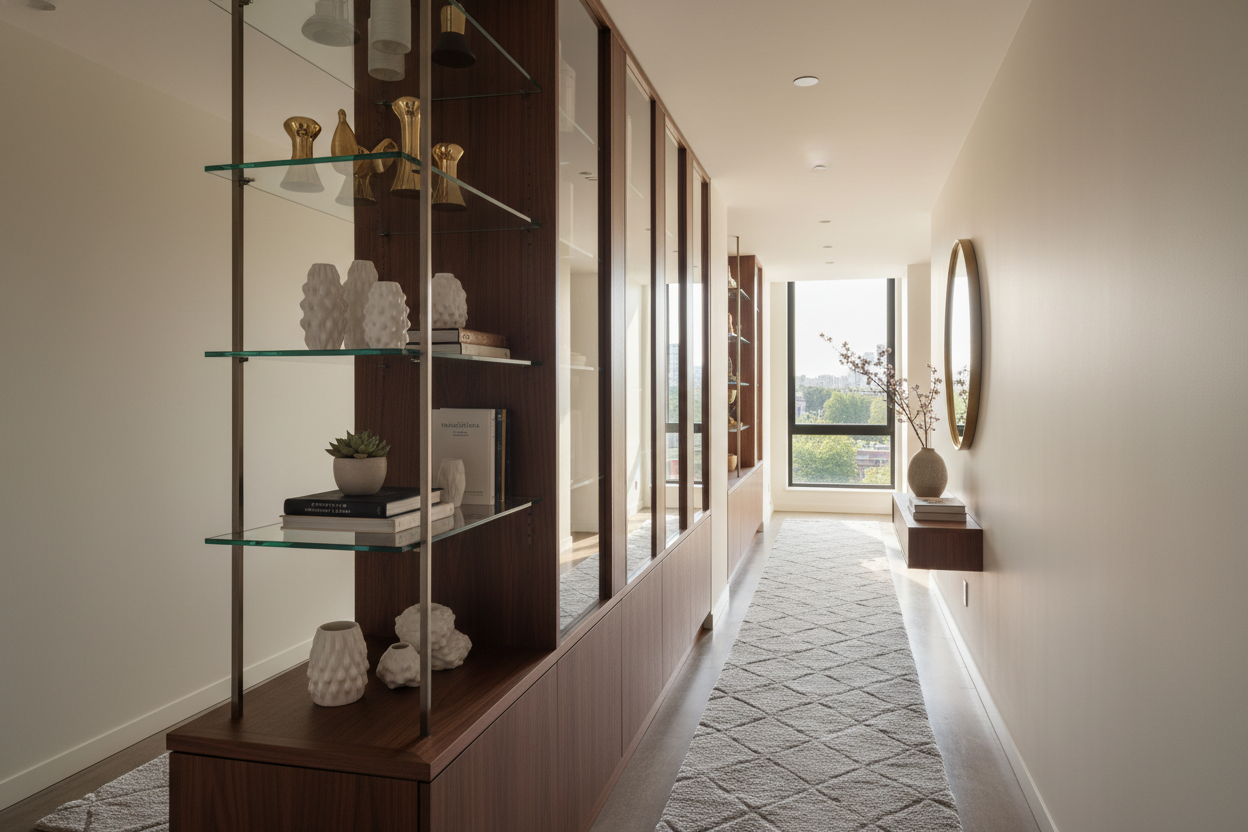
I spent three months staring at a 15-inch gap between my bedroom door and the bathroom wall. It was a classic 'dead zone'—too small for a standard credenza, too awkward for a floor lamp, and too depressing to leave empty. I tried a coat rack first, but it just became a mountain of hoodies that made the hallway feel like a locker room. Then I tried a skinny bookshelf, but it was so deep that I constantly hit my shoulder on the corner every time I went to brush my teeth.
The solution ended up being a narrow display case. It sounds counterintuitive to put a piece of furniture in a tight thoroughfare, but the glass-front design changed the entire geometry of the space. Instead of a solid block of wood stopping my eye, the glass let the wall color peek through, making the hallway feel intentional rather than cluttered.
- Glass doors prevent dust buildup on small collectibles.
- A shallow depth (under 14 inches) keeps the walkway clear for two people to pass.
- Verticality draws the eye up, making low ceilings feel higher.
- Integrated lighting turns a dark hallway into a soft light source at night.
The 'Dead Space' Dilemma (And Why Bookshelves Failed Me)
In older apartments, you’re often fighting against architectural quirks that make zero sense. My hallway had this weird recessed area that was exactly 16 inches wide. I initially thought a standard bookcase would work, but most 'slim' shelves are still too wide or, worse, too chunky. A thick wooden frame in a small gap feels heavy. It chokes the light and makes the area feel like a closet you forgot to close.
The problem with open shelving in a high-traffic area is the 'bump factor.' If you have a thin display case with open sides, you’re one snagged sweater away from knocking over a vase. I needed something enclosed. I wanted my weird collection of vintage matchboxes and travel ceramics to be visible, but I didn't want to be terrified of them every time I carried a laundry basket past them. A cabinet with a slim profile solved the 'clutter' look by giving the items a defined, protected border.
Why a Thin Display Case Actually Works Here
The secret is the optical illusion of transparency. When you use a white display case with glass doors, the frame visually recedes into the wall. If your walls are a light neutral, the cabinet looks like an architectural built-in rather than a piece of furniture I bought online and assembled on my living room floor. It’s about maintaining sightlines. Because you can see through the sides and front, your brain doesn't register the unit as an obstacle.
I’ve found that glass also bounces whatever natural light hits it. My hallway is notoriously dark, but the glass panes catch the reflection from the window at the far end of the living room. It’s a subtle shift, but it stopped the 'cave' feeling I had before. Plus, let's be honest: there is something incredibly satisfying about having a dedicated spot for the 'good' glassware that doesn't fit in the kitchen cabinets. It feels like a boutique hotel, not a cramped rental.
What I Keep Inside Mine (Without Looking Cluttered)
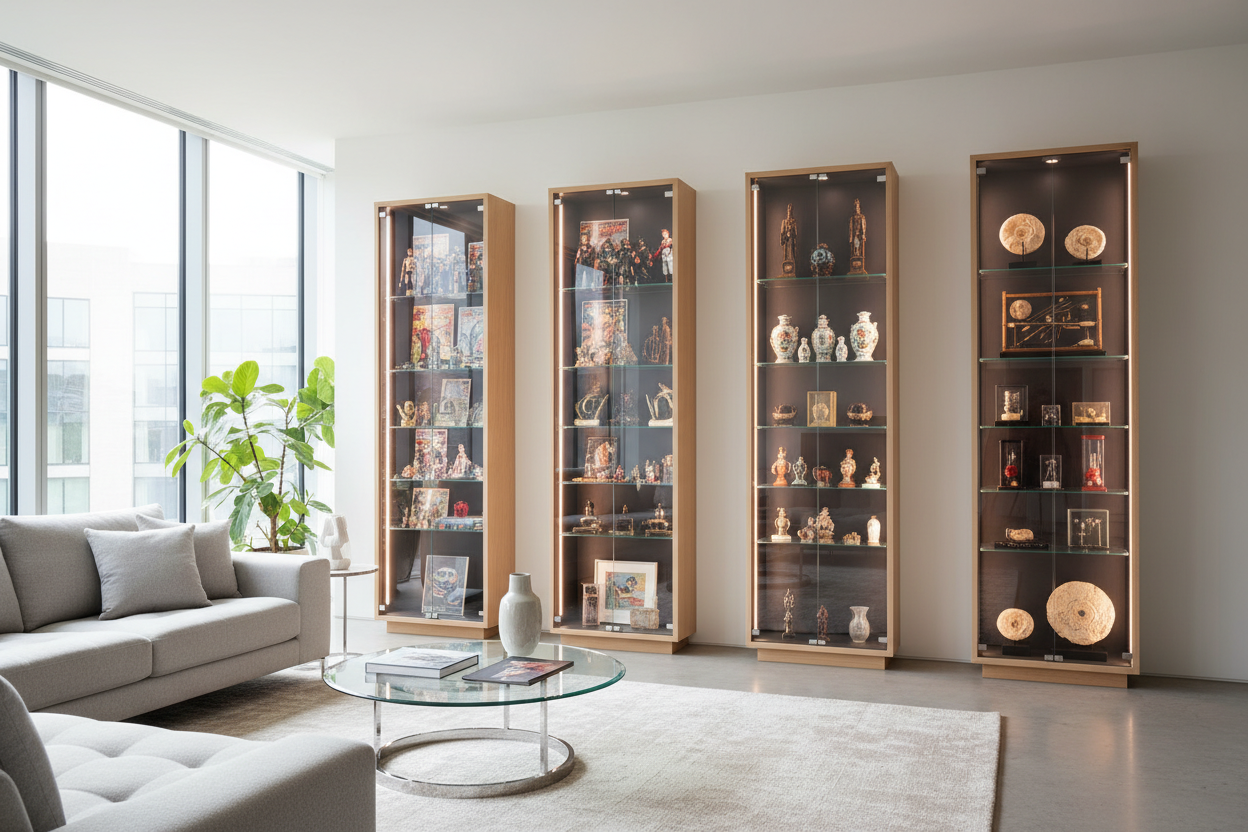
The biggest mistake people make with a slender footprint is overstuffing. If you pack a narrow unit tight, it looks like a junk drawer with a window. I follow the 'rule of three'—no more than three distinct groupings per shelf. I like to stack a couple of vintage art books horizontally to create a platform for a smaller object, like a brass figurine or a piece of driftwood. This creates different heights, which is crucial when you only have 12 inches of width to work with.
I also rotate my stuff. In the winter, I put my white ceramics in there to keep things bright; in the summer, I might swap in some green glass bottles. Because the space is so small, changing just two or three items makes the whole hallway feel different. One downside I discovered? You have to be meticulous about the glass. Fingerprints on a narrow case in a hallway are inevitable, so keep a microfiber cloth nearby. It’s a small price to pay for a 'custom' look.
The 3 Rules for Styling a Vertical Squeeze
First, you need light. A dark cabinet in a narrow space looks like a black hole. Choosing a display case with led light is the smartest move I made. It provides 'mood lighting' for the hallway so I don't have to turn on the harsh overheads when I’m getting a glass of water at 2 AM. It also highlights the textures of whatever you’re displaying, making cheap items look expensive.
Second, respect the negative space. On at least one shelf, leave 40% of the area empty. This gives the eye a place to rest and prevents the 'vertical squeeze' from feeling claustrophobic. Third, anchor the bottom. I put my heaviest, most solid objects on the lowest shelf—think thick coffee table books or a heavy stone bowl. This visually grounds the piece so it doesn't look top-heavy or like it’s about to tip over in a breeze.
What if Your Gap is in a Corner Instead?
Sometimes the 'dead space' isn't a flat wall but a corner that serves no purpose. If your hallway opens into a room with a harsh 90-degree angle, a flat-back cabinet might look awkward. In that case, a corner display case is usually the better play. It softens the room and uses the depth of the corner which is otherwise totally wasted.
I’ve seen people try to shove square cabinets into corners, and it always leaves a 'dust triangle' behind the unit that’s impossible to clean. If you're debating between a flat wall unit or something for the corner, check out this breakdown on is a corner cabinet display case worth it. For my hallway, the flat-back narrow case was the winner because it kept the path straight and narrow, just like I needed.
FAQ
Is a narrow display case stable?
Most are quite stable, but because they are tall and thin, you MUST use the wall-anchor kit. I don't care if you don't have kids or pets—one accidental bump while vacuuming can tip a slender unit. Anchor it to a stud, and it won't budge.
How deep should a hallway cabinet be?
Try to stay under 15 inches. Most standard hallways are 36 inches wide; if your cabinet is 12 inches deep, you still have 24 inches of walking space, which is the minimum for a comfortable flow without feeling like you're shuffling sideways.
Can I put books in a glass display case?
Yes, but don't spine-out every single one. Mix it up. Turn some books so the pages face out for a neutral texture, or stack them horizontally. It breaks up the 'library' look and makes it feel more like a curated gallery.


Leave a comment
This site is protected by hCaptcha and the hCaptcha Privacy Policy and Terms of Service apply.