










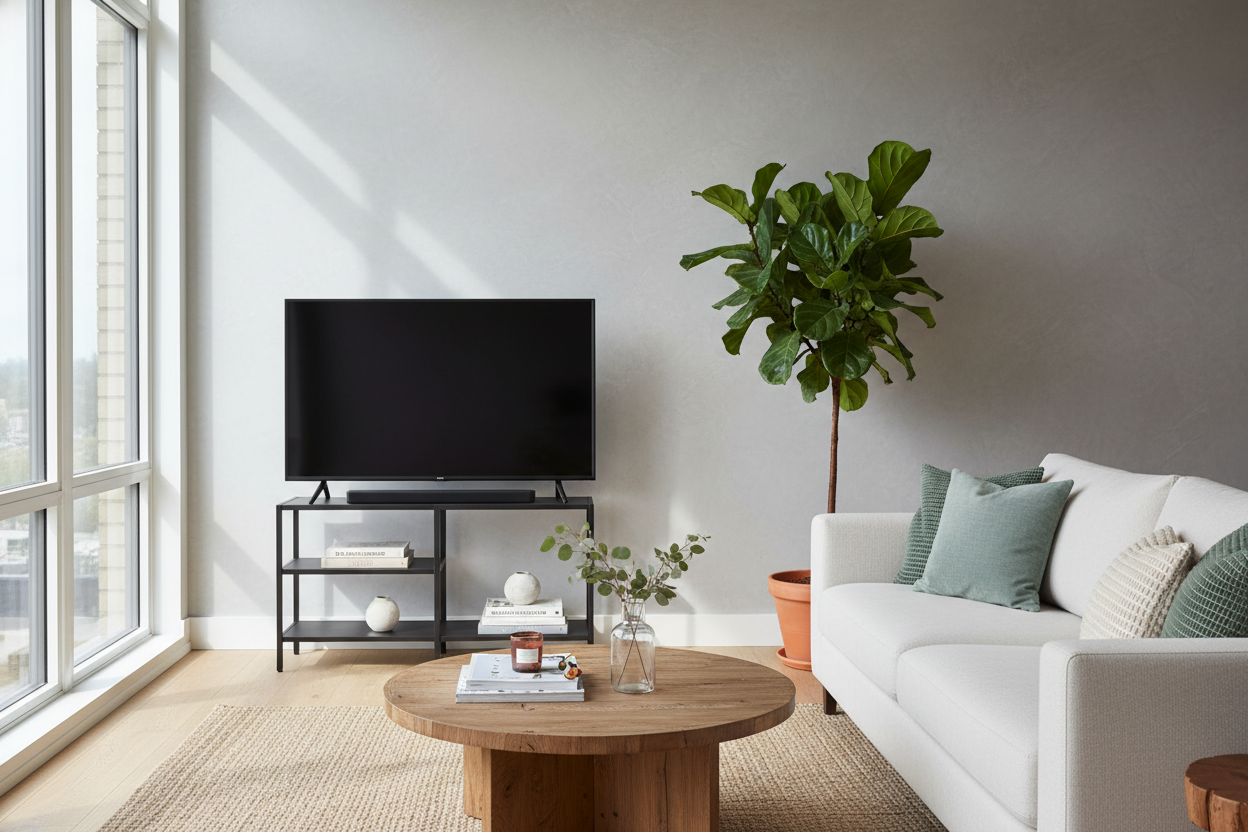
I have spent too many hours of my life staring at a 15-foot wall, clutching a tape measure, trying to find the exact millimeter of center. We’ve been conditioned to think that symmetry equals 'done,' but when you are working with a small television stand, centering is usually the worst thing you can do. It’s like putting a single postage stamp in the middle of a giant envelope—it just looks lost.
Quick Takeaways
- Centering small furniture on large walls creates a 'floating' effect that lacks visual anchor.
- Asymmetry creates dynamic tension and makes a room feel professionally designed.
- Use the Rule of Thirds to position your unit one-third of the way across the wall.
- Balance the resulting 'empty' space with tall items like plants or floor lamps.
- Small upgrades like hardware and cord management can make budget pieces look custom.
The Floating Island Trap We All Fall Into
The impulse to center furniture is strong. It feels safe. But when you place a tiny piece of furniture dead-center on a massive, blank wall, you create what I call the 'floating island' effect. The TV looks like it’s drifting in space, and the room feels unanchored. Instead of the eye being drawn to a cozy media nook, it gets distracted by the vast oceans of empty drywall on either side.
I’ve seen people try to fix this by flanking the stand with two identical chairs or two identical plants. Don't do it. That just doubles down on the rigid symmetry and makes your living room look like a waiting room at a dentist’s office. You want your home to feel lived-in and layered, not staged for a catalog that hasn't been updated since 1994.
Why Asymmetry is Your Living Room's Best Friend
Shifting your furniture off-center is a power move. When you move compact tv stands toward the left or right third of a wall, you immediately create visual interest. It tells the eye that the placement was a choice, not an accident. This isn't just about aesthetics, either; it’s about how you move through your home.
By sliding the stand toward one side, you can often maximize flow in a small layout. It opens up a wider, unobstructed path for walking, which is a godsend in tight apartments where every square inch of floor space is a premium. Suddenly, your 'small' room feels twice as wide because you aren't trying to squeeze past a centered obstacle.
The 'Rule of Thirds' for Your Small TV Credenza
If you aren't sure where to stop sliding, steal a trick from professional photographers: the Rule of Thirds. Mentally divide your wall into three equal vertical sections. Instead of aiming for the middle, align your small tv credenza within one of those outer thirds. This creates a 'heavy' side and a 'light' side, which is much more pleasing to the human brain than perfect balance.
This placement also allows the TV to become part of a larger composition. It stops being the 'altar' of the room and starts being a component of a gallery wall or a curated corner. I’ve found that a 48-inch unit looks significantly more expensive when it’s hugging a corner than when it’s struggling to command the center of a 120-inch wall.
How to Fill the Blank Space (Without Adding Clutter)
Once you’ve pushed your stand to the side, you’re left with a big, glorious gap on the other side. This is where the magic happens. You need something with height to balance the low profile of the media unit. A tall olive tree or a chunky arched floor lamp is the classic choice here. It fills the vertical space without adding 'visual noise.'
If you need that space to be functional, consider something that doesn't scream 'utility.' For those of us with pets, a stylish dog crate with barn doors is a brilliant filler. It has the visual weight of a side table but serves a real purpose. By placing it in that newly created negative space, you’ve turned a boring wall into a multi-functional zone that looks intentional and high-end.
A Quick Fix to Make a Cheap Small TV Stand Look High-End
Let’s be honest: a cheap small tv stand is often a necessity when you’re starting out or furnishing a guest room. But 'cheap' doesn't have to mean 'basic.' Once you have the positioning right, spend $20 on new hardware. Swapping out those generic silver pulls for matte black or solid brass handles makes a world of difference. It’s the easiest DIY you’ll ever do.
Finally, tackle the cords. Nothing kills a design faster than a 'spaghetti monster' of black cables hanging under a small television stand. Use a simple cord raceway painted the same color as your wall. When the wires disappear and the stand is positioned with a bit of swagger, that $60 particle-board unit suddenly looks like a designer find.
Personal Experience: The 40-Inch Failure
In my first apartment, I bought a 40-inch IKEA unit for a massive exposed brick wall. I centered it. I hated it for six months. I kept buying more 'stuff' to put on the stand to make it look bigger, which just made it look messy. The day I pushed it 3 feet to the left and put a massive leaning mirror on the right was the day I finally stopped hating my living room. I realized the furniture wasn't the problem—my obsession with the center point was.
FAQ
Can I still center the stand if I have a very large TV?
Even with a big TV, if the stand is small, centering it on a huge wall makes the whole setup look top-heavy. Offset it slightly and use a tall plant on the other side to balance the weight.
What if my sofa is centered on the wall?
Your sofa and TV don't have to be perfectly mirrored. You can angle your seating or use an area rug to define the 'viewing zone' while keeping the TV stand offset on the wall.
Is a small TV credenza enough storage?
Usually, no. That’s why the offset method is great—it leaves room for a separate bookshelf or a storage cabinet on the same wall without things feeling cramped.

Leave a comment
This site is protected by hCaptcha and the hCaptcha Privacy Policy and Terms of Service apply.