










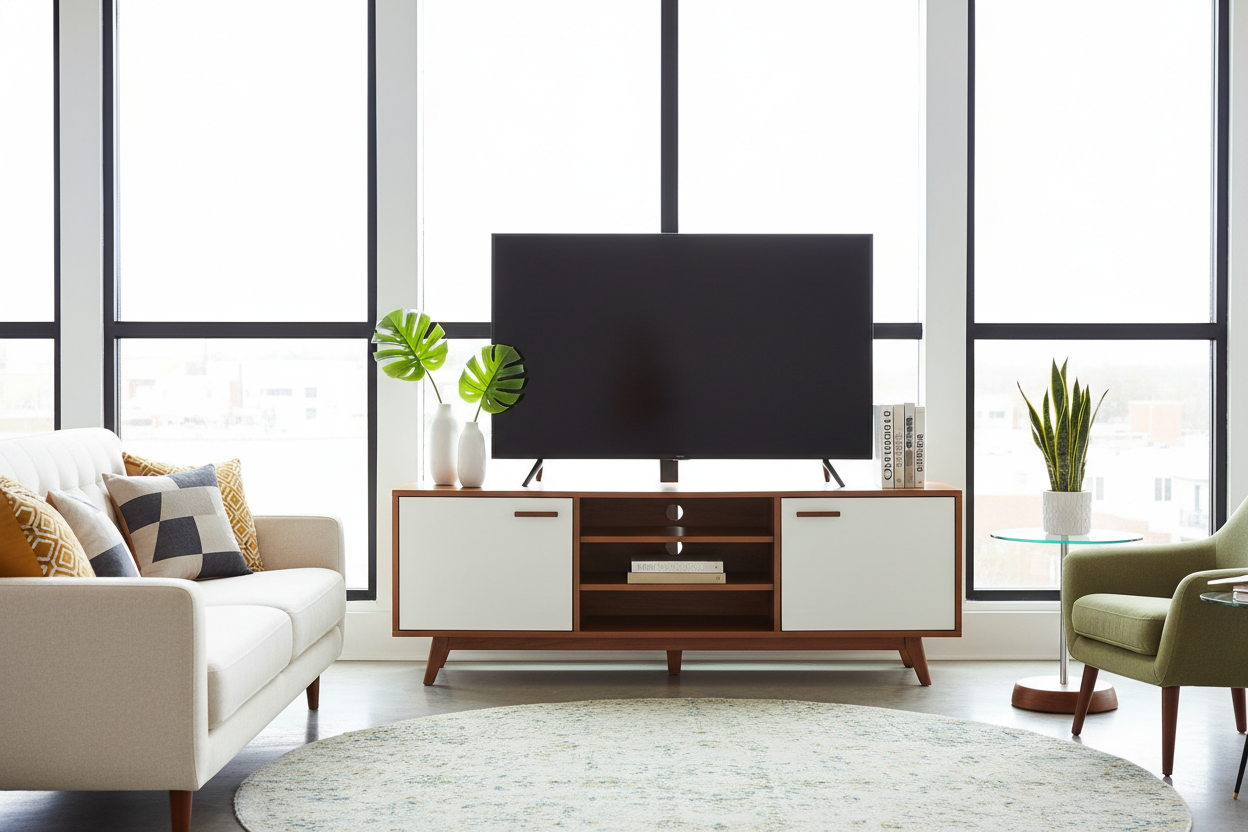
I’ve spent more hours than I care to admit staring at 47 open browser tabs of media consoles at 1 AM. It usually starts with a simple goal: find something that doesn’t look like it belongs in a college dorm but also doesn’t cost as much as a used Honda. But then the “Great Decor War” begins. My partner wants that clinical, ultra-modern white look that feels like a Scandinavian art gallery, while I’m firmly in the camp of warm, mid-century woods that actually feel like a home.
We spent weeks deadlocked until I realized we didn’t have to pick a side. A walnut white tv stand is the ultimate peace treaty. It’s the furniture equivalent of a compromise that actually leaves both people happy, rather than both people mildly annoyed. It bridges the gap between “too cold” and “too rustic” in a way that feels intentional, not accidental.
- The Best of Both Worlds: You get the warmth of natural wood grain without the heavy, dated feel of an all-wood behemoth.
- Visual Balance: White surfaces reflect light and keep the room feeling airy, while walnut anchors the space so it doesn’t feel like it’s floating.
- Hides the Tech: A white and walnut media console helps that giant black rectangle of a TV blend in rather than dominating the entire wall.
- Versatility: Walnut plays surprisingly well with almost any floor tone, from light oak to dark espresso.
The Great Living Room Debate: Warm Wood vs. Stark White
If you’re currently arguing over whether your living room should look like a cozy 1960s library or a sleek 2024 tech startup, you aren’t alone. It’s the most common clash I see. One person is terrified that white furniture will look sterile and show every speck of dust, while the other thinks all-wood furniture looks like their grandmother’s dusty attic. When you browse different TV stands, the binary choice can feel suffocating.
The beauty of a walnut and white tv stand is that it breaks that binary. It’s a stylistic bridge. The walnut brings in those organic, swirling patterns and deep honey tones that make a room feel lived-in and grounded. The white elements—usually the cabinet doors or the top surface—provide a clean, crisp break that screams “modern.” It’s a way to have your mid-century cake and eat your minimalist icing, too.
Enter the Peacemaker: Why the Two-Tone Look Actually Works
Design-wise, a solid walnut piece can sometimes feel very 'heavy' in a small apartment. It sucks up the light. Conversely, an all-white unit can disappear into white walls, making your TV look like a lonely black void floating in space. By mixing the two, you create a frame. The walnut base or frame provides a sturdy, architectural feel, while the white panels keep the piece from feeling like a giant block of lumber.
I’ve found that this combination is particularly effective if you have a lot of tech. Most of our gadgets are black or silver. Against a dark wood, they look cluttered. Against white, they look harsh. But a walnut and white tv unit provides enough visual interest that the cables and boxes seem to matter less. It’s about balance—the white keeps the 'modern' promise, while the wood keeps the 'home' promise.
Beware the 'Dorm Room' Trap: How to Spot Bad Two-Tone
Here’s where I have to get honest: not all two-tone furniture is created equal. I once bought a 'white walnut tv stand' from a site that shall not be named, and it was a disaster. The walnut was essentially a sticker that started peeling at the corners within three months, and the white finish was so glossy it looked like a cheap kitchen appliance. It felt like something I’d find in a freshman dorm, not a grown-up living room.
When shopping, look at the materials. You want real walnut veneer or solid wood paired with a matte or satin white finish. Avoid high-gloss laminates that reflect your TV screen like a mirror. There's a specific reason why some modern white finishes look cheap, and it usually comes down to the quality of the paint and the lack of texture. If it’s too shiny, it’s going to look like plastic.
How to Style a White and Walnut Media Console (Without It Looking Disjointed)
Once you get the piece home, the goal is to make it look like it belongs there, not like it just fell off a delivery truck. The trick is to repeat those tones elsewhere in the room. If your console has walnut legs, try adding a walnut picture frame on the opposite wall or a small side table in the same wood family. You don't need a matching set—in fact, please don't buy a matching set—but you need 'echoes' of the color.
For the white parts, use them as a backdrop for texture. A matte white door is the perfect place to show off a ceramic vase or a brass tray. I’m a huge fan of using brass or antique gold hardware on these pieces; it warms up the white and complements the walnut beautifully. If you’re nervous about the contrast, look at the rules for styling a black and walnut piece. The principles are similar: use neutrals, add greenery, and don't over-clutter the top surface.
Can You Mix a White Walnut TV Stand With Your Existing Floors?
The number one question I get is: 'Will walnut clash with my oak floors?' My answer is almost always a resounding no. Walnut is the 'universal donor' of wood tones. It has enough depth to work with dark floors and enough warmth to contrast beautifully with light ones. If you’re worried, the white elements in the stand actually act as a buffer, breaking up the wood-on-wood look.
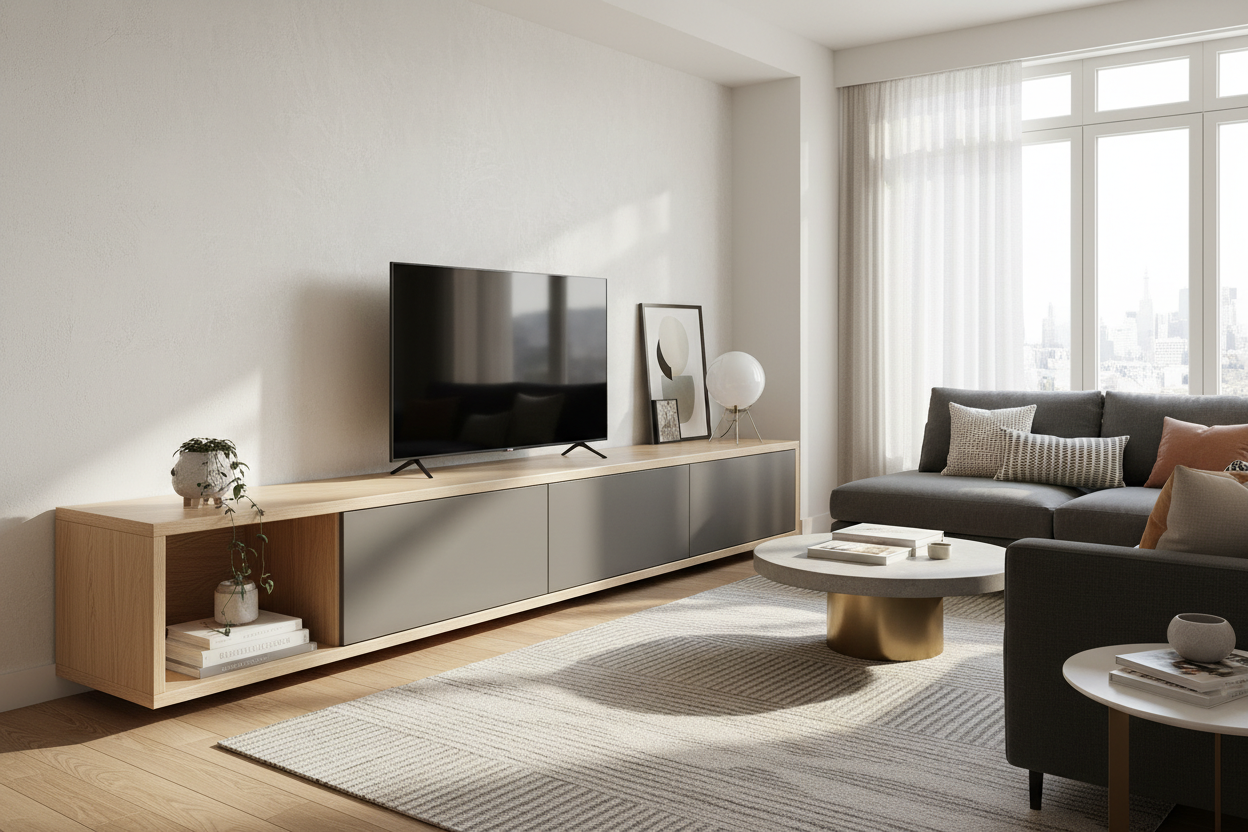
If the wood tones still feel a bit 'off' to you, the solution is a rug. A textured, neutral rug (think jute or a light gray wool) creates a visual island for the TV stand to sit on. This prevents the legs of the stand from directly touching the floor, which eliminates any clashing grain patterns. I’ve seen a modern minimalist TV stand with hidden storage look incredible on top of a light oak floor simply because the owner used a cream rug to separate the two. It works every time.
The Final Verdict on the Walnut and White TV Unit
Stop trying to find the 'perfect' single-material piece that satisfies everyone. It doesn't exist. Instead, embrace the contrast. A walnut and white tv unit isn't just a compromise; it’s a design choice that adds layers and sophistication to your living room. It says you know how to balance trends with tradition. It’s sturdy, it’s bright, and best of all, it might finally end the 1 AM furniture shopping arguments.
FAQ
Does walnut wood darken over time?
Actually, walnut is one of the few woods that tends to lighten slightly over time, especially if it’s in direct sunlight. It moves from a deep chocolate to a more honeyed brown. Keep it out of harsh UV rays if you want to maintain that deep, dark contrast against the white panels.
How do I clean the white surfaces without staining them?
Skip the harsh chemicals. A damp microfiber cloth is usually all you need for matte white finishes. If there’s a stubborn smudge, a tiny bit of mild dish soap does the trick. Avoid using 'magic' erasers on wood veneers, as they are abrasive and will ruin the finish over time.
What size TV stand should I get?
The golden rule is that your stand should be at least 10 to 12 inches wider than your TV. This prevents the 'top-heavy' look and gives you space for a lamp or a small plant to balance out the screen.

Leave a comment
This site is protected by hCaptcha and the hCaptcha Privacy Policy and Terms of Service apply.