










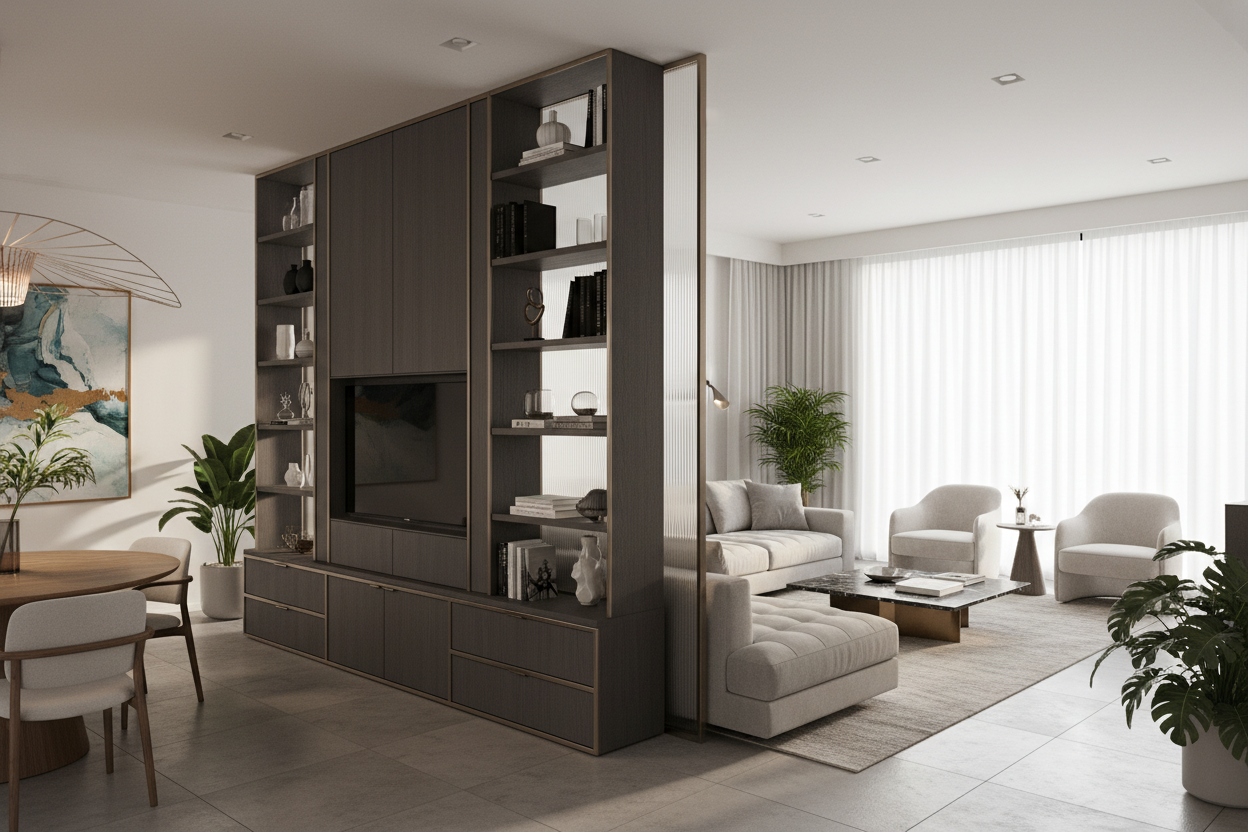
I remember standing in my first 'grown-up' loft, staring at a 20-foot stretch of open floor that felt less like a living room and more like a high school gymnasium. My instinct, honed by years of living in cramped studios, was to shove my sofa and every bookshelf I owned against the drywall. I thought I was maximizing space, but I was actually just creating a weird, empty dance floor in the middle of the room that served no purpose. It wasn't until I discovered wall units modern style—and specifically, how to pull them away from the perimeter—that the space finally started to make sense.
- Floating a wall unit creates distinct 'zones' in an open-concept floor plan without the cost of a renovation.
- Always check the back of the unit; raw particle board will ruin the look if it's visible.
- Mix solid storage with open shelving to keep the light flowing through the room.
- High-end materials like powder-coated steel and solid walnut are worth the extra spend for stability.
The 'Push Everything to the Walls' Mistake
We have this weird psychological reflex to treat the center of a room like lava. We line the perimeter with furniture, thinking it makes the room feel 'big.' In reality, it just makes the space feel unfocused and hollow. If you have an open-concept layout, your furniture needs to do the heavy lifting that walls used to do. When you stick to traditional wall mounted entertainment units, you're locked into that perimeter-only mindset. While those are great for small bedrooms, a large living area needs something that can stand on its own feet.
Floating a piece of furniture feels counterintuitive. You worry about blocking the 'flow,' but a well-placed modern wall system actually directs traffic. It tells your guests, 'This is where we eat, and that is where we binge-watch Netflix.' Without that physical boundary, you're just living in one giant, chaotic rectangle.
Why You Need a Modern Wall System to Anchor the Space
A freestanding wall unit is basically a faux wall that you can actually use. I'm talking about those substantial, 72-inch-plus structures that offer both storage and a visual anchor. By placing a unit perpendicular to a wall, you create a foyer where there wasn't one, or you separate a home office from the dining table. It’s a massive trend right now because we’re all realizing that modern wall units and entertainment centers are no longer just for holding a 50-inch plasma; they are architectural tools.
The trick is choosing a unit with a footprint that feels intentional. You want something with enough weight—think solid wood uprights or heavy-gauge metal frames—so it doesn't look like it's about to tip over if someone sneezes. It needs to feel like a permanent part of the room’s skeleton, even if it’s technically just a piece of furniture.
The Golden Rule: Look for Finished Backs
Here is where most people mess up: they buy a unit designed to sit against a wall and then they're shocked when the back is just a sheet of brown cardboard held on by tiny staples. If you’re floating a luxury wall unit, the back has to be just as pretty as the front. If you can't find a tall unit with a finished back that fits your budget, a long, low-profile mid century modern TV stand can act as a subtle room divider. It won't give you the height, but it will provide that necessary 'stop' for the eye.
Designer Wall Units vs. Basic Bookshelves: What's the Difference?
I’ve assembled enough $80 flat-pack bookshelves to know that they have the structural integrity of a wet noodle. If you’re using a unit as a room divider, you cannot go cheap. A basic bookshelf is meant to be anchored to a stud; if you put it in the middle of a room, it will wobble every time you walk past it. A true designer wall unit is engineered for balance. We’re talking about mitered joints, hidden hardware, and varied cubby sizes that distribute weight evenly.
Look for mixed materials. A unit that combines textured wood veneers with industrial metal supports adds a layer of sophistication that a plain white laminate shelf just can't touch. You want something that looks like it belongs in a gallery, not a dorm room. The goal is to make the furniture feel like an intentional design choice, not a temporary storage solution.
How to Style a Luxury Wall Unit Without Blocking the Sun
The biggest fear with large wall units is that they’ll turn a bright apartment into a dark cave. To avoid this, I use the 60/40 rule: 60% of the shelves should have 'stuff'—books, ceramics, maybe a small plant—and 40% should be negative space. This allows light to filter through the unit, maintaining that airy feel while still providing a sense of enclosure.
Place your heavier items, like large art books or storage bins, on the bottom third of the unit. This lowers the center of gravity and makes the piece feel grounded. As you move up to eye level, switch to glass vases or sculptural objects that let the light pass through. It’s about creating a silhouette, not a solid barrier.
Personal Experience: My 'Wall of Shame'
I once tried to use a cheap, open-back shelf as a divider between my bed and my 'living area' in a studio. I didn't check the stability, and I didn't consider the 'back' view. I ended up looking at the messy side of my book collection and the dusty power strips for six months. I eventually upgraded to a solid walnut unit with finished shelving on both sides, and it changed the entire energy of the flat. It felt like I’d gained an extra room for the price of one high-quality piece of furniture. My only regret was not doing it sooner—and trying to move that 200-pound walnut unit by myself. Get a friend to help you with the assembly; your lower back will thank you.
FAQ
Do I need to anchor a floating wall unit to the floor?
Most high-quality freestanding units are weighted to be stable, but if you have kids or pets, look for units that can be subtly tethered to the ceiling or have wide, heavy bases. Never float a unit that feels 'top-heavy.'
How tall should a room-dividing wall unit be?
If you want a true room feel, go for 6 feet or higher. If you just want to define a space without losing the open vibe, 3 to 4 feet (counter height) is usually the sweet spot.
Can I use a wall unit in a small apartment?
Yes, but stick to 'leggy' designs. Units that sit directly on the floor can feel bulky in small spaces, while units on thin metal legs keep the floor visible, which makes the room feel larger.


Leave a comment
This site is protected by hCaptcha and the hCaptcha Privacy Policy and Terms of Service apply.