










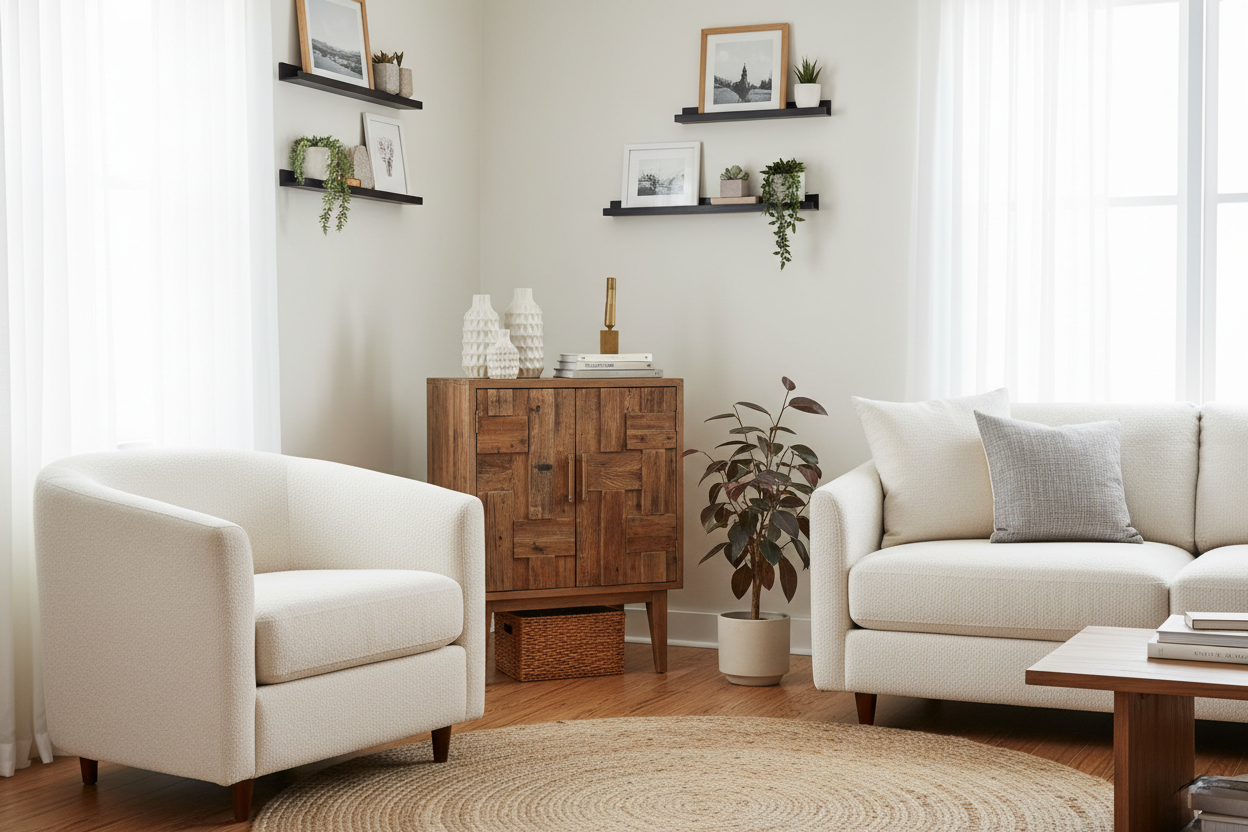
I have a graveyard of Fiddle Leaf Figs that would make a professional botanist weep. Every time I see a 'dead corner' in my living room, my instinct is to shove a $200 tree there and hope for the best. It never works. The corner is usually too dark, the plant gets spindly, and I end up with a brown skeleton in a ceramic pot. I finally realized that what that 32-inch gap actually needed wasn't a living organism, but a wood accent cabinet.
It is the ultimate design cheat code for spots that feel unfinished. Unlike a plant, it doesn't need sunlight or my failing memory to look good. It adds weight, texture, and—most importantly—a place to hide the clutter that usually ends up on my dining table.
- Wood adds organic warmth without the maintenance of a houseplant.
- Closed storage hides 'ugly' essentials like router cables or board games.
- Small footprints (12-15 inches deep) fit where bulkier furniture fails.
- Unique textures like fluted wood or reclaimed grain add instant character.
I Used to Think 'Dead Space' Meant 'Buy a Fiddle Leaf Fig'
We’ve all been there. You finish the living room, step back, and realize there is a weird, three-foot void between the window and the sofa. It feels lonely. Your first thought is a plant, but unless you have floor-to-ceiling southern exposure, that plant is going to look sad within six months. I’ve spent more money on 'low light' trees that died than I care to admit.
The shift happened when I stopped trying to make nature do the work of architecture. A furniture piece provides a vertical line that anchors the room. It doesn't just fill space; it defines it. When I swapped my dying fig for a textured timber piece, the whole room suddenly felt intentional rather than just 'mostly finished.'
Why Closed Timber Storage Actually Solves the Problem
There is something about the density of wood that calms a room down. When you use unique accent cabinets, you are bringing in grain patterns and craftsmanship that a fake olive tree just can't mimic. It creates a focal point that feels permanent. I’m partial to kiln-dried mango wood or solid oak because the weight makes the piece feel like an heirloom, not a temporary fix.
If you are working with low ceilings, height is your best friend. Choosing a taller contemporary wooden chest draws the eye upward, tricking the brain into thinking the room has more volume than it does. It’s a structural hack that also happens to be a great place to hide your collection of half-used candles and charging bricks.
How to Nail the Scale Without Crowding the Room
The biggest mistake I see (and I’ve made it) is buying a cabinet that is too deep. If the piece sticks out past the door frame or encroaches on the walkway by even an inch, it will feel like an obstacle, not an asset. You want at least 30 inches of clearance in front of the doors to actually open them without hitting the coffee table.
For those tight transition areas between the kitchen and the living room, I usually recommend finding a small wood accent cabinet with a depth of 12 to 14 inches. This 'slim-profile' approach gives you the storage and the surface area for styling without making the room feel like an obstacle course. I once tried to squeeze a 20-inch deep credenza into a hallway, and I had bruises on my hips for a month. Stick to the slim stuff for corners.
To Display or Hide? (The Glass Door Dilemma)
This is where you have to be honest about your habits. Are you a 'curator' or a 'shover'? If you have a collection of vintage ceramics or leather-bound books, you might want to upgrade to a glass door cabinet. Glass fronts are brilliant for dark corners because they reflect light, making the corner feel less like a black hole.
However, if that cabinet is going to hold your messy stack of mail and the kids' Nintendo Switch dock, go with solid doors. If you want a bit of drama, a black cabinet with glass doors provides a moody contrast that looks incredible against white or light gray walls. It creates a 'jewel box' effect that makes even cheap wine glasses look like high art.
Three Ways I'm Styling My Corner Cabinet Right Now
Once the cabinet is in place, don't just leave the top bare. That’s how it ends up as a junk mail magnet. I follow a simple 'Rule of Three' for styling. First, I lean a piece of art against the wall—don't even bother with a nail. It feels more casual and high-end.
Second, I add a small ambient lamp. This is the secret to fixing a dark corner. A warm 2700K bulb in a small shaded lamp does more for a room's vibe than any overhead light ever could. A solid wood modern sideboard is the perfect height for this. Finally, I throw down a small tray for keys or a single stack of books. It’s functional, it’s beautiful, and best of all, I don't have to water it.
FAQ
Is solid wood always better than MDF?
For the frame and legs, yes. You want the structural parts to be solid wood so they don't wobble. However, high-quality veneers over MDF are actually better for door panels because they don't warp or crack when the humidity changes in your house.
How do I stop a tall cabinet from tipping?
Always use the anti-tip kit. I don't care if you don't have kids. One heavy drawer pulled out too far can bring the whole thing down. It takes five minutes to drill into a stud, and it's worth the peace of mind.
What is the best wood tone for a small room?
Lighter woods like oak, ash, or light mango wood keep the space feeling airy. Dark walnut or black finishes are beautiful but they 'eat' light, so only use them if you have a lamp nearby or plenty of natural sunlight.


Leave a comment
This site is protected by hCaptcha and the hCaptcha Privacy Policy and Terms of Service apply.