










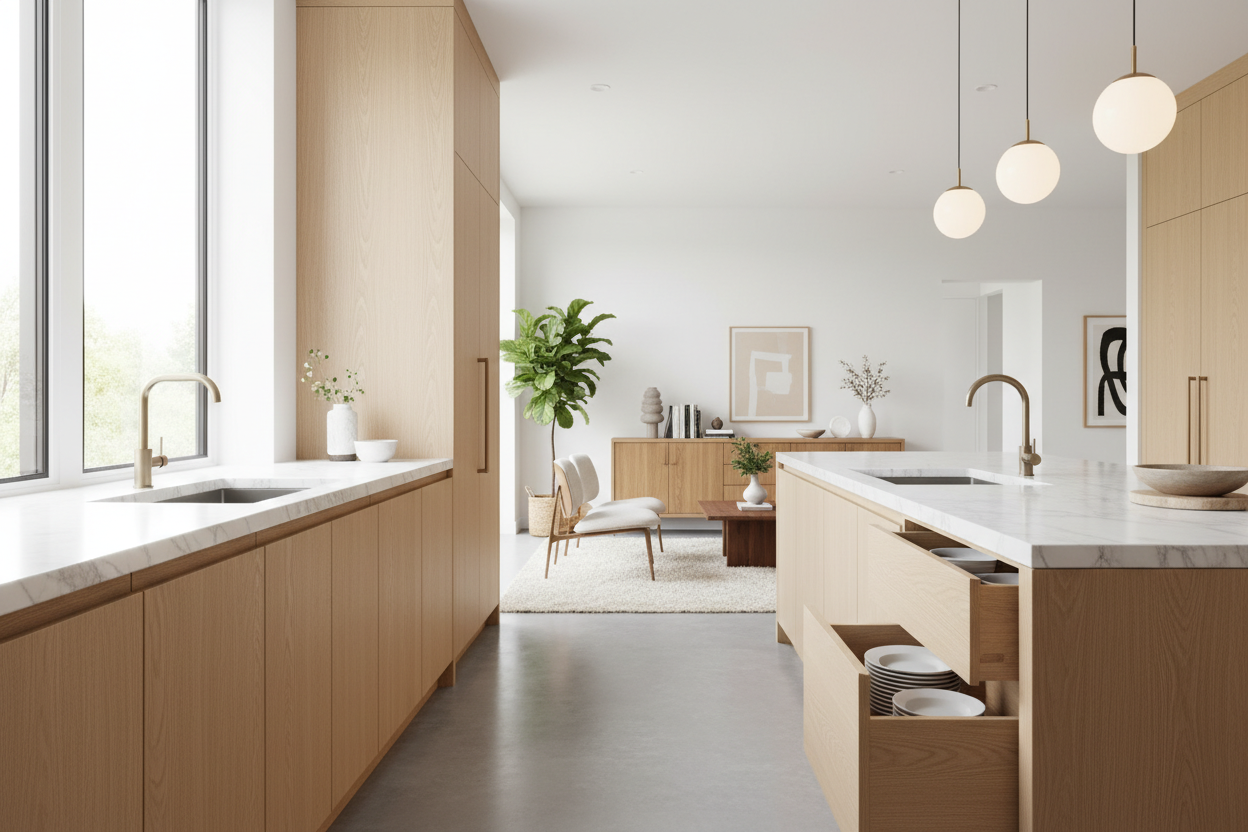
I was standing in a dusty showroom in industrial Brooklyn, staring at fifteen different shades of 'White Dove' and feeling like a total fraud. I had spent six months planning a full-gut kitchen renovation, yet I still couldn't tell why one cabinet box cost $800 and another cost $2,400. They both looked like white rectangles to me. It wasn't until I started poking around the back of the displays—literally sticking my head inside the boxes—that I realized finding the best custom cabinets has almost nothing to do with the door style and everything to do with the engineering.
My first kitchen was a DIY disaster of stock units that wobbled if you chopped onions too hard. This time, I was determined to find top custom kitchen cabinetry that would actually survive my heavy-handed cooking style. I’ve since learned that salespeople love to talk about 'luxury' and 'hand-crafted' vibes, but those are just words. You need to look for the structural tells that separate heirloom woodwork from expensive junk.
- Joinery is everything: If you see staples or glue drips, run. Real custom work uses dovetails and mortise-and-tenon joints.
- Hardware weight: High-end glides are rated for 100 lbs or more. If it feels flimsy, it will fail.
- Zero fillers: True custom means the cabinet fits the wall, not that a filler strip hides the gap where the cabinet didn't fit.
- The Finish: It should feel like a smooth stone, not like sticky house paint.
I Was Drowning in Wood Samples and Vague Quotes
The early days of my renovation felt like a second job I was failing. Every showroom I visited gave me a different 'tier' of quality, but the jargon was impenetrable. One guy told me their 'furniture-grade' plywood was the best; another told me their high-density fiberboard was actually superior for paint. I spent hours staring at 47 browser tabs of cabinet specs at 1 AM, trying to figure out if I was being overcharged or if I was just cheap.
The problem is that showrooms are designed to distract you with pretty hardware and quartz countertops. They don't want you looking at the thickness of the back panel or the way the shelf pins are seated. I realized that 'custom' is a loosely regulated term in the furniture world. Some shops just order standard-sized boxes from a factory and slap a custom door on them. That’s not custom; that’s just expensive assembly. I had to learn to look past the 'White Dove' paint and see the skeleton underneath.
The 'Plywood vs. MDF' Debate Is Missing the Point
Everyone obsesses over what the box is made of. I used to be a plywood snob—I thought if it wasn't 3/4-inch maple plywood, it was trash. But here is the truth: a poorly built plywood box is worse than a well-built MDF one. The real indicator of quality isn't the material; it's the joinery. When you’re hunting for the best cabinets, pull the drawers all the way out. You want to see dovetail joints—those interlocking teeth that hold the drawer front to the sides. If the drawer is just nailed together, it will fall apart in five years of daily use.
Look at the box construction too. True custom shops use I-beam construction or full 1/2-inch back panels to keep the box perfectly square. Cheap cabinets use 'hanging rails' or thin plastic corner brackets that can warp under the weight of heavy stone counters. I once saw a 'high-end' cabinet line that used staples to hold the drawer bottoms in. It’s a scam. If the maker isn't proud of their joints, they aren't making heirloom-quality furniture. They're just making boxes that look good in photos.
Hardware Is Where They Hide the Cheap Stuff
You touch your cabinet hardware fifty times a day. You don't touch the wood; you touch the handles and feel the glide. This is where builders love to cut corners because most homeowners don't know the difference between a generic soft-close hinge and a Blum or Grass brand name. I learned the hard way that cheap glides start to 'grind' after a year of holding heavy cast iron pans. You want full-extension, under-mount glides rated for at least 100 pounds.
Be wary of builders who upcharge for things that should be standard. Heavy-duty soft-close mechanisms are often buried in the hidden costs in your custom kitchen cabinet quote. If they are charging you an extra $50 per drawer for a name-brand glide, they are likely padding their margins. A real custom maker includes the best hardware as a baseline because they don't want the liability of a sagging drawer. I’ve seen 84-inch pantries with hinges that couldn't handle the weight of the door—it’s a recipe for a crooked kitchen.
Don't Let Them Ignore Your Awkward Corners
My kitchen has a weird 112-degree angle in one corner that made me want to cry. A standard cabinet company told me they’d just put a 3-inch filler panel there and call it a day. That is a waste of prime real estate. The hallmark of a true custom maker is their ability to maximize every single millimeter of a weird floor plan. They should be building the cabinet to the wall, not filling the gap with a piece of scrap wood.
I’ve seen people spend $50k on a kitchen only to end up avoiding kitchen custom cabinets and wasted so much space because they used 'semi-custom' sizes. If you have an awkward corner, a custom maker can create a blind corner pull-out or a custom-angled cabinet that actually functions. This level of precision extends to kitchen islands, where you can integrate base cabinets into a center workstation that fits your body height and your specific storage needs perfectly. If you see a filler panel wider than an inch, you aren't getting true custom work.
The Finish Will Tell You Everything You Need to Know
Finally, rub your hand under the bottom of the door. Is it rough? Does the paint feel thick and 'plasticky'? Most local shops use standard lacquer or house paint, which chips if you so much as look at it wrong. The best custom cabinets use a catalyzed conversion varnish. It’s a chemical-cure finish that is incredibly durable and feels like satin to the touch. It’s the difference between a car’s paint job and a DIY craft project.
When you invest in this level of finish, you’ll want to carry it throughout the house. I ended up matching my kitchen dining storage to the main cabinetry because once you see a professional conversion varnish next to a standard retail finish, the retail stuff looks like a middle school art project. It should resist moisture, heat, and the inevitable spilled glass of red wine without staining or bubbling. If the maker can't tell you exactly what kind of topcoat they use, they aren't the one.
FAQ
Is plywood always better than MDF?
Not necessarily. For stained wood, plywood is the standard. However, for painted doors, high-density MDF is actually more stable because it doesn't expand and contract with humidity, meaning your paint won't crack at the joints.
How can I tell if a cabinet is 'true' custom?
Ask them if they can make a cabinet 23 3/8 inches wide. If they say they only work in 3-inch increments (21, 24, 27), they are selling you semi-custom or stock boxes, not true custom cabinetry.
What is the most important hardware brand?
Blum and Grass are the industry leaders. If your cabinet maker uses these, it’s a very good sign they aren't cutting corners on the mechanics. Avoid 'house brands' or unbranded hardware at all costs.


Leave a comment
This site is protected by hCaptcha and the hCaptcha Privacy Policy and Terms of Service apply.