










I remember sitting in a high-end design center with a couple who had a firm $15,000 budget for their renovation. When the first quote for their custom kitchen cabinet layout came back at $28,400, the husband actually had to sit down. They weren't being scammed; they just didn't realize that the 'base price' in a showroom is a total fantasy.
If you've spent your Tuesday nights staring at 47 open browser tabs of shaker doors and brass hardware, you know the vibe. You see a beautiful kitchen online, you get a 'starting at' price, and then the reality of labor and hardware hits your bank account like a freight train. After years of designing layouts and dealing with the fallout of budget blowouts, I've learned where the money actually goes.
Quick Takeaways
- Base quotes usually cover empty boxes with basic shelves, not the functional features you see in magazines.
- Drawers can cost three times as much as standard door cabinets due to hardware and labor.
- Finishing 'exposed ends' is a common upcharge that homeowners overlook until the final contract.
- Professional installation on uneven floors requires 'scribing'—a skilled labor cost rarely included in the box price.
Why that initial estimate is almost never the final price
Showrooms love to talk about 'linear foot' pricing. It sounds simple, right? You measure your wall, multiply by the price, and call it a day. But that number is a trap. It almost always refers to custom kitchen units in their most basic form: a box, a door, and one or two adjustable shelves. It doesn't include the stuff that makes a kitchen actually liveable.
When you start adding the things you actually want—soft-close hinges, spice pull-outs, or integrated lighting—that linear foot price becomes useless. I always tell people that if the custom quote makes your eyes water, you should look for quality without the designer markup by looking at semi-custom or high-end RTA options instead. You get the same 3/4-inch plywood construction without paying for the showroom’s overhead.
Cost 1: The 'drawer tax' and internal organizers
Here is a hard truth: drawers are expensive. If you want a custom kitchen cupboard that features three deep pot drawers instead of two standard doors, expect the price of that specific unit to double or triple. You aren't just paying for more wood; you're paying for the undermount slides—usually $40 to $60 a pair for the good stuff—and the labor to build and square those drawer boxes.
Then there are the organizers. We all want that hidden trash pull-out or the tiered cutlery divider. In the custom world, these aren't just plastic inserts from a big-box store. They are often custom-built from maple or walnut. Adding these 'conveniences' to every cabinet can easily tack $3,000 onto a mid-sized kitchen quote before you've even picked a countertop.
Cost 2: Unfinished ends, toe kicks, and crown molding
When you buy custom cabinets for kitchen islands or peninsulas, the 'sides' of the cabinets are technically unfinished plywood by default. To make them look like the front, you need integrated end panels or 'skins.' I’ve seen homeowners forget this and end up with beautiful white doors but raw, yellowish wood showing on the sides of their island.
Then there is the 'trim'—the crown molding at the top and the toe kicks at the bottom. These are rarely included in the per-cabinet price. If you have high ceilings and want your cabinets to go all the way up, the extra riser material and crown molding labor can add a staggering amount to the final bill. It’s the architectural equivalent of 'destination fees' on a new car.
Cost 3: The reality of delivery and installation fees
There is a massive difference between a 'driveway drop' and a professional install. Most custom cabinet store quotes separate these out, and for good reason. Installing custom cupboards cabinets isn't just about screwing them into the wall. It’s about 'scribing' the wood to fit your house’s inevitable imperfections. No floor is perfectly level, and no wall is perfectly plumb.
A master installer will spend hours shaving down the edges of your cabinets so they sit flush against a wonky wall. If you’re trying to save five figures, this is where you pivot. Many of my clients have opted for a corner kitchen pantry cabinet set that they can assemble and level themselves. It takes more sweat equity, but it keeps that 'skilled labor' tax out of your contract.
Cost 4: Glass inserts and specialty paint matching
Everyone wants that one 'display' cabinet with glass doors and internal puck lights. Just know that you're paying a premium for the door frame to be routed for glass, the glass itself (which is often tempered), and the finished interior of the cabinet. Standard cabinets have unfinished or melamine interiors; glass cabinets must be finished to match the exterior.
Specialty finishes are the other budget killer. If you want a specific shade of 'Moody Teal' that isn't in the factory's standard palette, you'll pay a 'strike-off' fee and a percentage increase on the whole order. If you love the look of a black cabinet with glass doors, you might find it's significantly cheaper to buy a pre-finished standalone unit than to ask a custom shop to match a custom stain and install glass on-site.
When to supplement with freestanding furniture instead
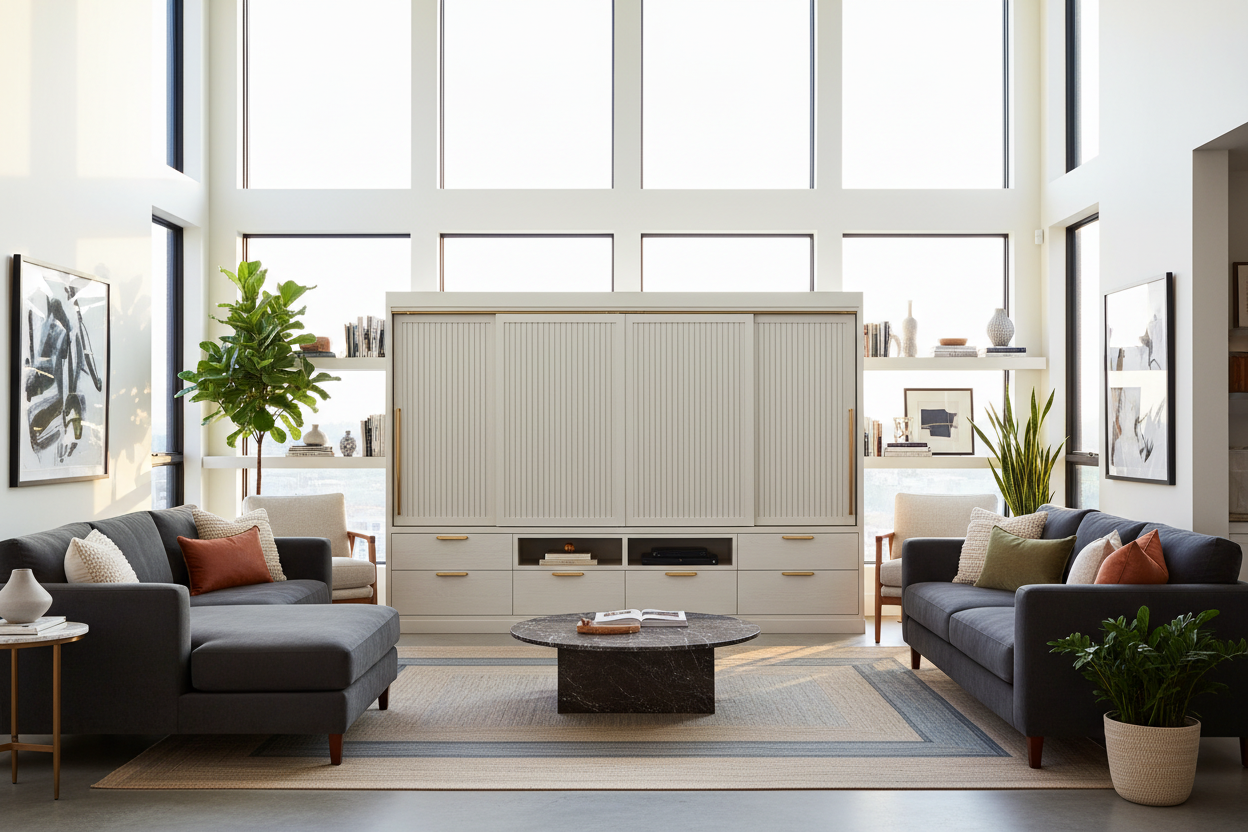
One of my favorite tricks to save a budget is to stop trying to fill every single inch with built-ins. If you have a long empty wall, don't spend $6,000 on a custom bank of shallow cabinets. A standalone display buffet with drawers can provide the same storage for a fraction of the price and, honestly, it adds more character to the room.
Mixing freestanding pieces with built-ins makes a kitchen feel like it evolved over time rather than being a sterile showroom floor. If you're struggling with the layout, spend some time choosing the perfect sideboard to act as a coffee station or bar area. It breaks up the 'wall of wood' effect and keeps your custom order focused only on the essential working zones of the kitchen.
My Biggest Mistake
Years ago, I ordered a full custom set for a client and completely forgot to account for the 'finished bottom' on the upper cabinets. Since they were installed at eye level over a sink, you could see the raw, stapled underside of the cabinet boxes every time you washed a dish. It cost me $800 in matching veneer skins and a day of labor to fix. Always ask: 'What will I see when I'm sitting down or looking up?'
FAQ
Is custom cabinetry actually better than big-box store cabinets?
Usually, yes. Custom shops use 3/4-inch plywood and solid wood drawers, whereas big-box 'stock' cabinets often use particle board and staples. However, high-end 'ready-to-assemble' options bridge this gap perfectly for half the price.
How much should I budget for installation?
A good rule of thumb is 15% to 25% of the total cabinet cost. If your kitchen is $20,000, expect to pay $3,000 to $5,000 for a professional to hang them correctly, especially if you have an old house.
Can I save money by painting them myself?
I wouldn't. Factory finishes are baked on in a dust-free environment. A DIY paint job on expensive custom wood rarely holds up to the grease and heat of a kitchen, and it can actually void your warranty.


Leave a comment
This site is protected by hCaptcha and the hCaptcha Privacy Policy and Terms of Service apply.