










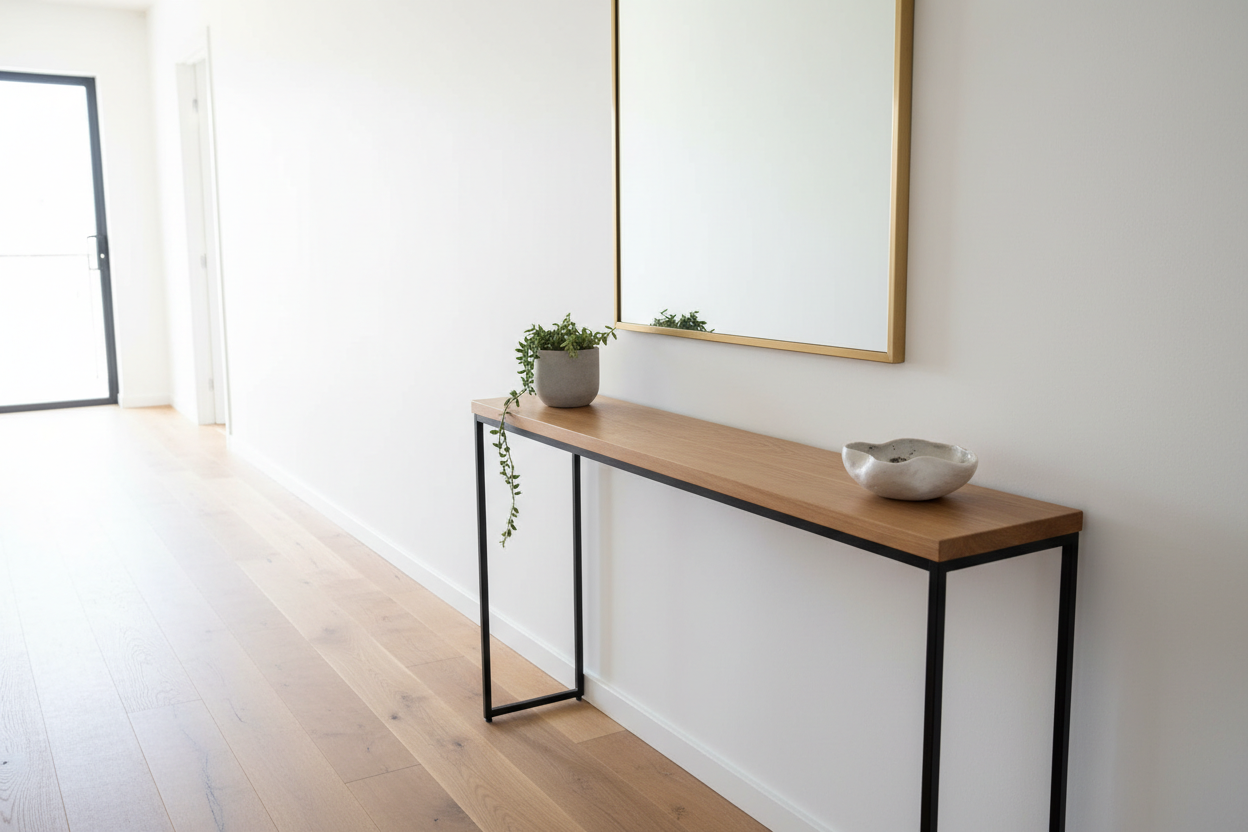
We have all been there. You walk through the front door, hands full of groceries, and immediately bump your hip against a bulky piece of furniture. It is the classic corridor conundrum: you need a place to drop your keys and mail, but your entryway feels more like a tunnel than a room. The solution lies in finding the right furniture proportions. Specifically, you need a piece that maximizes vertical utility while minimizing its footprint on the floor.
To answer the most pressing question right away: a truly narrow hallway table generally has a depth of 8 to 12 inches (20-30 cm). Anything deeper than 12 inches usually encroaches on the walking path in a standard corridor. If your hallway is exceptionally tight, you might even need to look for ultra-slim options that sit around 6 inches deep, often requiring wall anchoring for stability. The goal is to maintain a walkway clearance of at least 36 inches to prevent that claustrophobic feeling, though in older homes, you might have to settle for 30 inches.
My Battle with the Bowling Alley Hallway
I learned the importance of depth the hard way in my second apartment. The entryway was a long, dark stretch that barely measured 38 inches across. Desperate to make it feel like a home rather than a utility tunnel, I bought a standard console table online without checking the depth specifications. It looked beautiful in the photos, but once assembled, it stuck out 16 inches from the wall.
For months, I had to turn sideways to get past it if I was carrying a bag. It became a nuisance rather than a helper. Eventually, I swapped it out for a custom floating shelf I built from a piece of reclaimed lumber that was only 7 inches deep. The difference was immediate. The visual weight vanished, the walkway opened up, and I still had exactly enough room for a mail tray and a small lamp. That experience taught me that in narrow spaces, inches matter more than aesthetics.
Defining the Dimensions for a Thin Table for Hallway Spaces
When shopping for a thin table for hallway use, you have to ignore standard furniture categories. Most "console tables" sold at big-box stores are designed for living rooms, often sitting behind a sofa. These usually run 14 to 18 inches deep. In a narrow corridor, that is simply too much.
You should be looking for "slim" or "entryway" specific models. If you have a radiator in your hall, measuring the depth of that unit gives you a good baseline; you generally don't want your furniture protruding further than the radiator. If the space is free of obstructions, grab a tape measure and mark out 10 inches from the wall with masking tape. Walk past it several times. If you naturally shy away from the tape or brush against it, you need to go shallower.
The Visual Weight Factor
Physical dimensions are only half the battle. Visual weight plays a massive role in how cramped a space feels. A solid oak cabinet that is 10 inches deep will feel much larger and more imposing than a glass and metal table of the exact same size.
For the tightest squeezes, look for open bases. Hairpin legs or simple metal frames allow you to see the floor and skirting board continuously, which tricks the eye into thinking the floor area is larger than it is. Acrylic or "ghost" consoles are fantastic for this, as they provide surface area while virtually disappearing into the background.
Choosing the Right Console for Narrow Hallway Layouts
There are a few specific designs that work best when you are hunting for a console for narrow hallway areas. Understanding these shapes can save you hours of scrolling through furniture websites.
The Demilune
Demilune, or half-moon tables, are excellent for high-traffic zones. Because they have rounded edges and no sharp corners, they are much more forgiving if you do bump into them. The curve naturally guides traffic flow past the object rather than stopping it abruptly. They often fit snugly against the wall and taper off at the sides, preserving precious hip room.
Wall-Mounted and Floating Consoles
If floor space is at an absolute premium, get the furniture off the floor entirely. Floating consoles are mounted directly to the studs in your wall. Without legs to clutter the floor, the hallway feels wider. This also makes cleaning easier, as you can sweep or vacuum underneath without moving furniture. These are particularly good for modern or minimalist aesthetics, but you can find rustic wood beams that achieve the same effect for farmhouse styles.
Shoe Cabinets as Tables
A clever hack that many interior designers use is repurposing tilting shoe cabinets. IKEA and similar retailers sell shoe storage units that are incredibly slim—often just 6 or 7 inches deep—because the shoes are stored vertically. These units usually have a flat surface on top, effectively functioning as a table. You get the benefit of a surface for your keys and a hidden spot for the clutter that usually accumulates at the door.
Styling Your Narrow Surface
Once you have secured your narrow hallway table, styling it requires restraint. You do not have the depth for layered vignettes or large coffee table books. You have to think vertically.
A large mirror placed above the table is the oldest trick in the book for a reason. It reflects light and doubles the perceived depth of the corridor. If you are using a very shallow table (under 8 inches), standard table lamps might be too wide at the base. Their shades might also protrude into the walking path. Instead, consider installing wall sconces above the table or using a tall, slender buffet lamp with a small footprint.
Use a small tray to corral loose items. On a thin table, three sets of keys look like a mess, but three sets of keys in a ceramic bowl look like a design choice. If your table has an open bottom, you might be tempted to place baskets underneath for storage. Ensure these baskets do not stick out past the table legs, or you will be back to tripping over things.
When to Go Custom
Sometimes, the perfect piece just doesn't exist in mass-market catalogs. If your hallway has weird quirks—like a radiator, a fuse box, or an awkward alcove—you might need to build something or hire a carpenter. A simple shelf on heavy-duty brackets can be cut to the exact centimeter required. Radiator covers are another excellent way to reclaim space; by boxing in the radiator with a heat-safe cover, you create a shelf on top without stealing any extra floor space than the radiator was already using.
Ultimately, the entryway sets the tone for your entire home. It doesn't need to be grand, but it should be functional. By prioritizing depth and visual lightness, you can turn even the most cramped corridor into a welcoming entrance.
Frequently Asked Questions
How much space do I need to leave for a walkway in a hallway?
Ideally, you should maintain a minimum clearance of 36 inches (about 91 cm) for a comfortable walkway. In older homes or particularly tight apartments, you can squeeze this down to 30 inches, but anything less will feel restrictive and make moving furniture or carrying groceries difficult.
Can I put a lamp on a table that is only 8 inches deep?
Yes, but you need to be selective. Look for "buffet lamps" which typically have smaller bases and taller, narrower profiles. Alternatively, check the diameter of the lampshade; if the shade is 12 inches wide, it will overhang an 8-inch table and risk getting knocked over by passersby.
What is the difference between a sofa table and a hallway console?
The main difference is usually depth and height. Sofa tables are designed to sit flush against the back of a couch and are often deeper (14-18 inches) and lower. A dedicated hallway console is typically taller (around 30-34 inches high) and significantly shallower to accommodate traffic flow in corridors.


Leave a comment
This site is protected by hCaptcha and the hCaptcha Privacy Policy and Terms of Service apply.