










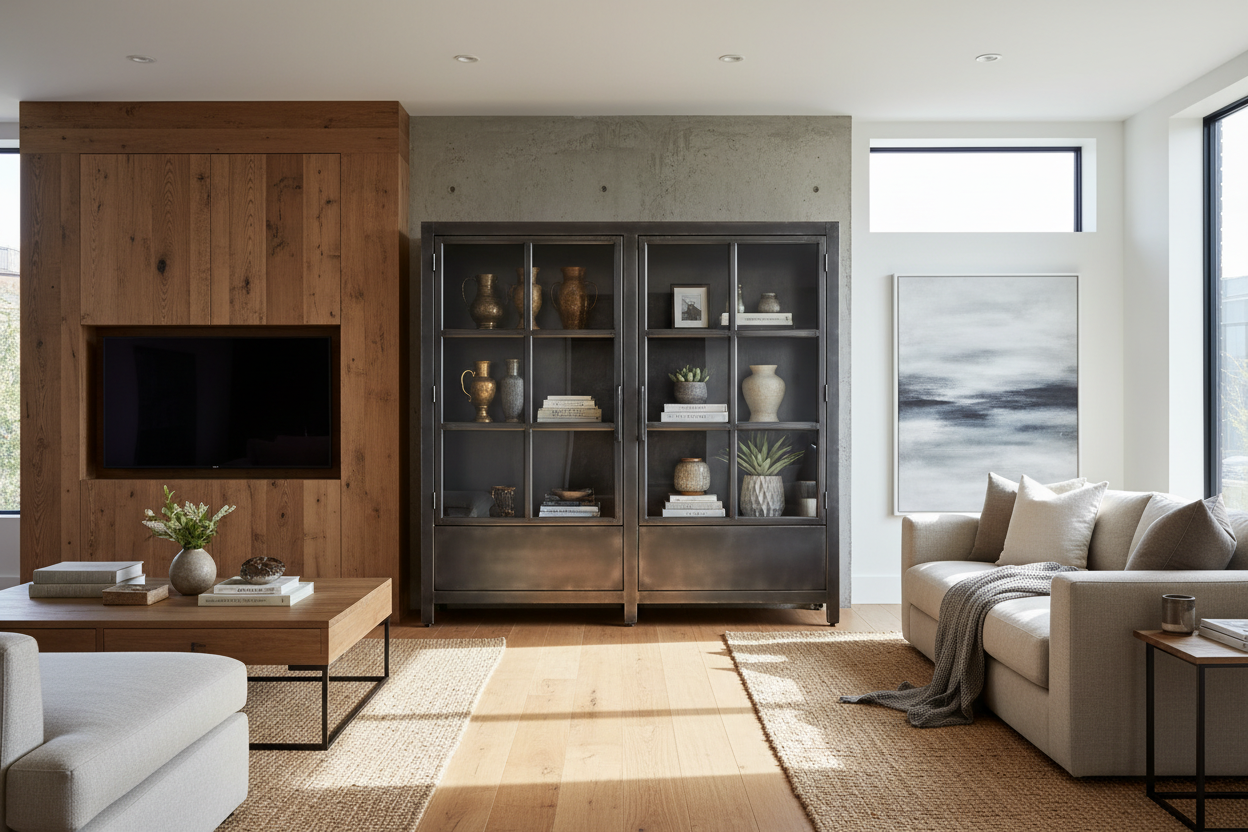
I spent three hours last Tuesday staring at my living room, feeling like I was trapped inside a cedar chest. I had the oak coffee table, the walnut bookshelves, and a teak sideboard that I thought was the 'anchor' of the room. Instead, it was just a sea of brown. It felt heavy and, frankly, a bit lazy. That is the exact moment I realized I needed an iron cabinet for home use to break the spell.
- Wood-on-wood creates visual fatigue; metal provides a necessary 'palate cleanser.'
- Iron frames offer a thinner, sleeker profile that wood can't structurally match.
- Modern metal furniture uses glass and powder-coating to avoid the 'locker room' vibe.
- Styling with organic materials like plants and ceramics softens the industrial edge.
Wood Fatigue Is a Real Design Problem
We have been conditioned to believe that 'quality' always equals solid wood. While I love a kiln-dried hardwood frame as much as the next person, there is such a thing as too much of a good thing. When every surface in your room has a grain pattern, nothing stands out. It all just blurs into a monochromatic heap of brown tones that can make even a large room feel claustrophobic.
I see this trap all the time: people buy a dining set, then feel they have to match the sideboard to the table. Stop doing that. When you are choosing the perfect cabinet and sideboard for your home, you should be looking for a material that fights against the existing textures. If your floors are wood and your table is wood, a wooden cabinet is just going to disappear into the wall. You need a 'disruptor' material.
Iron brings an architectural element that wood simply can't. It introduces a different light-reflecting quality and a sense of permanence. It feels like it was built into the house rather than just placed there. Mixing materials is the difference between a room that looks like a showroom and one that looks like it was curated over a decade.
Why Metal Cabinet Furniture is the Ultimate Palate Cleanser
Think of metal cabinet furniture as the black eyeliner of interior design. It defines the edges. Because iron is incredibly strong, the frames can be much thinner than timber. A wooden cabinet needs thick stiles and rails to hold the weight of the shelves; an iron cabinet can do the same job with a half-inch profile. This creates 'visual air'—you can see through and around the piece, which keeps your room feeling breezy.
I recently swapped a chunky pine dresser for a tall iron unit, and the room suddenly felt twice as big. It’s about the silhouette. The matte finish of powder-coated steel absorbs light in a way that satin-finished wood doesn't. It provides a resting point for your eyes. If your room feels 'mushy' or lacks a focal point, the sharp, 90-degree angles of a metal piece will snap everything back into focus.
There is also the 'heirloom' factor. A well-made iron piece doesn't warp, it doesn't swell in the humidity, and it doesn't get stripped by a rogue vacuum cleaner. It has a weight to it that feels honest. When you pull the handle on a heavy metal door, there is a satisfying 'thunk' that a plywood door can't replicate.
But Won't It Look Like a High School Locker?
This is the number one fear I hear from clients. They worry their living room will end up looking like a CrossFit gym or a 1950s infirmary. But the 'industrial' trend has evolved. We aren't talking about raw, rusted sheet metal anymore. We are talking about precision-engineered pieces with sophisticated finishes.
The secret is the 'transparency' factor. A black cabinet with glass doors is the foolproof way to avoid the locker look. The glass adds a layer of reflection and sophistication, turning the cabinet into a display case rather than a storage locker. It leans more 'Parisian bistro' or 'vintage apothecary' than 'high school hallway.'
Look for details like fluted glass, brass hardware, or tapered legs. These small design choices move the piece away from the utilitarian and toward the decorative. If the metal has a fine-textured powder coat rather than a glossy spray-paint finish, it will look expensive and intentional. It's all about the execution of the joints and the quality of the hardware.
Getting Your Metal Cabinet Decor Right
Once the piece is in your house, you have to 'warm it up.' Metal cabinet decor is a balancing act. If you fill a metal cabinet with metal objects, you’ve gone too far. You want to contrast the coldness of the iron with 'living' textures. I always suggest a 'rule of three' for the top: something organic (a trailing ivy), something earthy (a ceramic bowl), and something vintage (a stack of linen-bound books).
Inside, don't overstuff it. Iron cabinets look best when there is some negative space. If you're using it for dinnerware, stack white porcelain against the dark metal back—the contrast is stunning. If it's for a bar, the glint of crystal glassware against a matte black frame is a high-end look that never fails. The goal is to make the metal feel like a frame for the beautiful things inside it.
Where 'Heavy Metal' Actually Belongs in Your House
Most people relegate iron cabinets to the garage or maybe a home office. That’s a missed opportunity. A tall iron piece in a hallway is often the exact cure for empty walls that feel too narrow for a bulky wooden dresser. Because the profile is so slim, you get the storage without the 'hallway-closing' bulk.
In the dining room, an iron hutch makes your fine china look modern and less 'Grandma's house.' In the entryway, a low metal console can handle the abuse of keys, mail, and wet umbrellas without the finish ever failing. If you are feeling hesitant, start small. You don't need a six-foot wardrobe right away. Try a cabinet in bedroom with metal legs first. It introduces just enough of the material to see how it plays with your bedding and carpet before you commit to a massive statement piece.
I’ve even seen iron cabinets used in bathrooms for towel storage. Unlike wood, which can suffer in high-humidity environments, a powder-coated metal unit will stay pristine for years. It’s the ultimate 'buy it once' furniture choice.
The Reality Check: My Personal Experience
I’ll be honest: my first foray into iron furniture was a disaster. I bought a vintage 'industrial' locker from a flea market, thinking I was being edgy. It was loud, the doors didn't stay shut, and it smelled like old pennies. I hated it within a week. The lesson? Buy 'home-grade' iron, not 'industrial scrap.' Modern iron furniture is designed with magnetic catches and rubber bumpers so the doors close silently. If you buy a cheap version without these features, you will regret it every time you open a drawer and it sounds like a car crash. Check the specs for 'soft-close' or 'magnetic strips'—your ears will thank you.
FAQ
Is an iron cabinet too heavy for an apartment floor?
Usually, no. While iron is dense, the designs are often 'leggy' and use less material than a solid oak cabinet. A standard 72-inch iron cabinet weighs about 120-150 lbs, which is well within the limits of any modern residential floor. Just use felt pads to protect your hardwoods.
Does metal furniture make a room feel cold?
Only if you don't style it. If you surround it with a wool rug, some velvet pillows, or wooden accents, the metal actually makes those soft textures feel even 'warmer' by comparison. It’s all about the tension between materials.
How do I clean an iron cabinet?
This is the best part: you don't need special oils or waxes. A damp microfiber cloth is all it takes. For fingerprints on matte black finishes, a tiny bit of glass cleaner on a rag works wonders. It’s the lowest-maintenance furniture you will ever own.


Leave a comment
This site is protected by hCaptcha and the hCaptcha Privacy Policy and Terms of Service apply.