










I recently spent three hours trying to 'cable manage' a client’s living room, and it was a disaster. We were working with one of those ultra-slim, mid-century modern consoles that looks amazing in a catalog but has the storage capacity of a shoebox. By the time we plugged in the router, the soundbar, and the gaming console, the back of the unit looked like a plate of techno-spaghetti. It was a mess.
It made me genuinely nostalgic for the 90s entertainment center. You know the one: a massive, floor-to-ceiling fortress of honey-stained oak that could withstand a small earthquake. It was the undisputed king of the suburban living room, and while we all laughed at them once flat-screens arrived, we definitely lost something when we threw them out.
- Unrivaled Storage: They hid everything from VCRs to that one drawer full of dead batteries.
- Durability: Most were built with actual 3/4-inch plywood or solid oak, not the 1.2 lb density particle board we see now.
- Visual Peace: When the doors were shut, your living room actually looked like a living room, not a Best Buy showroom.
- Modular Potential: Many were actually three separate pieces, making them surprisingly versatile for large walls.
The Golden Age of Storing Literal Junk
The classic 1990 entertainment center was a masterpiece of specific engineering. It had those built-in CD towers with the little plastic grooves that held exactly 40 discs. It had the glass doors with the magnetic touch-latches that would inevitably rattle every time the bass hit during an action movie. But most importantly, it had that perfectly square cubby designed for a 32-inch Sony Trinitron that weighed 200 pounds.
There was a certain coziness to the entertainment center 90s aesthetic. It wasn't just a place for the TV; it was a display case for your life. You had the bottom cabinets for the board games with missing pieces, the side shelves for the encyclopedias, and the top bridge for the dusty silk ivy. It occupied space with authority. It didn't try to disappear into the wall; it was the wall.
I remember my parents’ unit—a beast of a thing we bought from a local furniture warehouse in 1994. It had a 'media bridge' that connected the two side towers, creating a literal archway for the television. When we finally replaced it with a 'sleek' stand in the mid-2000s, we realized we had nowhere to put about 60% of the stuff that had lived there for a decade. We ended up buying three extra plastic bins just to hold the overflow.
Why Minimalist Consoles Are Ruining Our Living Rooms
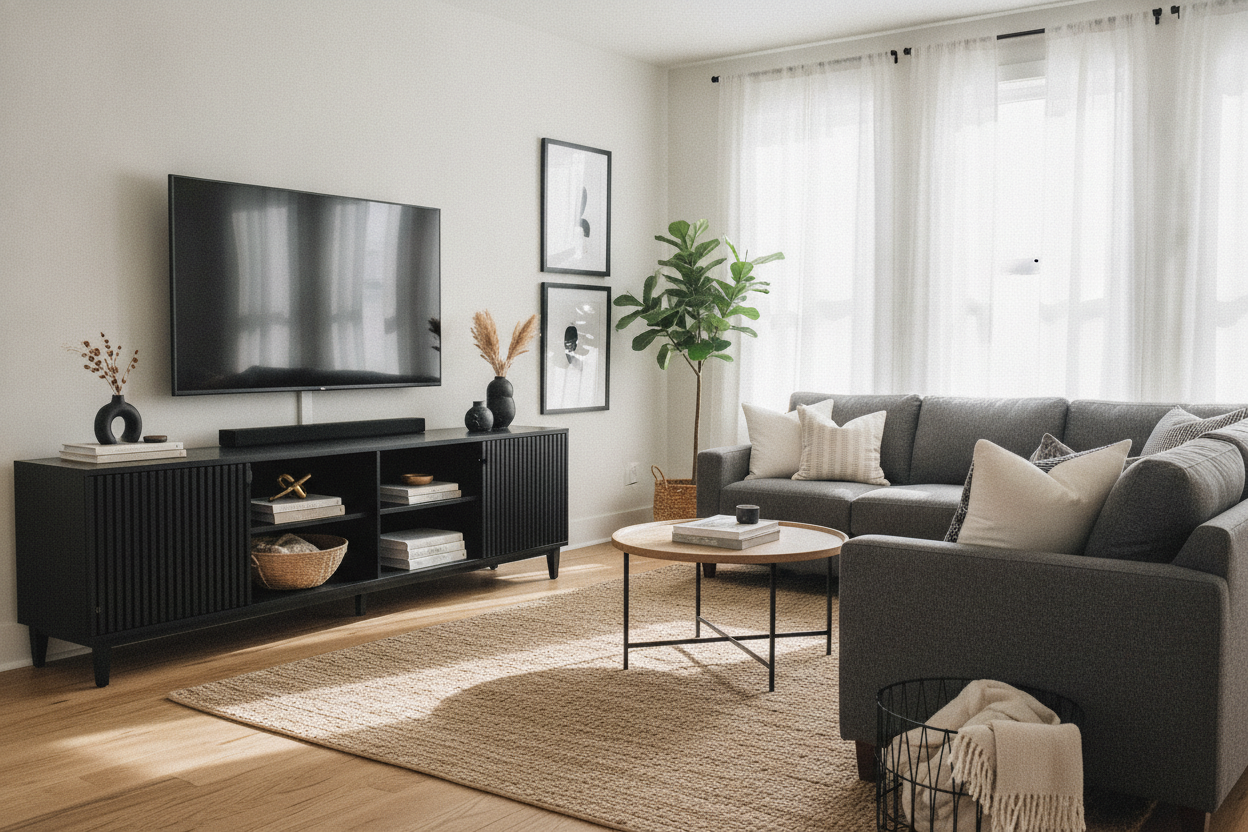
We’ve been sold a lie that 'minimalism' is the only way to live. We traded our massive storage walls for low-slung benches that sit six inches off the floor. Now, instead of a clean wall of wood, we have a floating TV with a black plastic wire cover running down the drywall like a bad scar. We’ve made some classic tv stand and cabinet mistakes by prioritizing a 'light' look over the reality of our electronics.
The problem is that our 'stuff' didn't go away; it just got uglier. We still have routers, mesh nodes, external hard drives, and charging docks. In a 90s tv stand, these lived behind closed doors. In a modern living room, they sit on top of the console, gathering dust and flashing blue LED lights at you while you’re trying to watch a movie. We sacrificed utility for a trend, and our living rooms are messier for it.
I’ve seen people try to fix this with baskets, but baskets are just clutter magnets. You need real, solid cabinetry to hide the chaos of a modern household. The tv stand 90s kids grew up with understood that life is messy and that a big black box of electronics is rarely a design feature.
Can You Make a 1990 Entertainment Center Look Good Today?
If you find a vintage 1990 entertainment center at a thrift store or in your parents' basement, don't immediately send it to the landfill. The 'bones' of these pieces are often significantly better than anything you'll find at a big-box retailer today. The trick is to kill the '90s orange' finish. That glossy, honey-oak stain is what makes them look dated. A weekend with a power sander and some high-quality primer can change everything.
I’ve seen some incredible 'glow-ups' where people remove the top bridge and the dated crown molding to create two separate pier cabinets. Paint them a moody charcoal or a deep forest green, swap the brass hardware for matte black pulls, and suddenly you have high-end custom cabinetry. If you want to keep the center section, consider replacing the dated glass with fluted glass or even cane webbing.
Updating the stereo section is the most satisfying part. If you swap that old component rack for a black cabinet with glass doors, you maintain that classic 90s tv cabinet functionality but with a much more sophisticated silhouette. It’s about keeping the storage volume while losing the 'bulk' of the 90s trim work. I’ve even seen people line the back of the shelves with peel-and-stick wallpaper to give it some depth.
The Modern Solution to the 'Big Black Box' Problem
Designers are finally waking up. We’re seeing a shift back toward larger, more integrated units because people are tired of looking at their TVs when they aren't using them. The industry is moving away from the open-shelf tv stand 90s format and back toward pieces that actually enclose the technology. We want our rooms to feel like libraries again, not gaming dens.
If you have the budget, the ultimate modern flex is a hidden TV mechanism. This is the 21st-century version of the 90s armoire. Instead of a giant screen dominating the room, the TV stays tucked inside a beautiful cabinet and rises up only when you’re ready for Netflix. It’s the perfect compromise: you get the massive storage of a 90s piece without the permanent 'black hole' on your wall.
I’ve installed a few of these for clients who live in open-concept lofts. It’s a total shift in how the room feels. When the TV is down, the furniture serves as a room divider or a buffet. It’s the kind of multi-purpose thinking that the 90s units almost got right, just updated for 4K screens that are 65 inches wide instead of 24 inches deep.
How to Get That 90s Storage Capacity Without the Bulk
You don't have to buy a literal vintage relic to get that level of organization. Look for pieces that emphasize closed cabinetry and verticality. A stylish black tv stand with a wider footprint can offer the same linear feet of storage as an old wall unit without feeling like it’s closing in on you. The key is to look for 'slatted' or 'fluted' doors that allow infrared signals to pass through so you can keep the doors shut while using your remotes.
When shopping, check the weight capacity. A lot of modern 'entertainment centers' are rated for only 50-75 pounds. If you have a high-end receiver or a large collection of vinyl, you’ll want something built with a sturdy frame. Look for 'cord management ports' that are actually large enough to fit a standard plug—you'd be surprised how many designers fail that basic test.
Ultimately, the tv cabinet 90s families loved was about more than just the TV. It was the heart of the home's organization. We can bring that back by choosing modular units that span a larger portion of the wall. Instead of one tiny stand, buy three matching units and bolt them together. You get the 'built-in' look and all that glorious, clutter-hiding space, but with a profile that fits the 21st century.
FAQ
Will a 65-inch TV fit in an old 90s entertainment center?
Usually, no. Most were built for the 4:3 aspect ratio of tube TVs. You can sometimes make it work by removing the middle 'bridge' and the side shelves, but you’re often better off using the side towers as separate bookcases and buying a new low-profile stand for the TV itself.
How do I get rid of the 'honey oak' smell?
That smell is usually a mix of old furniture wax and dust trapped in the unfinished back panels. Give the whole thing a wipe-down with a 50/50 vinegar and water mix, then seal the back panels with a clear shellac or primer. It kills the odor instantly.
Are these units heavy to move?
Incredibly. Most 90s units are made of high-density particle board with thick oak veneers. They do not flat-pack. If you’re buying one second-hand, bring at least two strong friends and a furniture dolly. Do not try to 'wing it' with a sedan; you need a truck.


Leave a comment
This site is protected by hCaptcha and the hCaptcha Privacy Policy and Terms of Service apply.