










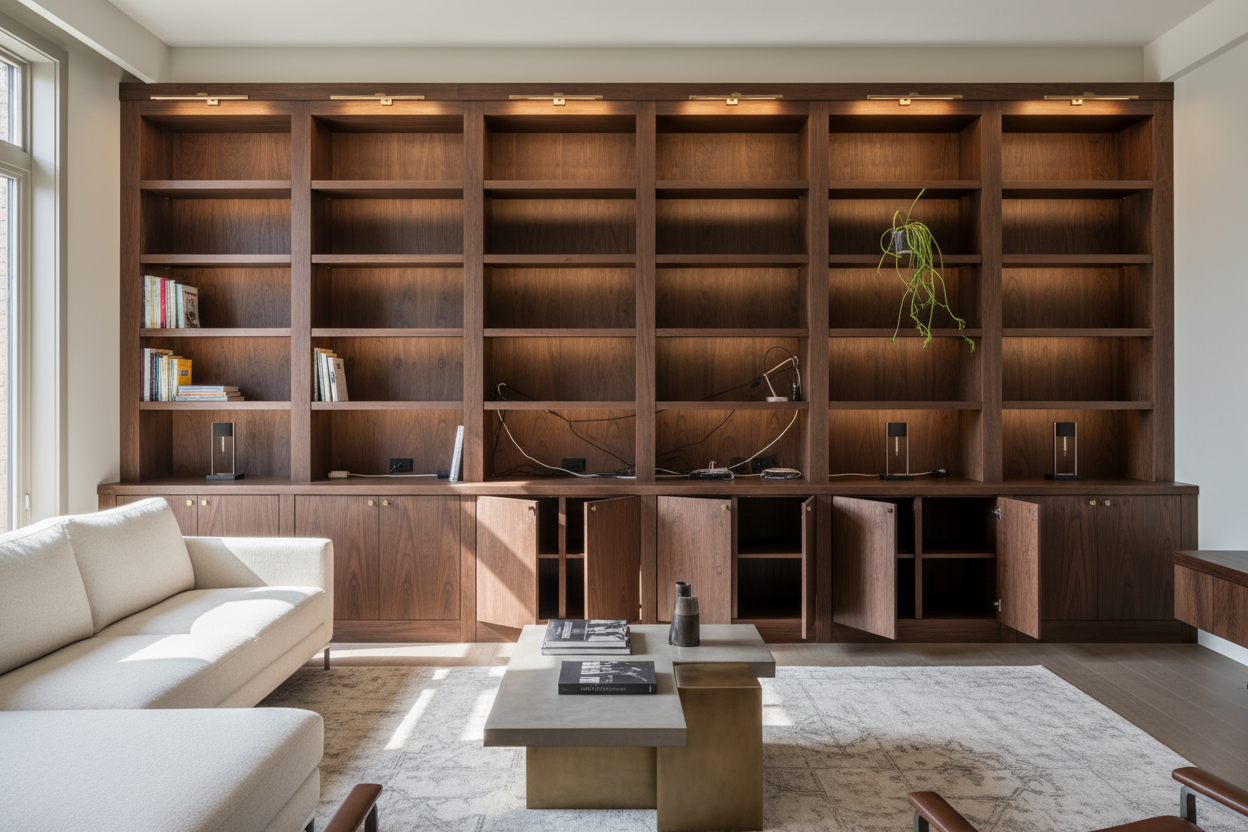
I remember staring at my blank 14-foot living room wall at 2 AM, convinced that if I just had floor-to-ceiling millwork, my life would finally be organized. I’d seen the photos: perfectly staged vases, color-coordinated books, and hidden wires. I spent months pinning built in cabinets and shelves until I finally pulled the trigger on a custom commission. I thought I was buying 'timelessness,' but what I actually bought was a very expensive cage for my furniture layout.
Quick Takeaways
- Custom millwork is permanent; if your tech or TV size changes, you are stuck with an expensive renovation bill.
- The 'open shelf' trap leads to visual clutter rather than actual storage for things you use.
- Modular systems offer 90% of the high-end look at a fraction of the cost.
- Permanent fixtures should only be used to anchor architectural features like fireplaces.
The $8,000 Living Room Illusion
I fell for the romanticized idea of custom millwork. Social media makes you feel like your house is unfinished without white oak built in shelves cabinets. I ignored the fact that my house is a standard suburban layout, not a historic brownstone with 12-foot ceilings. I hired a local carpenter, picked out a 'classic' shaker door style, and handed over an $8,000 check thinking it was an investment in my home's value.
The reality set in about three days after the sawdust cleared. While the 3/4-inch maple plywood felt sturdy and the paint finish was flawless, the room suddenly felt five feet smaller. I had sacrificed floor space for a massive, unmovable wall of wood that looked more like a library than a cozy living room. I realized I hadn't designed for my life; I had designed for a photo shoot.
Where We Went Wrong: The 'Stuff' Ratio
The functional failure of our built in cabinets with shelves was the ratio of open to closed storage. I went with 70% open shelving because I wanted to display my 'curated' book collection. The problem? I don't actually have enough aesthetic objects to fill 12 feet of vertical space. Unless you want to spend another $2,000 on decorative beads, oversized bowls, and brass figurines you don't care about, you'll end up with a lot of empty, dusty gaps.
Meanwhile, the lower cabinets—the only place to hide the ugly stuff like routers, gaming consoles, and my kid's plastic toys—were overflowing within a week. I had built a shrine to my ego but had no place to put my vacuum attachments. If you’re going custom, flip the script: 70% doors, 30% shelves. Your sanity (and your duster) will thank you.
The 'Permanent Furniture' Trap
The biggest headache, however, was the layout paralysis. When you bolt large built in shelves cabinets to the wall, you are making a permanent decision about where your sofa, your chairs, and your TV will live forever. About a year into owning them, I wanted to swap our 55-inch TV for a 75-inch OLED. I measured the 'TV niche' I had so carefully planned, and it was exactly 58 inches wide. To fit the new TV, I would have had to hire a carpenter to rip out the structural supports and repaint the entire unit.
It’s not just the tech. We recently bought a new sectional that’s slightly deeper than our old sofa. In a normal room, I’d just slide the TV stand down a few inches to center it. With built-ins, there is no sliding. You are locked into a configuration that might not work for the next piece of furniture you buy. It paralyzes your ability to evolve the space as your family grows or your tastes change.
When You Actually Need Anchored Storage
There is one scenario where I still stand by permanent millwork: when it’s framing a legitimate architectural feature. If you are building a surround for a built in electric fireplace, the permanence makes sense. The fireplace is already a fixed point in the room; you aren't going to move it, so building shelving around it creates a cohesive, intentional hearth that feels like it belongs to the house rather than just sitting on top of it.
What I Wish I Did Instead
If I could go back, I would skip the custom carpenter and go modular. I spent a long time debating if a custom built in desk and cabinets setup was worth the ROI, and for a living room, the answer is a hard no. You can achieve a nearly identical look with high-end modular systems that use 'filler strips' to bridge the gap to the wall. They look built-in, but they can be unscrewed and moved if you ever decide to turn your living room into a dining room.
I also highly recommend looking into a built in desk and shelves IKEA hack. Using Billy or Sektion bases with custom doors from a third-party company gives you that bespoke, high-end feel for about 20% of the price. If you mess up the layout or decide you want a bigger TV in five years, you aren't out $8,000. You're out a few hundred bucks and a Saturday afternoon of assembly. Flexibility is the ultimate luxury in home design, and custom millwork is the enemy of flexibility.
FAQ
Do built-ins actually increase home value?
Marginally. While they look great in listing photos, many buyers see them as a limitation if their own furniture doesn't fit the layout. You rarely get a 100% return on the investment.
What is the ideal shelf depth?
Standard book depth is 12 inches. If you want to store media equipment or larger bins, you'll need 15 to 18 inches, but be careful—deep shelves can make a room feel much smaller.
Should I use MDF or solid wood?
For painted built-ins, high-quality MDF is actually better than solid wood because it doesn't expand and contract with temperature changes, meaning your paint won't crack at the joints.


Leave a comment
This site is protected by hCaptcha and the hCaptcha Privacy Policy and Terms of Service apply.