










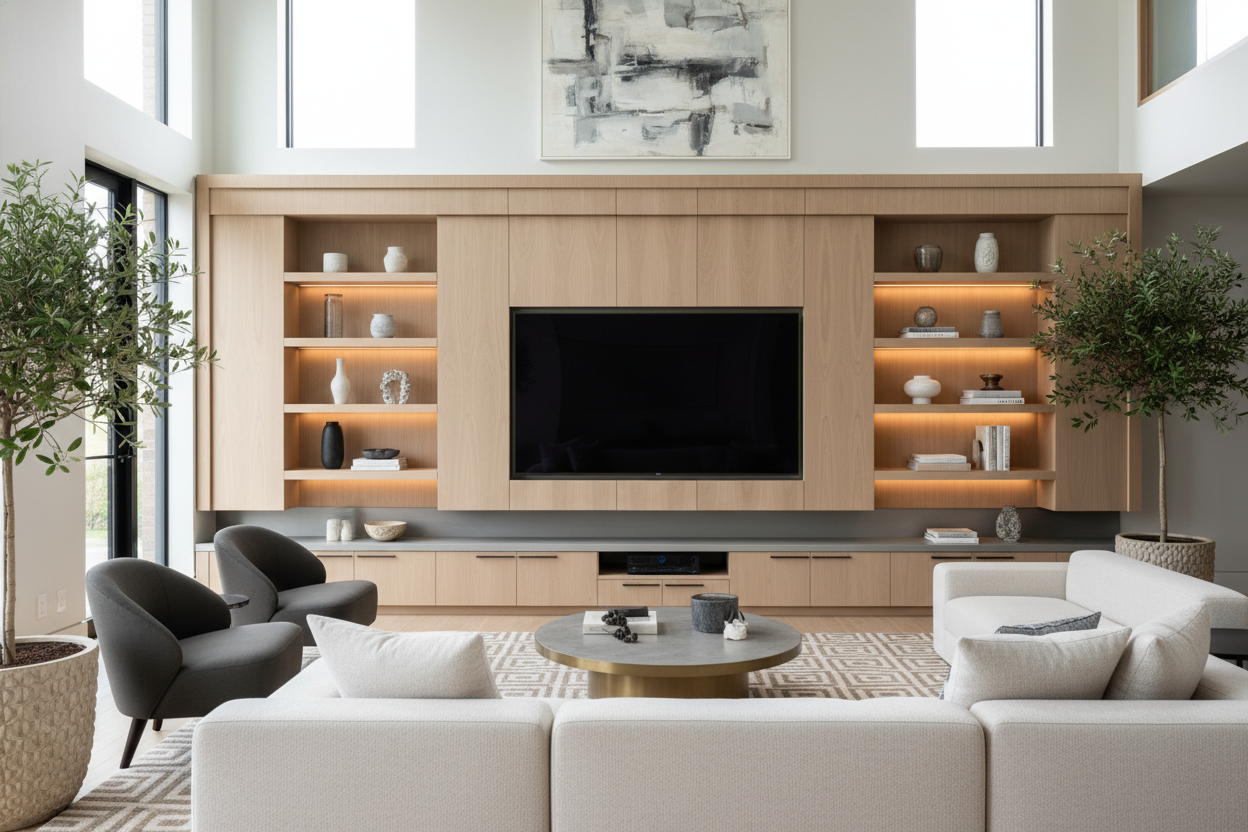
I spent three months researching refresh rates and nit brightness for my new 75-inch screen, only to realize I had made a rookie mistake the moment I unboxed it: I tried to hide it. I thought a minimalist, low-profile stand would keep the room feeling airy. Instead, that massive screen looked like a giant black hole sucking the soul out of my living room. It is time to admit that a tv units wall approach isn’t just for 90s mansions—it is a functional necessity for modern scale.
- Scale matters: Your furniture needs to be at least 25% wider than your screen to avoid the 'top-heavy' look.
- Storage hides the chaos: Cables, controllers, and routers need a home that isn't a dusty tangle on the floor.
- Visual balance: Framing the TV makes it look like an architectural choice rather than an appliance.
- Modular is better: You do not need a custom carpenter to get a high-end built-in look.
The 'Giant Black Hole' Living Room Dilemma
When you pair a massive screen with a flimsy console, you create a visual anchor that is way too heavy for its base. I see this in almost every living room I visit. People spend $2,000 on a screen and then try to upgrade your basic Tv Stands with something they found at a thrift store meant for a 32-inch tube TV. The scale is just wrong.
The result is a room that feels lopsided. The TV dominates the wall, making your expensive sofa look tiny and your ceiling look low. A proper wall unit and tv stand combo provides the necessary 'heft' to ground the electronics. You want the TV to feel like it is part of the wall, not a billboard hanging on it. My first attempt at this involved a 60-inch console under a 75-inch TV. It looked like a bodybuilder standing on a toothpick. Never again.
Counterintuitive Design: Why Your Big Screen Needs Bigger Furniture
It sounds backward, but if you want your TV to look smaller, you need to surround it with more furniture. This is the magic of a wall tv media unit. By filling the surrounding vertical and horizontal space, you dilute the visual impact of the screen. Instead of your eyes being drawn directly to the black rectangle, they move across the shelves, the cabinetry, and the decor.
A wall unit with tv stand integration creates a dedicated zone for entertainment. When the furniture is nearly as large as the wall itself, the TV becomes just one element of the design. I have found that using a tv stand wall unit that spans at least 80% of the wall width makes the room feel more expensive and intentional. It stops being a 'TV room' and starts being a designed living space.
The Magic of Contemporary Entertainment Center Wall Units
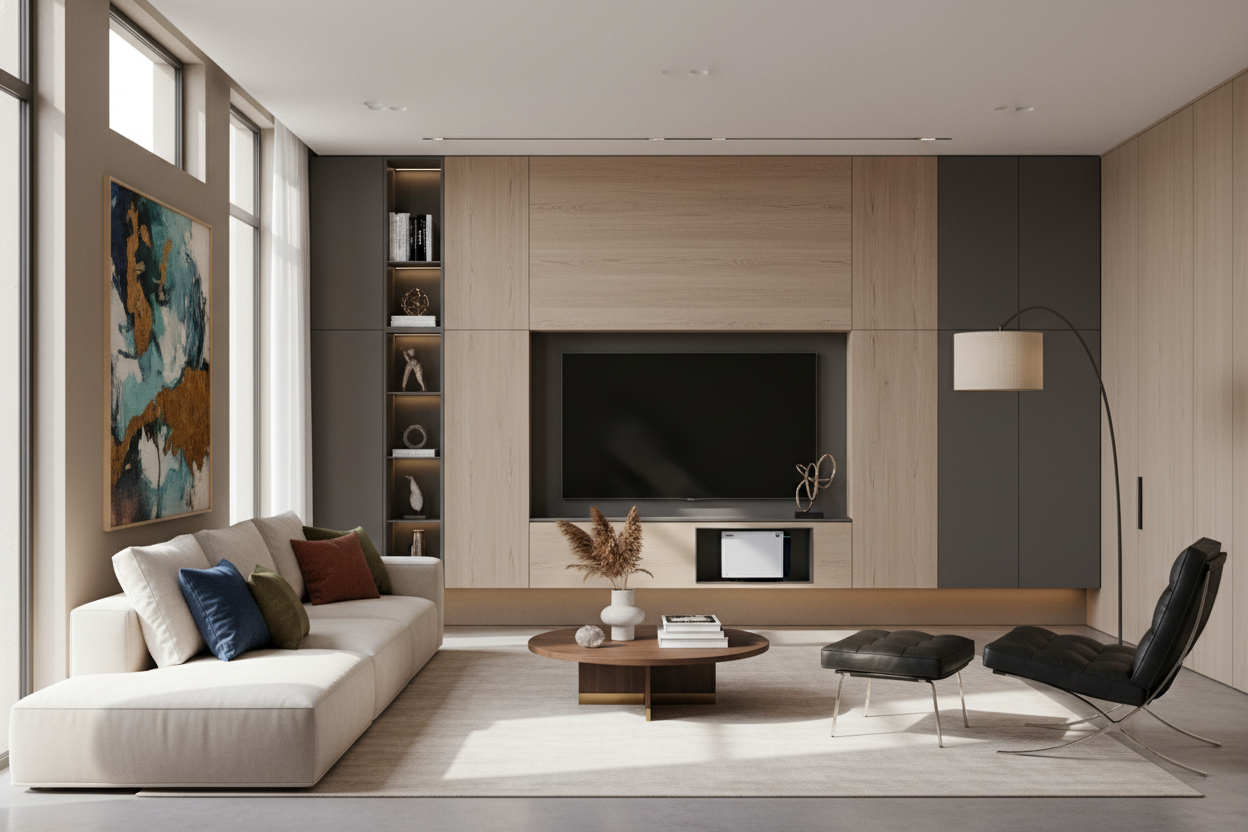
Forget those honey-oak behemoths from your parents' basement. Modern silhouettes are all about clean lines, matte finishes, and push-to-open doors. I recently helped a friend transition from a cluttered open-shelf setup to a modern wall cabinet for living room storage, and the difference was staggering. The room felt bigger because the visual clutter was hidden.
Contemporary entertainment center wall units often use a mix of closed cabinetry and slim profile shelving. This allows you to hide the ugly stuff—like your PS5 or that mess of HDMI cables—while showing off your favorite art books. Look for units with a depth of about 15 to 18 inches. Anything deeper starts to eat into your floor space, but that 15-inch sweet spot fits almost any component while remaining sleek.
Faking Custom Built-Ins with a Wall Unit and TV Stand Combo
You do not need to spend $10,000 on a custom carpenter to get that high-end look. The secret is modularity. By combining a long, low base unit with vertical piers or floating cabinets, you can mimic the look of a custom tv stand wall cabinet for a fraction of the cost. I am a huge fan of using a floating tv stand wall mounted media console as the anchor and building around it.
The trick to making modular pieces look like built-ins is the 'gap' management. Try to find pieces that share the same finish and keep the spacing between units consistent—usually about 2 to 4 inches if they aren't touching. If you are feeling brave, you can even add crown molding to the top of a wall to wall tv cabinet to bridge the gap to the ceiling. It is a weekend project that adds serious value to your home.
How to Style a Wall TV Media Unit Without It Looking Cluttered
Once you have the structure, the biggest mistake is filling every single inch of shelf space. You need negative space to let the design breathe. I follow a 60/40 rule: 60% of the shelves should have objects, and 40% should be empty. For the items you do display, group them in odd numbers. Three vases of varying heights always look better than two.
Lighting is the 'secret sauce' here. If your unit doesn't come with it, buy some puck lights or LED strips. A freely arranged tv stand with led lighting can completely change the vibe of the room at night. It adds depth and makes the unit look like a gallery piece. Also, please, for the love of design, use cable management sleeves. Nothing ruins a beautiful wall units entertainment setup faster than a 'black spaghetti' of wires hanging down the middle.
Is a Wall to Wall TV Cabinet Right for Your Space?
Before you pull the trigger, measure your wall three times. A full-scale system is a commitment. You need to ensure you have at least 24 inches of clearance from the edge of the unit to any doorways or walkways. If your room is narrow, stick to a lighter color—white or light oak—to keep it from feeling claustrophobic.
If you have a wall that feels 'blank' or a TV that feels like it is floating in space, it is time to go big. Stop fearing large-scale furniture; it is often the only way to make a large room feel cozy and a small room feel organized. My only regret with my own setup was waiting two years to do it.
FAQ
How high should I mount my TV in a wall unit?
Your eyes should be level with the middle of the screen when you are sitting on your sofa. Usually, this means the center of the TV is about 42 inches from the floor. Do not be the person who mounts their TV near the ceiling; your neck will thank you.
Can I mix different wood tones in a wall unit?
It is risky. If you are going for a modular look, I recommend sticking to the same finish for the main structure. You can bring in different tones through your decor items or a single accent shelf, but the 'bones' should match to keep it looking like a cohesive unit.
What is the best material for a long-lasting media unit?
Look for high-density MDF with a quality veneer or solid wood. Avoid the cheap, lightweight particle board found in the 'flat-pack' bargain bins; it will sag under the weight of a 75-inch TV within six months. I always check the weight capacity of the top shelf before buying.

Leave a comment
This site is protected by hCaptcha and the hCaptcha Privacy Policy and Terms of Service apply.