










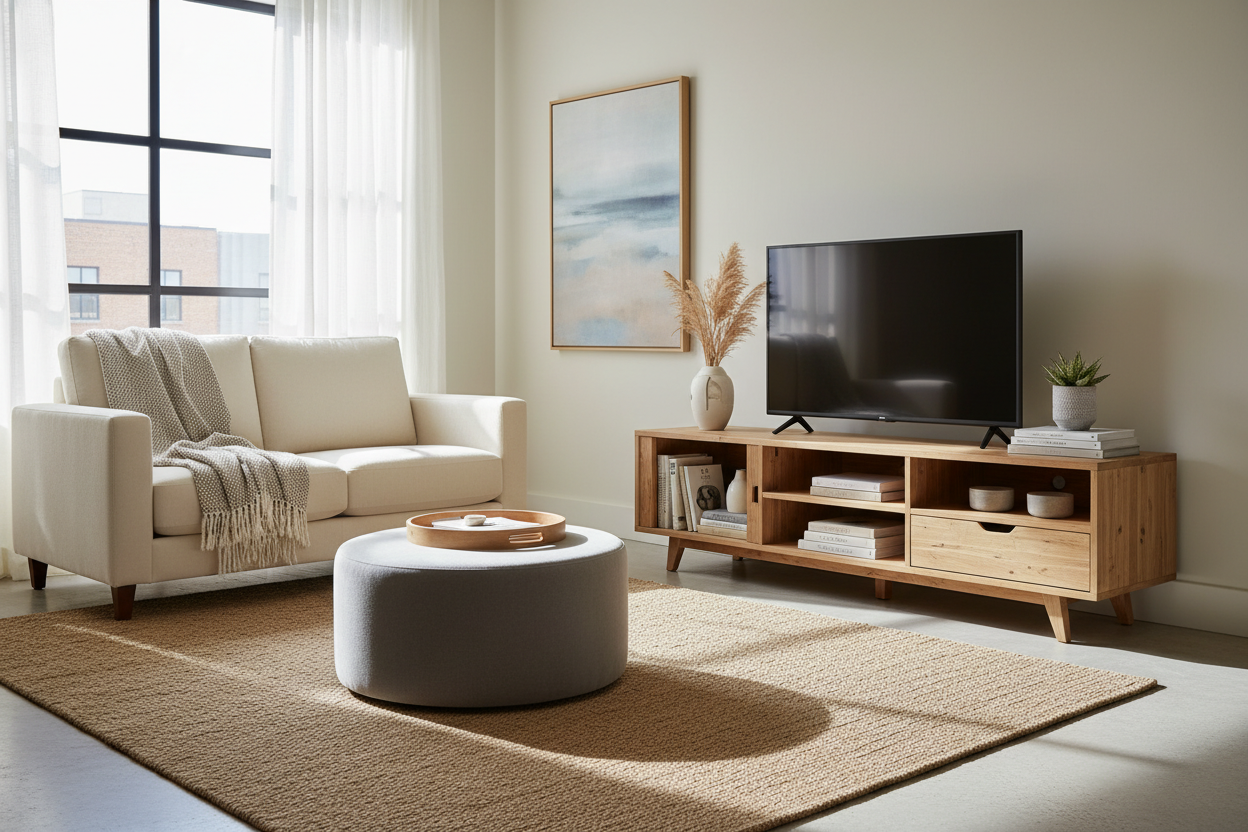
I have spent far too many nights staring at a 42-inch TV perched precariously on a 40-inch stand. It is a specific kind of design sadness. When you are hunting for small tv stands for living room setups, the temptation is to buy the absolute smallest thing that fits the box. But I have learned the hard way: a stand that is too small does not make a room look bigger; it just makes your furniture look like it belongs in a dollhouse.
- Scale Over Size: A stand should be at least 20% wider than your TV to avoid a top-heavy look.
- Leg Room: Furniture with legs (especially tapered ones) creates the illusion of more floor space.
- Hidden Mess: In small quarters, visible cords are visual poison.
- Verticality: Use tall plants or lamps to 'anchor' a petite console so it doesn't look lost.
The 'Floating Island' Problem (And Why Your Stand Looks Lost)
The biggest mistake I see in tiny apartments is the 'floating island' effect. You buy a petite console, shove it against a massive blank wall, and suddenly the room feels even more cramped. It looks untethered, like a piece of furniture that forgot to grow up. When searching for a small space solution, you have to think about the wall, not just the floor dimensions.
A 40-inch console on an 8-foot wall looks like a mistake. To fix this, you don't necessarily need a bigger stand—you need to integrate it. I usually tell people to treat the console as the center of a larger composition. If the stand is small, the surrounding decor needs to do the heavy lifting to fill the visual gap.
Anchor the Space: Small Space TV Stand Ideas That Actually Work
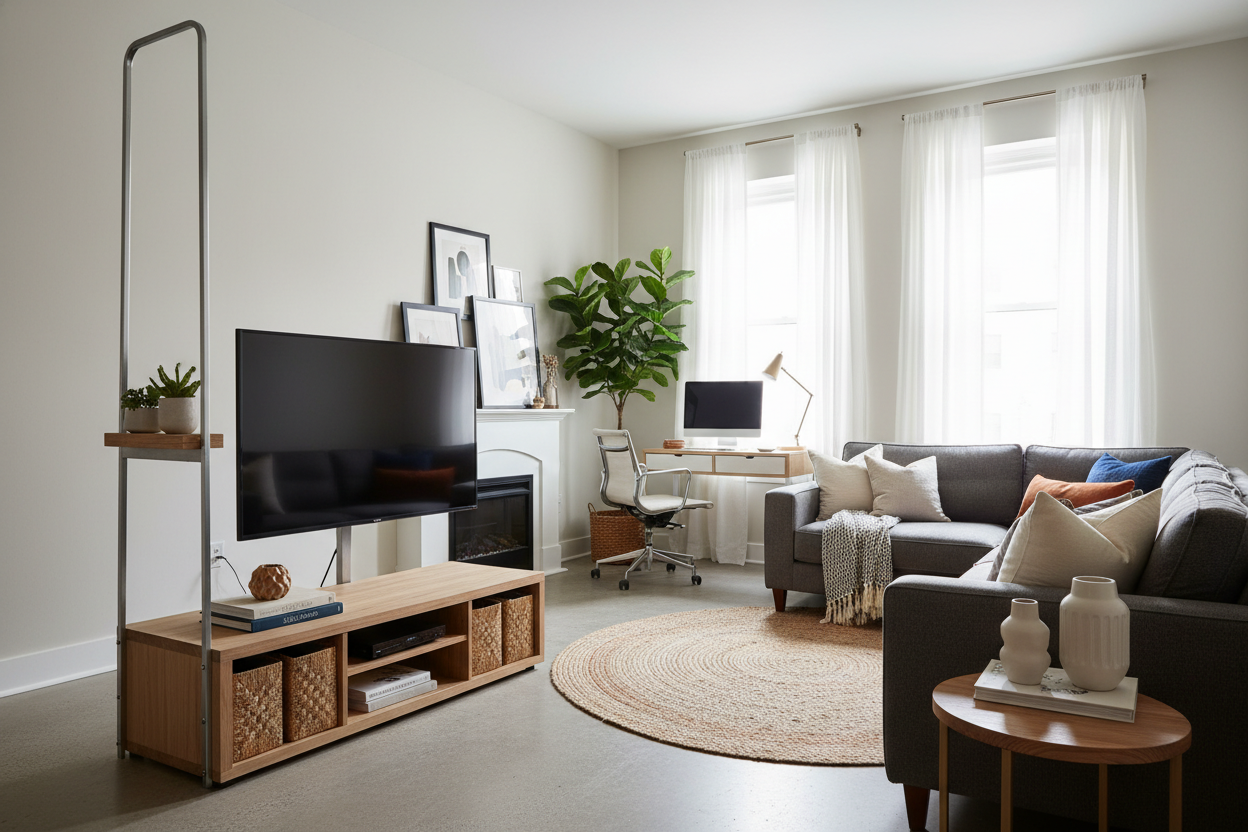
To ground a petite unit, you need to trick the eye into seeing a larger 'media zone.' I’ve had great luck flanking a small console with 6-foot fiddle leaf figs or a sleek floor lamp. It creates a vertical boundary that tells the eye, 'This is where the entertainment area begins and ends.'
When I was styling a small TV stand for bedroom corners, the logic was the same. You use the corner to your advantage by adding a gallery wall of framed prints around the screen. This expands the visual footprint upward and outward. It stops the TV from looking like a lonely black rectangle floating in a sea of drywall. These small space tv stand ideas aren't about adding more bulk; they are about adding more intention.
Why I'm Obsessed With Tapered Legs Right Now
If you want your living room to feel like it has room to breathe, get your furniture off the floor. A solid, boxy cabinet that sits flat on the carpet acts like a visual anchor in the worst way—it stops the eye and makes the floor space feel cut off. I always hunt for consoles with 6 to 8 inches of clearance.
Tapered legs, specifically those mid-century styles, are a massive win for tv stand ideas for small spaces. Because you can see the floor extending underneath the piece, your brain registers the room as being larger than it is. It is a simple optical illusion, but it works every single time. Plus, it makes vacuuming under there significantly easier than moving a 50-pound particle-board box.
The Great Debate: Closed Cabinets vs. Open Shelves
I am going to be blunt: open shelving in a small living room is a trap. Unless you are a minimalist monk who only owns one sleek wooden remote, your open shelves will eventually become a graveyard for tangled HDMI cables, dusty PlayStation controllers, and random coasters. In a tight space, visual clutter equals physical claustrophobia.
I almost always recommend a modern TV stand with cabinets. Being able to shove the router, the power strip, and the clutter behind a solid door is a luxury you cannot afford to skip when your square footage is limited. If you can't see the mess, it doesn't exist.
My Go-To TV Stand Ideas for Small Spaces
If you are stuck with a basic, boring console, swap the hardware. Most budget-friendly stands come with generic plastic knobs. Replacing them with solid brass or matte black pulls can make a $100 stand look like a custom piece. It’s the easiest 'fake it until you make it' hack in the book.
For those who move often, an adjustable TV stand for living room flexibility is a smart play, but keep your styling asymmetrical. Put a stack of oversized art books on one side and a single sculptural vase on the other. This breaks up the rigid symmetry that often makes small furniture look stiff and 'dorm-like.'
How much wider should my stand be than my TV?
Ideally, aim for at least 3 to 6 inches of clearance on both sides. If the TV is wider than the stand, it will look top-heavy and unstable, even if it is technically safe.
Can I use a dresser as a small TV stand?
Absolutely, provided it is the right height. Most people find 24 to 30 inches to be the sweet spot for viewing from a standard sofa. Just make sure it can handle the weight of the screen.
What is the best material for a small console?
I prefer kiln-dried hardwood or high-quality metal. Avoid cheap 1.5 lb density particle board if you can; it sags under the weight of a TV within a year, and there is nothing sadder than a bowing shelf.


Dejar un comentario
Este sitio está protegido por hCaptcha y se aplican la Política de privacidad de hCaptcha y los Términos del servicio.