










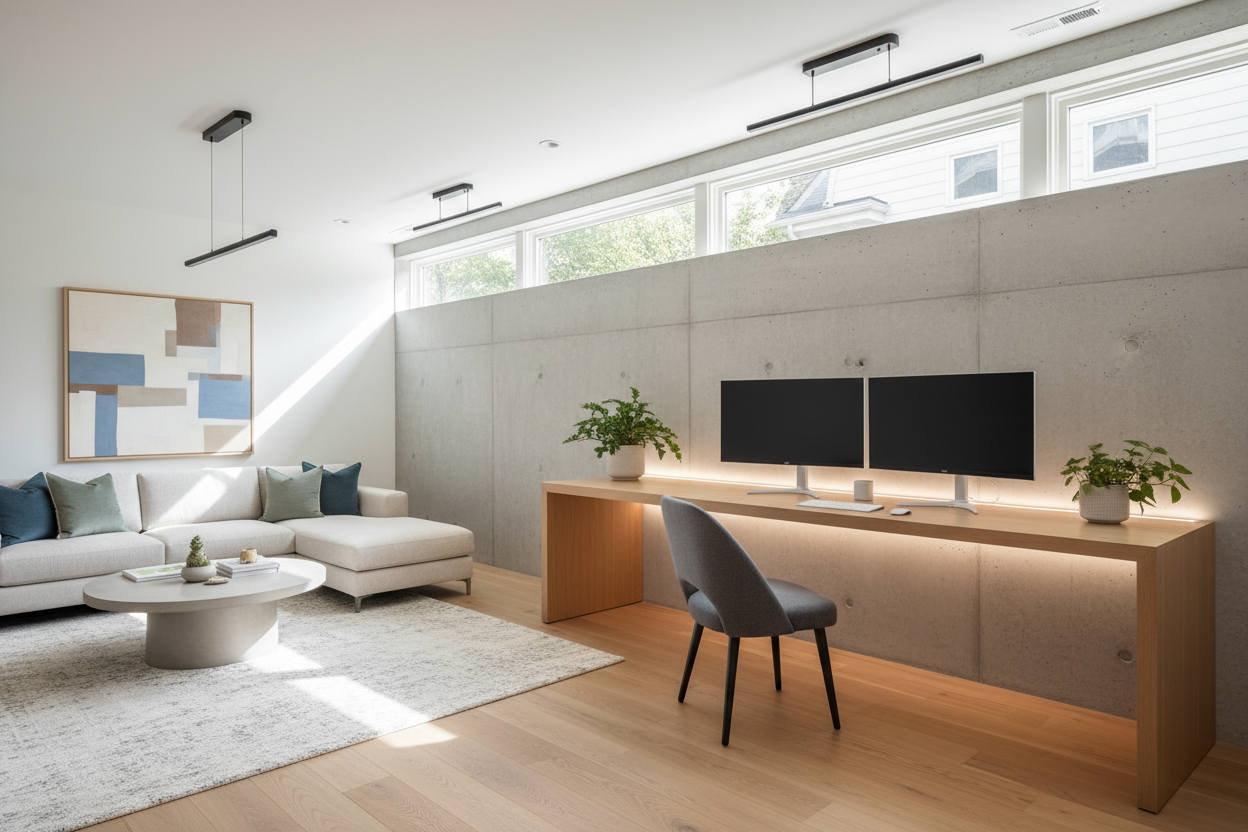
I have seen too many clients retreat to a folding table next to the water heater and call it a workspace. If you are tired of feeling banished to the subterranean depths of your home, you need strategic basement office ideas that prioritize light, warmth, and workflow. Designing an office in a basement requires a completely different approach than a standard above-ground room, primarily because you are fighting against low ceilings, awkward structural columns, and a severe lack of natural sunlight.
Whether you are carving out a small basement office in an unfinished corner or planning a fully finished basement office remodel, this guide will break down exactly how to turn a cold, neglected lower level into a highly productive sanctuary you actually want to spend time in.
Quick Decision Guide
- Prioritize layered lighting: Relying on a single overhead builder-grade flush mount is the fastest way to induce eye strain. You need ambient, task, and accent lighting.
- Float your desk: Pushing your desk against a blank wall emphasizes the lack of windows. Face the center of the room instead.
- Manage the climate: Basements run cold and damp. Invest in a dehumidifier and an oversized, plush area rug with a thick pad.
- Use vertical space: Keep the floor plan open by utilizing tall shelving for storage, drawing the eye upward to make low ceilings feel higher.
Conquering the Cave: Lighting and Color
Faking Natural Light
The biggest hurdle in basement office design is the lighting. If you are looking for basement office ideas no windows, your strategy must revolve around faking daylight. Swap out harsh, yellow bulbs for LEDs in the 3000K to 3500K range. This temperature mimics natural morning light without feeling like a sterile hospital. Add bias lighting (LED strips) behind your monitor to reduce eye fatigue, and place a warm table lamp on your basement desk.
Strategic Paint Choices
A common mistake in a basement home office is painting the walls stark white to make it brighter. Without natural light to bounce around, stark white just looks gray and dingy. Instead, opt for warm off-whites, soft creams, or even a moody, saturated color like deep navy or forest green if you want to lean into a cozy, modern basement office ideas aesthetic. Paint the ceiling the same color as the walls to blur the visual boundaries and make the room feel taller.
Space Planning & Layout
Floating the Desk vs. Wall Placement
When planning your basement office setup, resist the urge to shove your desk into a corner. If you have the square footage, float the desk in the middle of the room facing the door. This layout commands authority and prevents you from staring at drywall all day. For a small basement home office where floating isn't an option, place your desk perpendicular to the wall so you still have a view of the room.
Creating Visual Zones
If your office space in basement is part of a larger, open-concept family room, you need to establish boundaries. You don't necessarily need to build walls to turn basement into office. Use a large area rug to anchor the basement workspace ideas, and place a backless bookcase as a room divider. This allows light to flow through while clearly defining the workroom from the recreation area.
Designer's Honest Take: Lessons from My Own Projects
A few years ago, I designed a basement home office for a client in a 1920s craftsman home. They wanted a moody, executive feel, so I specified a beautiful, massive walnut desk. I learned two hard lessons on installation day.
First, I didn't fully account for the narrow, winding basement stairwell. We had to remove the door frame, take the desk off its hinges, and pray we didn't scrape the newly painted walls. Always, always measure your clearance before ordering heavy furniture for a lower level.
Second, once the desk was in the room, the dark wood absorbed absolutely every ounce of light in the space. It felt like a black hole. I had to scramble to add a light-colored leather desk mat and extra ambient lighting to balance the visual weight. Since then, I almost exclusively recommend lighter woods like white oak or ash, or glass-topped desks, when brainstorming small basement office design ideas. They keep the footprint feeling airy and reflect whatever light you do have.
Frequently Asked Questions
How do I build a small basement office with no windows?
If you are working with small basement office ideas no windows, focus on reflective surfaces. Hang a large mirror opposite your primary light source to bounce illumination around the room. Keep your furniture silhouette visually light—think desks with thin metal legs rather than heavy, solid wood bases.
What is the best way to define an office space desk in a basement?
Use an oversized area rug to act as the footprint for your office. Make sure the rug is large enough that your chair can roll back without catching the edge. You can also paint an arch or a color-blocked square on the wall behind your desk to visually frame the basement study ideas.
Is a DIY basement home office worth it?
Taking on a diy basement office can save you thousands, especially if you handle the cosmetic updates like painting, laying luxury vinyl plank flooring, and assembling flat-pack storage. However, I highly recommend hiring a licensed electrician to ensure you have adequate, grounded outlets for your computer equipment and proper overhead lighting.


Dejar un comentario
Este sitio está protegido por hCaptcha y se aplican la Política de privacidad de hCaptcha y los Términos del servicio.