










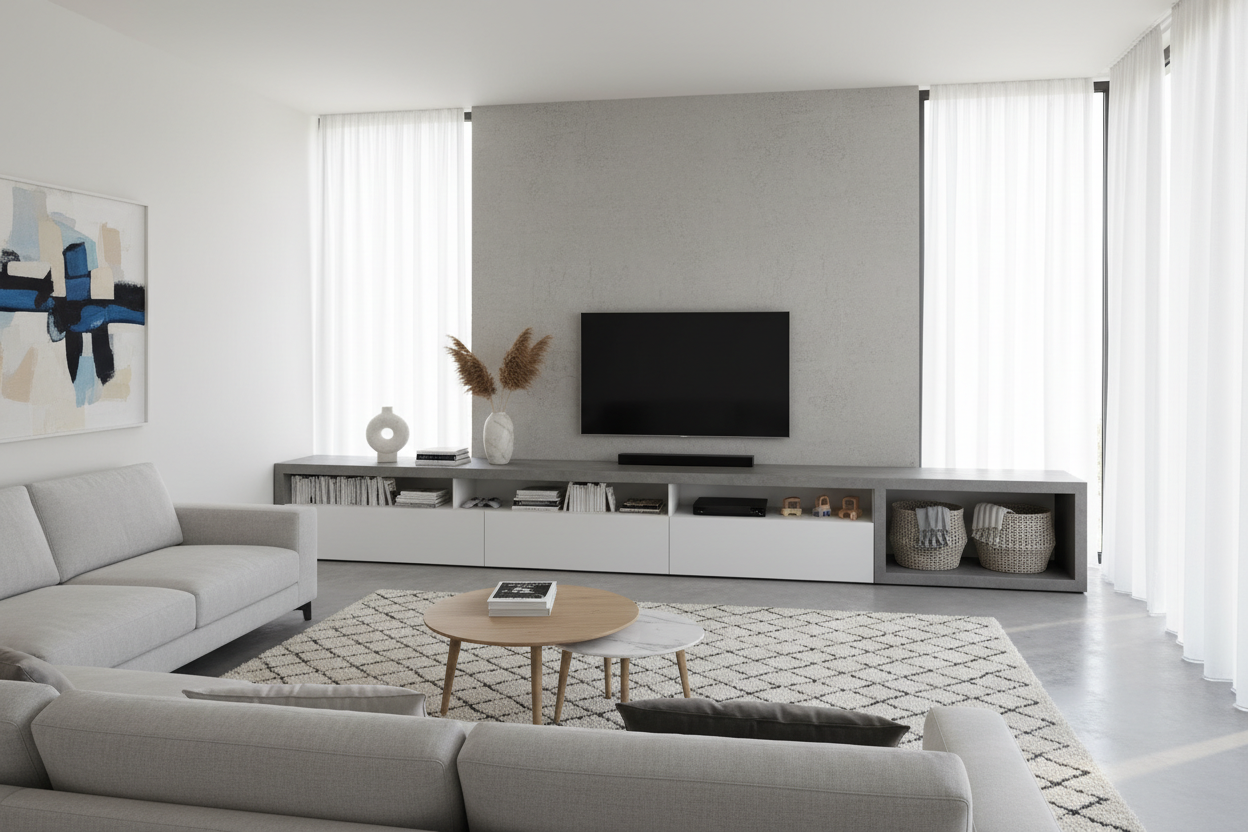
I spent three years staring at a massive, oak-colored beast of a cabinet that housed my TV, a 2006 DVD collection I never watched, and a printer I hadn't used since the Obama administration. It dominated the room, making my 12x15 living room feel like a walk-in closet. When I finally decided to swap it for a long short tv stand, I was terrified I’d end up with a pile of loose HDMI cables and nowhere to put the board games. It felt like a choice between having a stylish home and having a functional one.
Quick Takeaways
- Horizontal volume often equals vertical volume; you aren't losing as much storage as it seems.
- Low profiles create visual breathing room that makes small apartments feel twice as big.
- Deep, wide drawers are functionally superior to dark, cavernous shelves for electronics.
- Cable management is easier when the distance between the TV and the floor is minimized.
The Minimalist Dilemma: Sleek Aesthetics vs. Ugly Board Games
The anxiety of downsizing from a wall-eating unit is real. We’ve been conditioned to think that more height equals more storage, but most of that vertical space in a traditional entertainment center ends up filled with dust or decorative filler that you don't actually like. When you move to a low-profile design, the fear is that your router, your Nintendo Switch, and your stack of Catan expansions will suddenly have no home.
I realized that my old unit was 60% air. By switching to a stand that sits closer to the ground, you're forced to curate. You stop keeping manuals for appliances you no longer own. The 'short' part of the stand keeps the eye line low, which tricks the brain into thinking the ceiling is higher than it is. It’s a design hack that designers have used for decades, but for those of us with a lot of junk, it feels like a gamble.
Why a Long Short Entertainment Center Actually Surprised Me
Geometry is a funny thing. If you take a 60-inch tall cabinet and flatten it out into an 84-inch wide base, you aren't actually losing much cubic volume; you're just reconfiguring it. A long short entertainment center utilizes the 'dead space' along your baseboards. This horizontal expansion is a much more efficient use of a room's footprint because it leaves the wall space above the TV open for art or just... nothing. And nothingness is a luxury in a cluttered world.
When I set up my first wide console, I found I could fit just as many board games by laying them flat rather than stacking them like books. It’s about the footprint. A unit that is 70+ inches long provides a massive amount of internal real estate while only standing 15 to 18 inches off the floor. It feels substantial without being oppressive.
Horizontal Drawers Are Secretly Better Than Tall Shelves
I will die on this hill: deep, wide drawers are better than shelves. In a tall media unit, things at the back of a shelf are basically gone forever. You need a flashlight and a prayer to find a spare HDMI cable. With something like a black tv stand entertainment center that uses drawer storage, you pull the drawer out and see everything from a bird's eye view.
Drawers are also better for hiding the 'ugly' stuff. Controllers, remotes, and those weird dongles for the TV don't look good on an open shelf. They look like clutter. But in a 24-inch wide drawer, they stay organized and out of sight. I’ve found that a single long drawer can hold more tech accessories than three small cubbies ever could.
How to Hide Your Bulkiest Tech in a Low-Profile Unit
The biggest challenge with a short unit is the 'tech tower'—those bulky routers and game consoles that don't always fit in a 12-inch high opening. My trick? Don't put the router inside the unit at all. I used heavy-duty command strips to mount my Wi-Fi router to the back of the TV itself. It’s completely invisible and the signal is actually better because it's not encased in wood or MDF.
For consoles like the PS5 or Xbox, ventilation is the priority. If your unit has a back panel, take a hole saw and double the size of the cable management cutouts. If you're worried about the tech being an eyesore, choosing a console table entertainment center with a high-gloss finish can help. The reflective surface tends to bounce light around the room, which distracts the eye from the dark voids where your cables and boxes live. Just make sure you leave at least two inches of clearance on all sides of any console to prevent it from turning into a space heater.
Styling the Top (Without Re-Cluttering It)
The 'long' part of the stand gives you a lot of runway. The temptation is to fill it with every candle and picture frame you own, but don't. Use the extra surface area to create 'zones.' Put the TV on one side and a single, large structural vase or a stack of art books on the other. This asymmetrical look is much more modern than centering everything.
I've seen people struggle with the vast empty space next to a 55-inch screen on an 80-inch stand. If you want to get fancy, you can learn how to style wide media consoles by using trays to group smaller items. A tray turns a 'pile of stuff' into a 'curated collection.' It also makes it easier to clear the surface when it's time to dust.
The Verdict: Is the Trade-Off Worth It?
Moving to a low-profile stand requires a change in how you think about your belongings, but the visual payoff is massive. The room feels lighter, the TV looks like a piece of art rather than a monitor in a box, and you're forced to stop hoarding old tech. When debating the merits of a traditional tv stand and entertainment center, ask yourself if you'd rather have more cabinets to fill with junk or more room to breathe. For me, the extra floor space and the clean sightlines won every time.
Personal Experience: The PS5 Problem
I bought a 72-inch wide, 14-inch tall unit last summer. The assembly was a bit of a slog—42 cam locks that I definitely over-tightened—but once it was against the wall, the room felt twice as big. My biggest mistake? I didn't measure my PS5. It wouldn't fit vertically in the shelves. I ended up mounting it horizontally on a hidden bracket behind the TV. It was a 20-minute fix that saved the 'clean' look I was going for. If you're going short, always measure your tallest piece of tech first.
FAQ
Will my remote work if the box is inside a drawer?
If your devices use Bluetooth (like most modern consoles and Fire Sticks), yes. If they use Infrared (IR), you'll need an IR repeater, which is a cheap little cable that lets the signal pass through solid wood doors.
Should I wall mount the TV or put it on the stand?
With a very short stand, wall mounting is usually better. It allows you to set the TV at the perfect eye level while leaving the surface of the stand free for decor. Aim for the center of the screen to be about 42 inches from the floor.
Are these stands sturdy enough for heavy TVs?
Most modern LED TVs are surprisingly light, but check the weight rating. Solid wood or high-grade MDF stands are fine, but be wary of thin particle board if you're rocking an older, heavier 65-inch screen.

Dejar un comentario
Este sitio está protegido por hCaptcha y se aplican la Política de privacidad de hCaptcha y los Términos del servicio.