










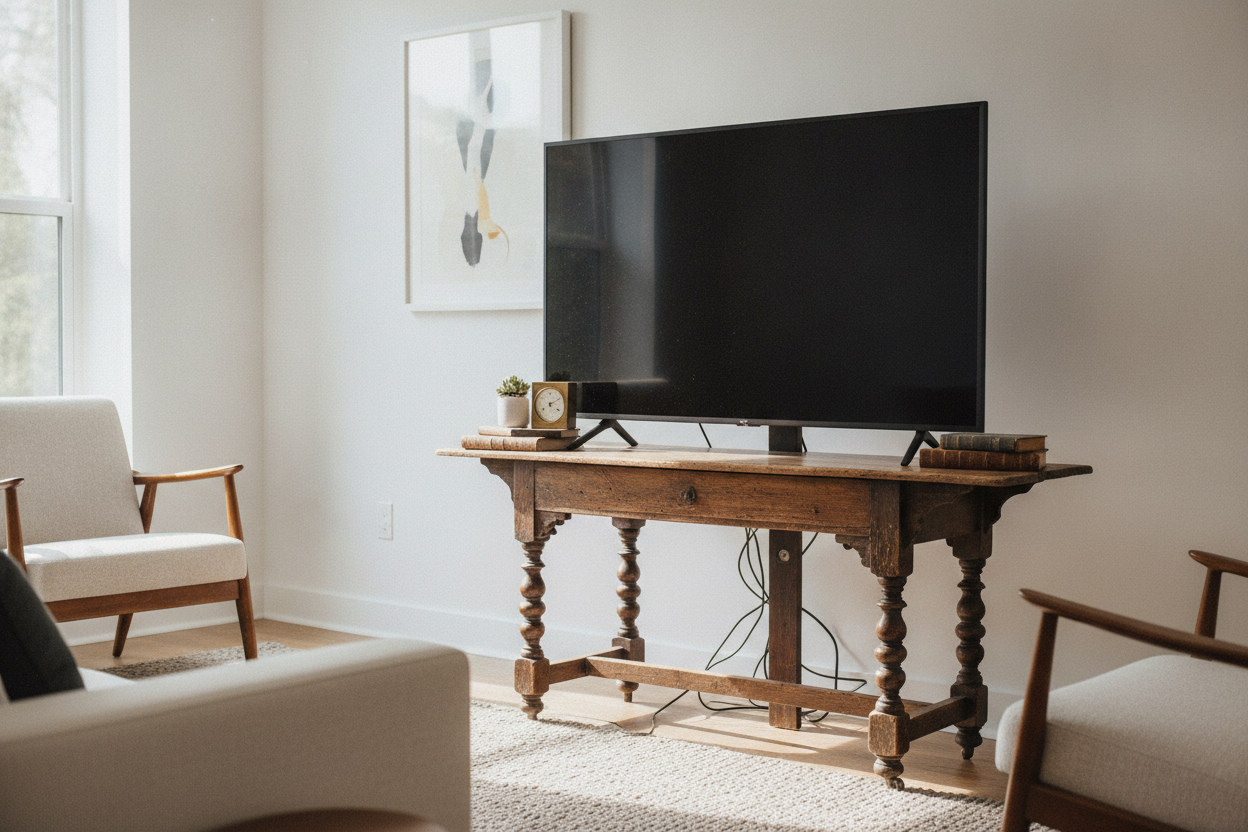
I spent three weeks staring at a 65-inch black rectangle sitting on the floor of my living room because I couldn't bring myself to buy a generic, gray-wash MDF console from a big-box store. Every time I went browsing standard TV stands, I felt like I was looking at furniture designed for a dorm room, not a home with actual personality. I wanted something with a soul, which led me down the rabbit hole of finding the perfect antique tv stand.
The tension is real, though. You’re trying to marry a piece of 19th-century craftsmanship with a piece of 21st-century silicon and glass. It can look like a masterpiece or a total disaster. Before you drag a heavy 1940s sideboard into your house, you need to know if it can actually handle the job without cracking under the pressure—literally.
Quick Takeaways
- Check for center support legs; most vintage pieces weren't built for the concentrated weight of modern large-scale screens.
- Measure the depth twice—modern screens are thin, but their stands often require more surface area than an old tv stand provides.
- Avoid pieces with high-gloss finishes if you have overhead lighting, as the glare from the screen will bounce off the wood.
- Be prepared to get creative with cable management to avoid drilling into historical wood.
The Truth About Mixing 19th Century Wood with 21st Century Tech
There is a specific kind of warmth that comes from a vintage television stand that you just won't find in a modern showroom. The patina, the dovetail joints, and the smell of actual beeswax polish create a contrast with the cold, sterile glass of a flat screen. It makes the room feel lived-in rather than staged.
People are moving away from the 'tech-forward' look. We're tired of living rooms that look like Best Buy showrooms. A vintage entertainment center breaks up the monotony. Whether it's a mid-century credenza or an ornate tv stand from the Victorian era, these pieces act as an anchor that tells a story, making the TV feel like a secondary part of the room rather than the main event.
Will It Actually Hold the Weight of Your Screen?
This is where things get dicey. An old tv in cabinet setup from the 1950s was built to hold a heavy tube, but that weight was distributed differently. If you’re looking at vintage television cabinets or a delicate vintage tv table, check the joinery. If the top is bowing even slightly without anything on it, walk away.
I’ve found that a wide storage cabinet with drawers is usually the safest structural bet. These pieces were often built to hold heavy linens or silverware, meaning they have solid internal framing. If you choose a vintage tv cabinet with doors, make sure the interior shelves are reinforced. Many old cabinet tv units have thin plywood backs that offer zero structural integrity, so the top bears all the load.
The Cable Management Nightmare (And How to Fix It)
The biggest heartbreak is finding a gorgeous antique tv cabinet and realizing there’s nowhere for the HDMI cables to go. You have two choices: the drill or the drape. I personally refuse to drill holes into a 100-year-old vintage tv unit. It’s a permanent modification that kills the resale value and the history.
Instead, use adhesive cord clips along the back legs of your vintage tv stand with storage. If you have a mess of consoles, consider a modern hidden TV mechanism if you really hate the tech look, but for a true antique, exterior cord covers painted the same color as your wall are your best friend. It’s about making the wires disappear into the architecture rather than the furniture.
Preventing the 'Spaceship Landing' Effect
A massive TV on a small antique tv stand looks ridiculous. It’s top-heavy and visually jarring. To make a vintage retro tv cabinet work, the TV should ideally be no wider than the stand itself. If the screen overlaps the edges, it looks like a spaceship just landed on a tiny wooden pedestal.
Balance the visual weight by surrounding the screen with analog items. Put a stack of linen-bound books on one side and a heavy ceramic lamp on the other. If you’re using a retro wooden tv cabinet, the goal is to pull the eye away from the black void of the screen. Learning how to style a display cabinet TV stand is mostly about layering textures so the TV becomes just another object in the room.
When Faking It Is Actually the Better Choice
I’ll be honest: sometimes a real antique is just too much work. If you have a 85-inch screen that weighs 100 pounds, a small vintage tv stand is going to snap. Or maybe you just don't have the patience to hunt through estate sales for a vintage tv stand for sale that isn't covered in lead paint.
In those cases, an antique style tv stand or a vintage inspired tv stand is the move. You get the aesthetic of a retro wood tv cabinet but with the benefits of pre-drilled cable holes and reinforced tops. A large TV cabinet spacious storage unit can give you that heavy, old-world look without the stress of wondering if your TV will be on the floor by morning.
My Personal Take: The Mid-Century Mistake
I once bought a stunning 1960s teak sideboard to use as a vintage tv stand. It was beautiful, but it had those iconic, thin peg legs. Within three months of placing my old-style heavy plasma on it, the center of the unit had sagged nearly half an inch. I had to crawl underneath and install a makeshift 'fifth leg' using a block of scrap wood. It worked, but it was a lesson learned: beauty doesn't equal weight-bearing capacity. Always look for a center support or a solid plinth base when shopping for antique looking tv stands.
FAQ
Can I put a 65-inch TV on a vintage dresser?
Yes, but check the height. Most dressers are 30-36 inches tall, which might put the TV above eye level when you're sitting on a sofa. Aim for a height of 22-28 inches for the best viewing angle.
How do I hide wires on an antique tv stand without drilling?
Use 'J-channels' or adhesive cable raceways attached to the back of the furniture, not the wall. You can also hide power strips inside a decorative basket placed next to the stand.
Are old tv cabinets for sale worth the money?
Only if they are solid wood. Many 'vintage' cabinets from the 70s and 80s are actually particle board with a veneer. Knock on the side; if it sounds hollow and thin, it’s not worth the investment.

Dejar un comentario
Este sitio está protegido por hCaptcha y se aplican la Política de privacidad de hCaptcha y los Términos del servicio.