










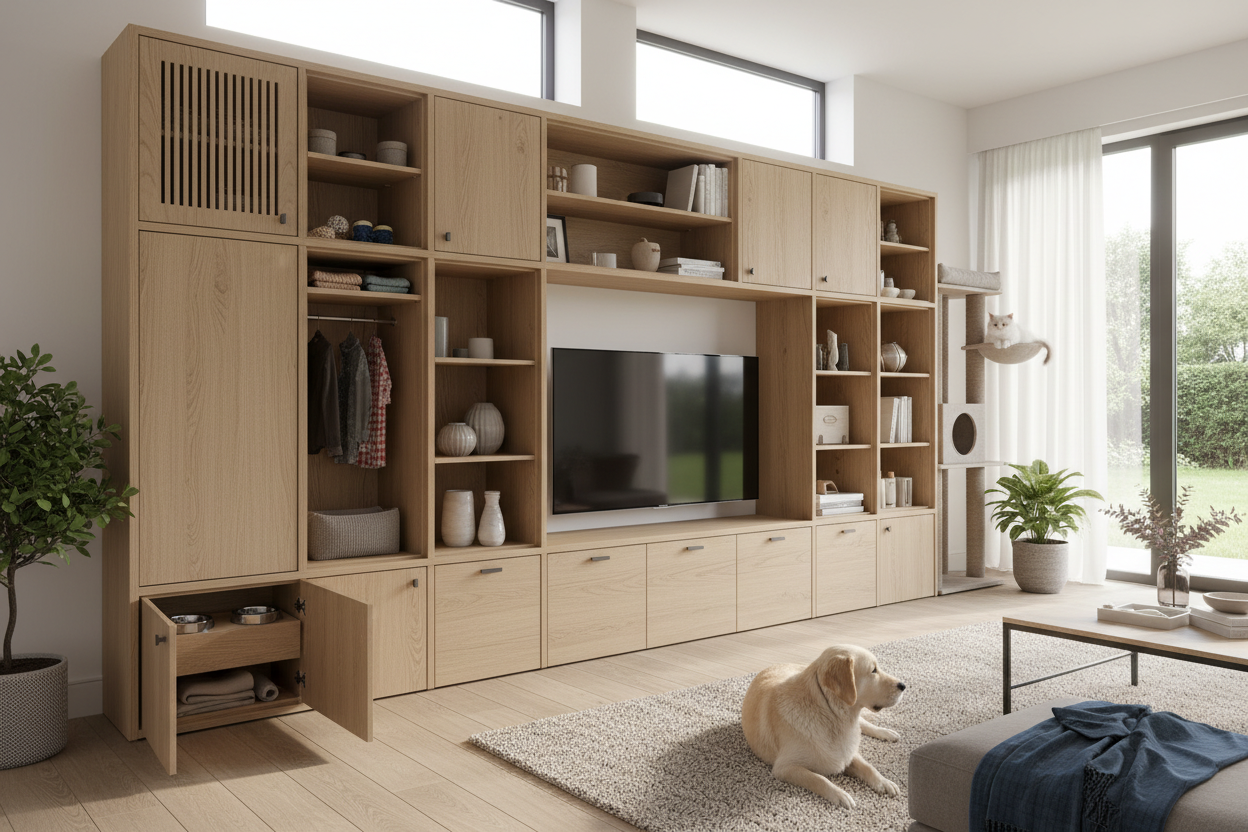
I spent three months and a small fortune picking out the perfect velvet sofa, only to have it flanked by a rusted wire dog crate and a neon yellow tennis ball launcher. My living room didn't look like an adult's home; it looked like a Petco clearance aisle. I was constantly tripping over a 36-inch crate that seemed to take up half the floor space, and no amount of 'aesthetic' blankets could hide the fact that my dog lived in a metal cage in the middle of my sanctuary.
That was the moment I realized furniture wall units weren't just for displaying dusty encyclopedias or housing a 75-inch TV. They are the only way to reclaim your floor while still being a 'good' pet parent. By thinking vertically and choosing pieces with actual structural integrity, you can stop living in a kennel and start living in a home again.
Quick Takeaways
- Vertical storage is non-negotiable for cat owners who want to ditch the ugly carpeted towers.
- Lower cabinets must be at least 24 inches deep to comfortably house most medium-to-large dog crates.
- Hardwood or high-pressure laminates are the only materials that survive a teething puppy or a bored cat.
- Always anchor your unit to the wall—pet movement creates dynamic weight that can topple unanchored shelves.
The 'Pet Store Chic' Living Room Problem
We’ve all been there. You buy a beautiful rug, and then you have to put a plastic tray under a food bowl right on top of it. Then comes the scratching post—usually covered in that specific shade of beige carpet that matches nothing in the known universe. Before you know it, your design aesthetic is 'Pet Store Chic,' and it’s exhausting to look at.
The problem is that pet gear is designed for function, not form. Manufacturers assume you don't care what a crate looks like as long as it holds the dog. But when you're living in a 900-square-foot apartment, every square inch of visual clutter feels like a personal attack. You need a system that absorbs the mess rather than just sitting next to it.
Why Small Storage Bins Just Don't Cut It
I tried the 'basket method' for a year. I bought those cute seagrass bins to hold the squeaky toys and the leashes. Within a week, the dog had chewed the handles off the bins, and the cat was using the wicker as a personal manicure station. Beyond the durability issue, small bins don't solve the big problems: the crate and the climbing space.
A low-profile media console is great for a minimalist, but it leaves six feet of empty wall space above it. That is wasted real estate. When you switch to massive wall units, you’re not just adding shelves; you’re creating a dedicated architecture for your life. You can tuck the toys in a drawer, hide the litter box in a ventilated cabinet, and still have room for your actual human belongings.
Swapping the Base Cabinets for Built-In Dog Dens
The smartest thing you can do with the bottom 30 inches of your wall unit is to stop thinking of it as 'cabinet space' and start thinking of it as 'real estate.' Most standard wall units come with flimsy particle board doors. If you’re serious about integration, you want a base that can actually handle a living creature. This is where you look for a Large Dog Crate Furniture With Divider to serve as the foundation of your setup.
By using a furniture-grade crate as the bottom 'anchor' of your wall unit, you eliminate the footprint of a separate metal cage. I’ve seen people remove the back panels of their lower cabinets to allow for airflow, effectively turning a standard unit into a custom kennel. Just make sure your dog has enough room to stand up and turn around—usually a 24-inch depth is the bare minimum for a comfortable den.
Ditch the Carpeted Tower: Vertical Space is for Cats
Cats want to be high up. They don't actually care if the thing they’re climbing is covered in hideous carpet or if it’s a sleek, modern shelf. The beauty of large wall units is the staggered shelving. You can create a 'staircase' effect with open shelves that allows your cat to reach the ceiling without ever touching a piece of traditional Cat Furniture.
I personally use a mix of closed cabinets for my 'stuff' and open, reinforced shelves for the cats. If you leave a 12-inch gap between the top of the unit and the ceiling, that becomes their 'skywalk.' It keeps them off the kitchen counters and gives them a sense of security, all while looking like a sophisticated library to your human guests. Just be sure to add a few adhesive felt pads to the shelves to give them grip during high-speed zoomies.
Material Matters When Mixing Pets and Cabinetry
If you buy a cheap unit made of paper-thin MDF, your pets will destroy it in six months. I learned this the hard way with a $300 'bargain' unit that literally dissolved when my dog knocked over his water bowl near the base. When you are looking at Entertainment Furniture Units What Designers Look For Before You Buy, you have to prioritize moisture resistance and finish durability.
Look for kiln-dried hardwoods or high-grade plywood with a real wood veneer. Avoid anything with 'paper foil' finishes—one cat scratch and the whole thing starts peeling like a bad sunburn. Also, check the hardware. You want soft-close hinges so the doors don't slam and spook your pets, and magnetic latches are a godsend for keeping curious paws out of the treat drawer.
My Personal Experience: The Great Topple of 2021
I once thought I could get away with a free-standing bookshelf for my cat's climbing needs. I didn't anchor it because I was 'renting' and didn't want to mess up the drywall. One afternoon, my 15-pound Maine Coon launched himself from the sofa to the top shelf. The entire unit tipped forward, narrowly missing the TV and sending my collection of vintage glassware to its grave. Now, I don't care if it's a 400-pound solid oak unit; I use L-brackets and hit the studs every single time. Safety isn't just about the furniture; it's about the living things on it.
Frequently Asked Questions
Will my dog feel cramped in a furniture-style crate?
Not if you size it correctly. Most furniture crates follow the same dimensions as standard wire ones. The key is ensuring there is enough ventilation—look for units with slats on at least three sides so they don't get too hot.
How do I keep the wall unit from smelling like a pet?
Airflow is everything. Don't trap a litter box or a bed in a fully sealed cabinet. Use decorative metal grilles or 'breathable' rattan door inserts. Also, stick to non-porous surfaces that don't absorb odors like unfinished wood does.
Can I really use regular shelves for cats?
Yes, but you need to check the weight rating. A standard shelf might be rated for 20 pounds of 'static' weight (books), but a jumping cat exerts 'dynamic' force. Double up on the shelf pins or use heavy-duty brackets to be safe.

Dejar un comentario
Este sitio está protegido por hCaptcha y se aplican la Política de privacidad de hCaptcha y los Términos del servicio.