










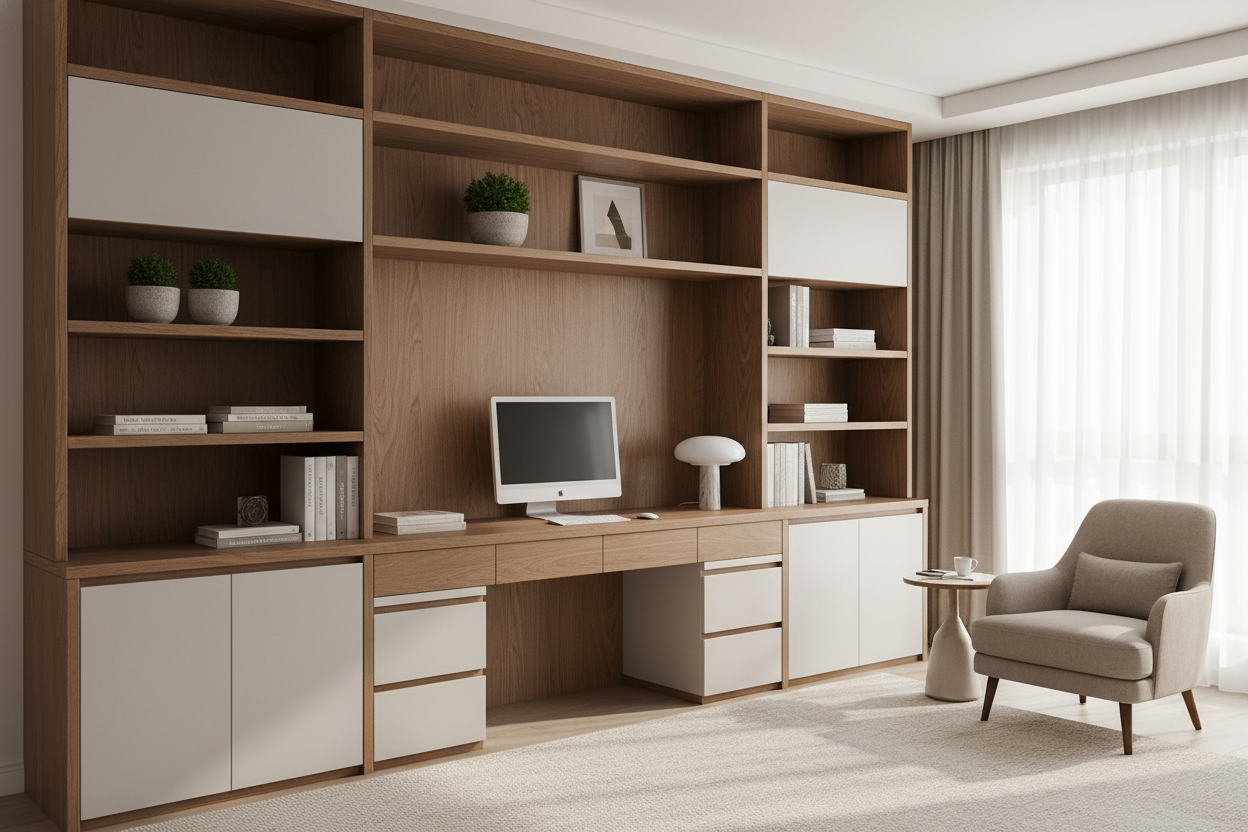
I spent three years working from a desk that was essentially a glorified TV tray, surrounded by a chaotic 'system' of three different mismatched filing cabinets and a leaning tower of Amazon boxes. Every time I sat down to work, my brain felt like it had 47 browser tabs open before I even touched the mouse. It wasn't until I finally looked into office wall units that I realized my problem wasn't a lack of discipline; it was a lack of architectural boundaries.
The truth is, your brain is constantly scanning your environment for threats or tasks. When you see a pile of unsorted mail on a random shelf or a tangle of cords behind a standalone desk, your focus takes a hit. You don’t just need a place to sit; you need a system that closes the loop on visual clutter so you can actually get through your to-do list without a headache by 2 PM.
Quick Takeaways
- Visual noise from scattered furniture creates subconscious stress that drains your workday energy.
- A single, cohesive wall unit provides 'closed' storage for ugly essentials and 'open' storage for inspiration.
- Contrary to popular belief, one large unit makes a small room feel bigger than multiple small pieces.
- Integrated cable management is the secret to a professional-looking setup that doesn't look like a server room.
The Psychology of Visual Clutter in Your Workspace
We often think that as long as we have a flat surface and a chair, we’re good to go. But a freestanding desk sitting in a sea of mismatched storage is a recipe for distraction. When you’re upgrading your home office, you have to consider the 'visual weight' of your furniture. If your eyes are jumping from a black metal filing cabinet to a pine bookshelf to a plastic bin under the desk, your brain is working overtime just to filter out the mess.
I’ve found that a home office wall unit acts as a visual anchor. It tells your brain, 'Everything inside this frame is work, and everything outside is home.' By consolidating your storage into one vertical plane, you eliminate the peripheral noise that keeps you from entering a flow state. It’s the difference between working in a library and working in a garage sale. You want the library vibes.
How a Home Office Wall Unit Solves the Storage Problem
The magic of a wall unit for home office use lies in the ratio of open to closed storage. You probably have a printer that looks like a beige plastic brick from 2004, a stack of tax returns, and a bunch of extra toner cartridges. You do not need to see these things. A good wall system uses heavy-duty lower cabinets—ideally with 3/4-inch thick shelving that won't sag under the weight of paper—to hide the 'ugly' stuff.
Meanwhile, the upper half of the unit should be reserved for things that actually make you feel good. Think of it as a curated display. By mastering full wall desk layouts, you can position your primary workspace so that these storage elements are within arm's reach but don't crowd your elbows. I personally prefer a unit that’s at least 84 inches tall; it uses the vertical space you’re already paying for in rent or mortgage but aren’t currently using.
Will a Wall Unit for Home Office Overwhelm a Small Room?
This is the biggest fear I hear from people living in apartments or small suburban spares. They think a home office wall unit will swallow the room whole. In reality, the opposite is true. When you cram a desk, a bookshelf, and a storage chest into a 10x10 room, you create dozens of small gaps and shadows. This 'choppiness' makes the room feel cramped and cluttered.
One unified structure creates a clean, architectural line that draws the eye upward. It’s much more efficient than trying to fit a bulky corner desk with large storage into a space where it doesn't quite belong. By using one wall for everything, you actually free up the rest of the floor space, making the room feel more intentional and less like a storage unit you happen to work in.
Integrating Your Tech Without the Tangled Mess
Nothing kills a high-end aesthetic faster than a 'cable waterfall' spilling off the back of a desk. Professional home office wall system furniture is designed with this in mind. I look for units that feature built-in grommets and recessed channels. If you’re spending more than $1,000 on a setup, it should absolutely have a way to hide your surge protector and that bulky laptop power brick.
I once made the mistake of buying a cheap flat-pack unit that had no back panel. I thought I’d be clever and just run the wires behind it. Total disaster. Every time a cable slipped, I had to move the entire heavy unit to reach it. A proper system has access points at desk height and baseboard height. It allows you to run task lighting—like those warm LED strips under the shelves—without visible wires ruining the vibe. It turns your office from a tech-tangled mess into a streamlined cockpit.
Styling Your Office Wall Units for Maximum Focus
Once the unit is built and the tech is hidden, don't just shove your old binders back onto the shelves. The goal is focus, not just storage. Use the eye-level shelves for things that inspire you but don't distract you. I like to mix in some home office wall art ideas, like leaning a framed print against the back of the unit rather than hanging it. It adds depth and makes the furniture feel like a part of the room’s soul.
Keep the color palette tight. If your wall unit is a dark walnut, use brass or matte black accents. If it’s white, maybe go with oak or glass accessories. Avoid the temptation to use every square inch of shelf space. 'Negative space' is your friend here. A few empty spots on a shelf give your eyes a place to rest, which is exactly what you need when you look up from a grueling spreadsheet.
My Personal Experience: The Particle Board Lesson
A few years ago, I tried to save money by 'hacking' a wall unit together using four cheap laminate bookcases I found at a big-box retailer. I spent six hours assembling them, only to realize they didn't line up perfectly. There were 1/8-inch gaps between them that drove me insane every single day. Within six months, the shelves started to 'smile' (that's industry speak for sagging) because they weren't rated for the weight of my reference books. I eventually bit the bullet and invested in a real modular wall system with solid wood veneers and adjustable levelers. The difference in my mental clarity was immediate. It felt like I finally had a 'real' job, even though I was still working in my sweatpants.
FAQ
Do wall units need to be anchored to the wall?
Yes, absolutely. Any unit over 48 inches tall is a tipping hazard, especially if you have kids or pets. Most quality systems come with anti-tip kits. Don't skip this step; a fully loaded unit can weigh hundreds of pounds.
Can I put a printer inside a closed cabinet?
You can, but check for ventilation and pull-out trays. Printers generate heat and need a bit of 'breathing room.' A pull-out shelf is the best way to keep it hidden but accessible when you actually need to grab a hard copy.
How deep should a wall unit be?
For standard books and decor, 12 to 15 inches is plenty. However, if your desk is integrated into the unit, you’ll want a work surface that is at least 20 to 24 inches deep so you aren't staring directly into a wooden panel while you type.

Dejar un comentario
Este sitio está protegido por hCaptcha y se aplican la Política de privacidad de hCaptcha y los Términos del servicio.