











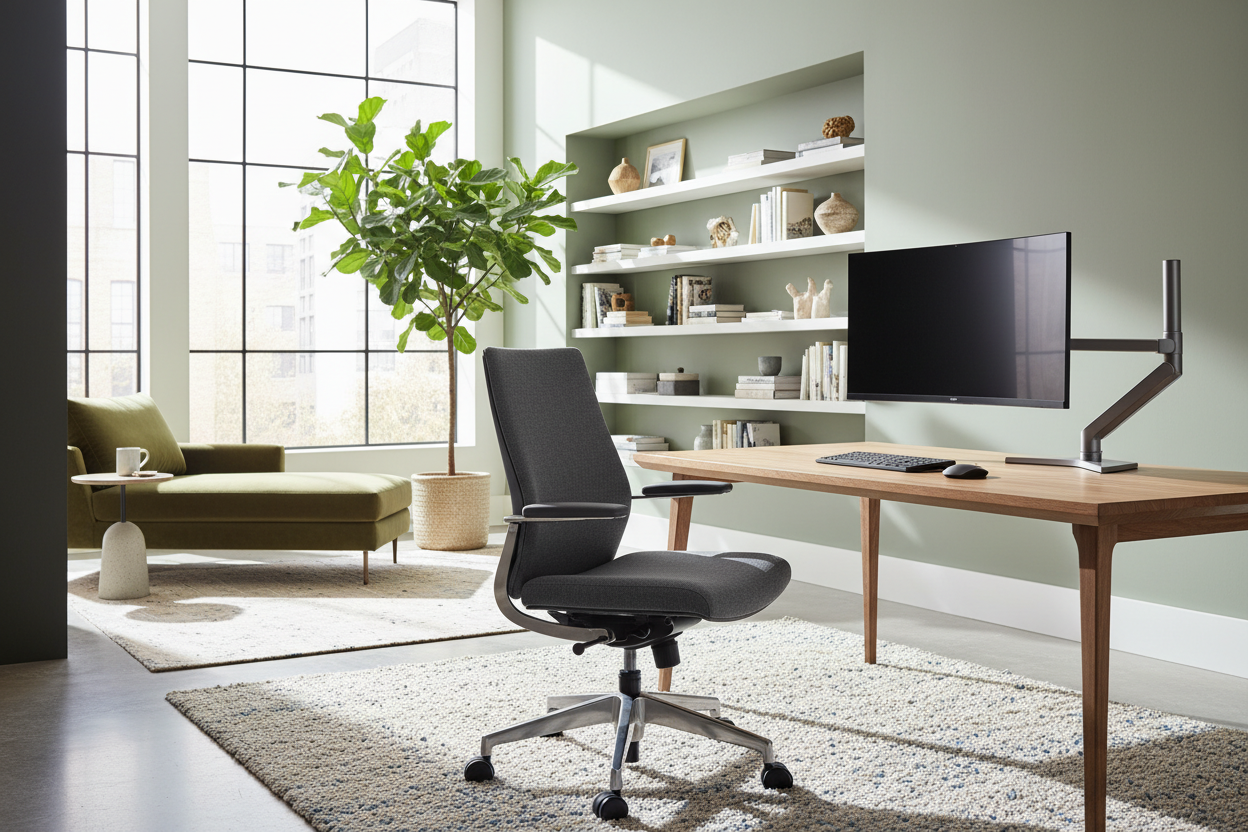
We often treat the home office as an afterthought, repurposing a dining chair or buying the first visually appealing option we see online. This is a design dilemma I see constantly: a client spends thousands on a custom desk but pairs it with seating that destroys their posture. The truth is, selecting the right athome office chair is less about finding a matching color and more about engineering your environment for sustained focus.
Quick Decision Guide: Key Features to Look For
If you are rushing to make a purchase, prioritize these four non-negotiable elements to ensure longevity and comfort:
- Lumbar adjustability: Look for a support system that moves up and down to hit the curve of your specific spine, not a fixed cushion.
- Seat depth (Seat Pan): You should have about two to three fingers of space between the edge of the seat and the back of your knees.
- Mechanism quality: Synchro-tilt mechanisms (where the back reclines faster than the seat) offer superior ergonomic support compared to standard center-tilt.
- Base stability: A five-star base is the industry standard for safety; avoid four-leg bases for daily heavy use.
Balancing Visual Weight and Ergonomics
In interior design, we talk about "visual weight"—how heavy an object looks in a room. The classic mistake homeowners make is buying an "executive" style high-back leather chair for a small apartment corner. These massive silhouettes dominate the room and make the space feel claustrophobic.
For a residential setting, I always recommend a chair with a mid-back profile or a transparent mesh backing. This allows light to pass through the furniture, maintaining an airy, open feel. If you require a headrest for long hours, look for modular designs where the headrest doesn't add unnecessary bulk to the chair's silhouette.
Materiality: Beyond the Aesthetic
The tactile experience of your chair dictates your thermal comfort throughout the day. While leather (and vegan leather) offers a sophisticated, executive look, it is not breathable. If your workspace lacks aggressive air conditioning, you will find yourself sticking to the material by midday.
The Case for Performance Fabric
Fabric upholstery brings softness and warmth, helping the chair blend into a bedroom or living area design scheme. However, ensure the rub count (Martindale test) is above 30,000 for durability. I often steer clients toward commercial-grade polyester blends that mimic the texture of wool or linen but offer stain resistance.
Mesh Tension
Mesh is fantastic for airflow, but be wary of low-quality tension. Cheap mesh sags over time, resulting in the plastic frame digging into your thighs. High-end elastomer mesh retains its tautness and distributes weight evenly.
My Personal Take on athome office chair
I learned a hard lesson early in my career regarding "waterfall edges." I once specified a stunning, vintage-inspired velvet chair for a client who wanted a "Mad Men" aesthetic. It looked incredible in the mood board. However, the seat pan was completely flat with hard piping along the edge.
After using a similar model in my own studio for a week to test it, I realized the issue. Within two hours, the hard edge cut off circulation to my lower legs—a phenomenon known as contact stress. No amount of cushioning can fix bad geometry. Now, regardless of how beautiful a chair looks, I physically run my hand over the front edge of the seat. If it doesn't curve downward gently (the waterfall effect) to relieve pressure on the hamstrings, I won't put it in a client's home. That subtle curve is the difference between a productive afternoon and numb legs.
Conclusion
Your chair is the cockpit of your productivity. By prioritizing adjustable mechanics and breathable materials over pure aesthetics, you create a workspace that supports your health. Invest in a piece that respects both your body's mechanics and your home's design language.
Frequently Asked Questions
How do I protect my hardwood floors from chair casters?
Standard hard plastic casters will mar wood floors over time. Swap them out for "rollerblade style" soft rubber wheels. They are silent, smooth, and safe for hardwood without needing an unsightly plastic floor mat.
Does the chair back need to be higher than my shoulders?
Not necessarily. For most typing and task work, a mid-back chair that supports the lumbar and thoracic spine (up to the shoulder blades) is sufficient. High-back chairs are only necessary if you frequently recline to read or take calls.
How do I know if a chair fits my body size?
Check the cylinder height range. When seated, your feet should be flat on the floor with your knees at a 90-degree angle. If the chair doesn't go low enough, you will strain your lower back; if it doesn't go high enough, you will create tension in your shoulders.

Dejar un comentario
Este sitio está protegido por hCaptcha y se aplican la Política de privacidad de hCaptcha y los Términos del servicio.