










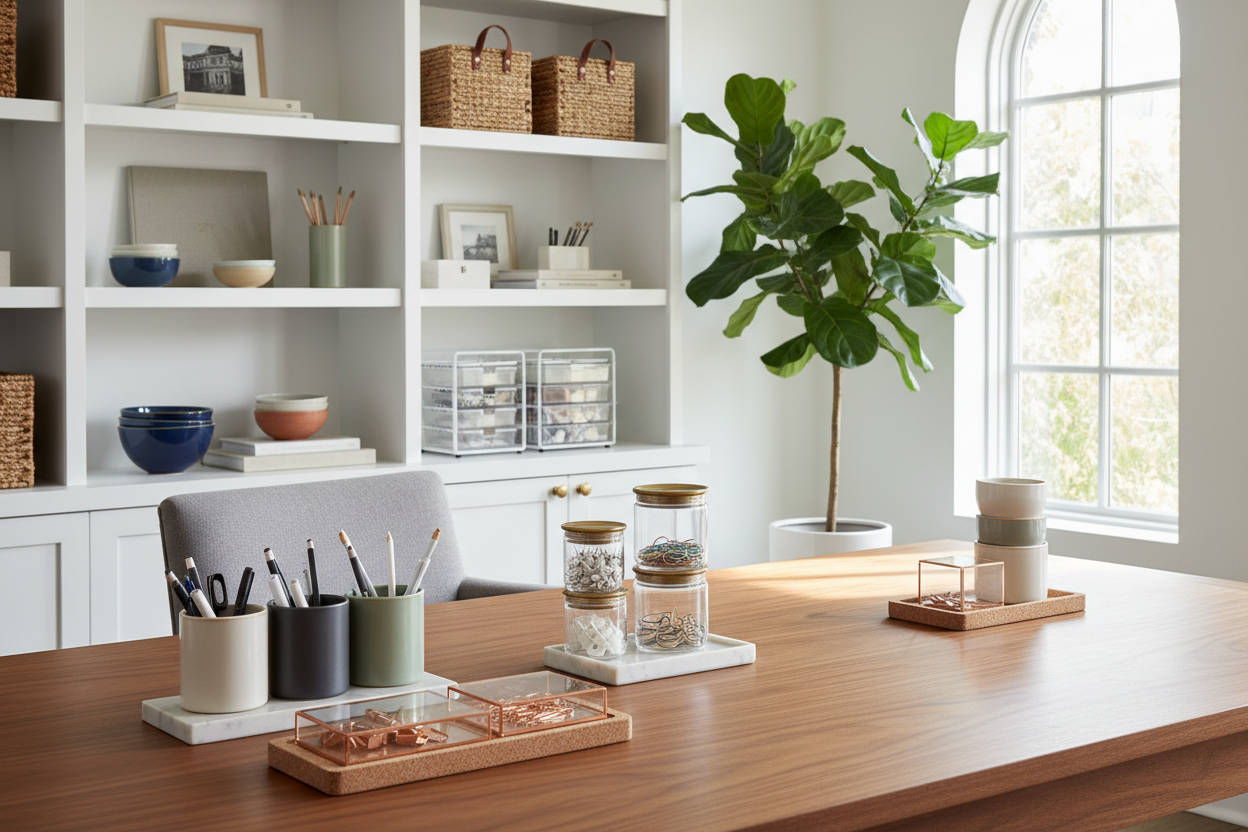
There is nothing quite as distracting in a home office or executive suite as visual noise. You might have the perfect mahogany desk and an ergonomic chair worth a small fortune, but if your surface is littered with loose paperclips, tangled cables, and mismatched pens, the entire aesthetic falls flat. The solution lies not just in cleaning up, but in selecting office supply storage containers that act as architectural elements rather than mere utility bins. As a designer, I view these pieces as the jewelry of the workspace—functional accents that define the room's character.
Quick Decision Guide: Selecting the Right Storage
- Material Integrity: specific materials dictate the vibe. Leather adds warmth and sound dampening; acrylic offers a modern, airy feel; solid wood provides grounding and permanence.
- Visual Weight: Consider how heavy the object looks. Opaque containers add visual weight and hide clutter, while transparent options feel lighter but require tidy contents.
- Modularity: Look for stacking capabilities or uniform footprints that allow you to expand your storage system as your needs grow without ruining the layout.
- Accessibility: Ensure frequently used items are in open trays or shallow drawers, while archival items go in lidded boxes.
Elevating Materiality and Texture
When specifying accessories for a client's desk, I urge them to move away from the standard wire mesh products found in big-box stores. To achieve a sophisticated look, we must prioritize tactile materials. storage containers for office supplies should feel substantial in your hand.
Leather and Felt
For executive spaces, full-grain leather trays or felt-lined boxes are superior choices. They offer acoustic benefits, softening the sound of dropping a stapler or keys onto the desk surface. Over time, high-quality leather develops a patina that adds a sense of history and prestige to the workspace.
Acrylic and Metal
If your office leans towards a minimalist or industrial aesthetic, heavy-gauge acrylic or brushed brass works wonders. However, the quality of acrylic matters; look for hand-polished edges rather than mold-injected seams. This small detail catches the light differently, turning a simple pen cup into a prism-like feature.
Space Planning and Visual Balance
The placement of your storage is just as critical as the design. A common mistake is crowding the "primary reach zone"—the semi-circle area within arm's length while seated.
I recommend a "grouping" strategy. Instead of scattering containers across the desk, cluster them in groups of three (the rule of odds) on a secondary corner. This creates a curated vignette rather than a scattered mess. Ensure there is a variation in height among the containers to keep the eye moving. A tall document file next to a medium catch-all tray and a low business card holder creates a pleasing architectural skyline on your desk.
The Hidden Factor: Ergonomics of Storage
We often discuss ergonomics regarding chairs, but it applies to storage too. Deep bins for small items like paperclips are a ergonomic nightmare; you shouldn't have to dig. Look for shallow, wide containers for small consumables. Conversely, vertical storage for writing instruments prevents the ink from pooling incorrectly and makes grabbing a pen a seamless motion.
Lessons from My Own Projects: The "Acrylic Trap"
I feel compelled to share a specific lesson I learned the hard way while styling a home office for a tech entrepreneur in San Francisco. We selected a stunning, high-end set of completely clear acrylic office supply storage containers. They looked incredible in the catalog and on the empty desk.
However, two weeks later, the client called me. The issue wasn't the quality of the containers—it was the reality of what went inside them. Clear storage demands that the contents be aesthetically pleasing. A mix of half-used highlighters, crumpled receipts, and cheap blue biros looked terrible on display. It created "visual chaos" despite being organized.
My takeaway? Unless you are committed to buying exclusively beautiful stationery (like brass pens and uniform gold clips), opt for opaque storage. We swapped his set for charcoal lacquer boxes with lids, and the sense of calm was instantly restored. Sometimes, the best design choice is the one that hides the mess completely.
Conclusion
Your workspace is a reflection of your professional intent. By choosing storage that balances high-quality materials with smart ergonomics, you aren't just tidying up; you are curating an environment that fosters focus. Treat these containers as investment pieces, and your office will thank you.
Frequently Asked Questions
How do I clean leather office storage containers?
Dust regularly with a dry microfiber cloth. For genuine leather, avoid water; instead, use a specialized leather conditioner once a year to prevent cracking and maintain the material's luster.
What is the best storage solution for a very small desk?
Go vertical. Utilize wall-mounted organizers or monitor risers with built-in drawers. This keeps the limited surface area clear for your laptop and notebook while keeping essentials within reach.
Can I mix different materials, like wood and metal?
Absolutely. In fact, mixing materials prevents the "showroom" look. A walnut desk tray pairs beautifully with a brushed brass pen cup. The key is to keep the color palette cohesive (e.g., warm woods with warm metals).


Dejar un comentario
Este sitio está protegido por hCaptcha y se aplican la Política de privacidad de hCaptcha y los Términos del servicio.