










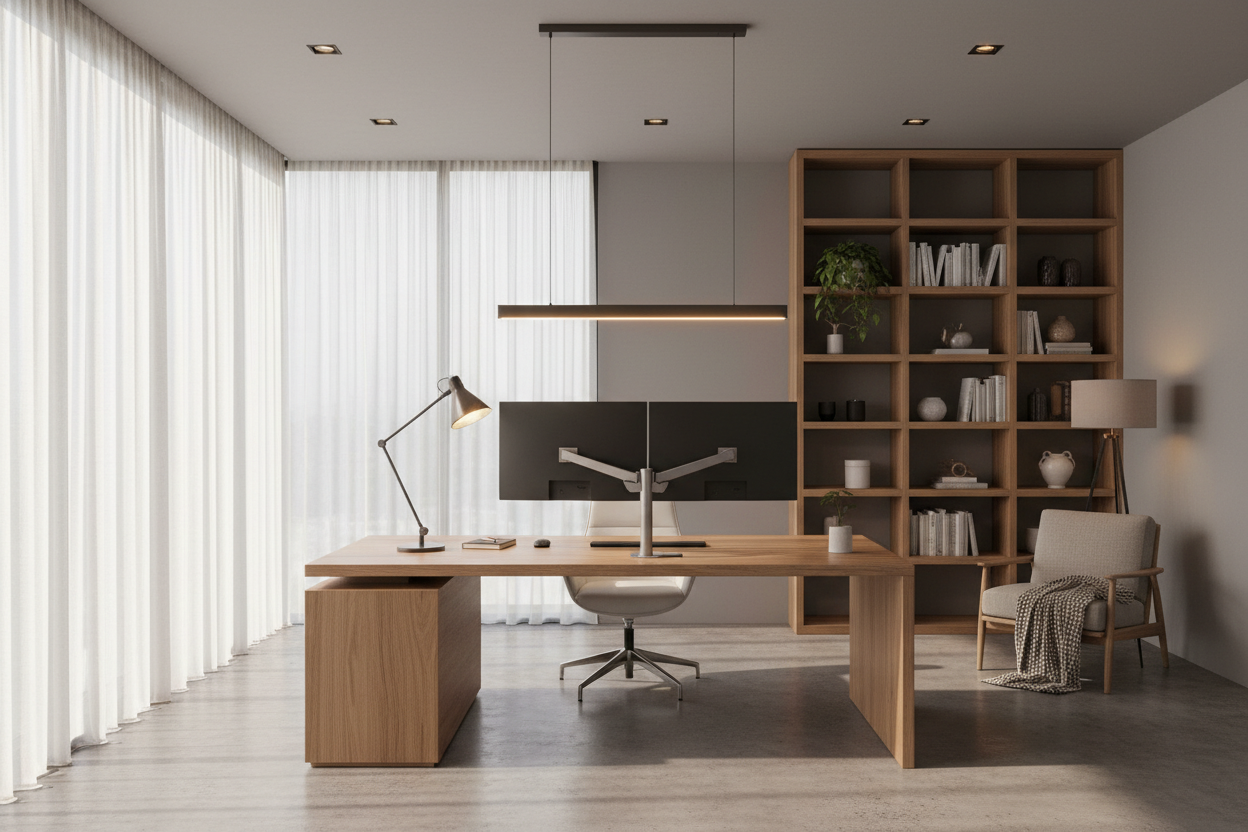
You have invested in the ergonomic Herman Miller chair and the solid walnut desk, yet by 3:00 PM, you feel a distinct wave of fatigue and eye strain. It is rarely the furniture that causes this mid-afternoon slump; it is almost always the illumination. Most workspaces suffer from the "cafeteria effect"—flat, overhead washing that kills depth and strains the eyes. Correcting the lighting in office environment designs is not just about buying a brighter bulb; it is about sculpting the space to support your circadian rhythm while maintaining a sophisticated aesthetic.
Key Features to Look For
- Color Temperature (Kelvin): Look for 3500K to 4000K for focus areas; anything lower induces sleepiness, anything higher feels clinical.
- Layering Capability: A mix of ambient (overhead), task (desk), and accent (decorative) lighting.
- CRI (Color Rendering Index): Aim for 90+ CRI so wood finishes and fabric swatches look true to life.
- Adjustability: Articulating arms and dimmable drivers are non-negotiable for adapting to daylight changes.
- Glare Control: Fixtures with high-quality diffusers or baffles to prevent screen reflection.
Structuring the Luminous Layering
In high-end interior design, we never rely on a single light source. To create a functional office environment lighting scheme, you must treat light as a material, just like wood or stone. It occupies space and defines edges.
The Ambient Foundation
This is your base layer. Avoid the standard 2x4 fluorescent troffers found in commercial builds. Instead, opt for suspended linear LED pendants with both direct (downward) and indirect (upward) light distribution. This bounces light off the ceiling, reducing shadows and making the room feel taller. If you are retrofitting a home office, recessed cans are acceptable, provided they are placed near the perimeter of the room to wash the walls, rather than directly over your head where they cast unflattering shadows.
Precision Task Lighting
The desk lamp is the workhorse of the office. When selecting a fixture, ergonomics are paramount. An articulating arm allows you to position the beam below eye level, preventing direct glare. Material-wise, consider architectural metals like brushed brass or matte black powder coats. These finishes absorb stray light rather than reflecting it, keeping the visual noise down. The goal is a pool of light on your documents, not on your monitor.
Color Temperature and Biological Response
Lighting is biological. The temperature of your light sources dictates your cortisol levels. For an effective office, we aim for "cool white" (3500K-4500K) during the day. This spectrum mimics mid-day sunlight, suppressing melatonin and keeping you alert. However, as the evening approaches, your lighting needs to shift.
I often specify smart bulbs or fixtures with "tunable white" technology for executive suites. This allows the light to warm up to 2700K (soft white) after 5:00 PM, signaling to the body that the workday is winding down, even if you are still finishing an email.
Visual Balance and Material Interaction
Light interacts with every surface it touches. If you have a glass or high-gloss lacquer desk, a focused downlight will create a blinding hotspot. In these cases, you need a source with a wide dispersion lens or a fabric shade to diffuse the output. Conversely, if your office features dark woods like mahogany or walnut, these materials absorb light. You will need roughly 20% more lumens in a dark-paneled room to achieve the same perceived brightness as a white-walled room.
My Personal Take on lighting in office environment
I learned the hard way about the relationship between texture and light during a project for a tech executive in San Francisco. We installed these stunning, architectural linear pendants directly over a custom high-gloss lacquer desk. It looked incredible in the renderings.
However, the moment we flipped the switch, the reflection on the desk surface was blinding. It was essentially a mirror. You couldn't read a paper document without squinting because of the glare bouncing off the table. It wasn't a "style" issue; it was a functional failure. We had to rush order a set of honeycomb louvers (a grid that snaps onto the light) to cut the glare angle and swap the bulbs for a softer, frosted output. Now, I always check the desk finish before I even look at a light fixture catalog. If you have a shiny desk, get a matte diffuser. Trust me.
Conclusion
Treating your office lighting as an afterthought is a disservice to your productivity and your interior's potential. By layering your sources and paying attention to color temperature, you transform a utility space into a sanctuary of focus. Assess your current setup, identify the shadows, and bring in the light.
Frequently Asked Questions
What is the best lumen count for a home office?
For a standard 10x10 room, aim for roughly 3,000 to 6,000 lumens total, distributed across all sources. Your desk lamp alone should provide about 450 to 800 lumens for detailed work.
Can I mix different metal finishes on light fixtures?
Absolutely. Mixing metals adds depth. A matte black floor lamp pairs beautifully with a brass desk lamp. Just ensure the color temperature of the bulbs matches; mismatched light colors look far worse than mismatched metals.
How do I stop my LED lights from flickering on video calls?
Flickering usually happens when a high-quality LED is paired with an old, incompatible dimmer switch, or if the LED has a low refresh rate. Ensure your dimmer is rated for LED loads (CL or ELV dimmers) and buy bulbs labeled "flicker-free" or with high-quality drivers.

Dejar un comentario
Este sitio está protegido por hCaptcha y se aplican la Política de privacidad de hCaptcha y los Términos del servicio.