










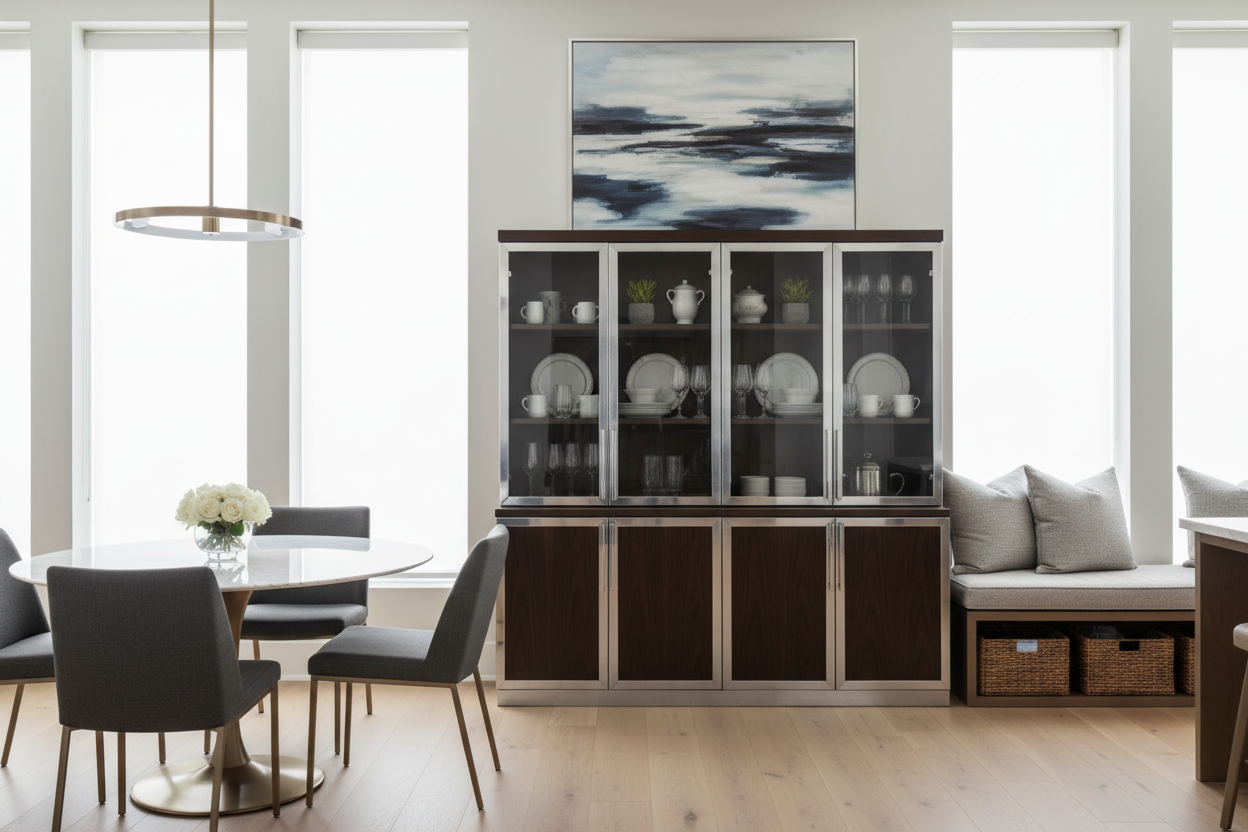
I spent three years living with a 60-inch oak hutch that looked like it belonged in a cathedral, not my modest 12-by-14 dining room. It was a hand-me-down from my aunt, and while it was solid wood, it was also a massive visual energy vampire that sucked the natural light out of the room. Every time I walked past it, I felt like the furniture was winning the battle for square footage. Finally, I snapped and replaced it with a 36 inch wide china cabinet, and the room finally started to breathe.
- A 36-inch footprint provides enough storage for a full 12-piece service without swallowing the wall.
- Leaving negative space on either side of your cabinet makes the room feel larger and more intentional.
- Verticality is your friend; look for height (72 inches plus) to maximize storage on a narrow base.
- Closed bottom storage is a non-negotiable for hiding the 'ugly' essentials like mismatched serving platters.
The Problem With 'Heirloom' Sized Dining Furniture
We’ve been conditioned to think that a 'real' dining room needs a massive, wall-to-wall hutch. My old 60-inch beast was technically high-quality, but it was a disaster for my lifestyle. Because I had so much room, I kept everything: three different sets of holiday plates, 14 gravy boats I never used, and a stack of chipped ramekins that should have been tossed in 2012.
It wasn't just the hoarding; it was the physics. The piece was so wide it crowded the window trim, making the whole wall look cramped. It made the dining table feel off-center, even when it wasn't. Massive furniture often creates a 'storage locker' vibe rather than a curated home. I realized I didn't need more space; I needed a better boundary.
Why a 36 Inch Wide China Cabinet Is the Sweet Spot
Three feet. That’s the magic number. A 36 wide china cabinet is roughly the width of a standard interior doorway, which is a scale our eyes are naturally comfortable with. When you center a 36-inch piece on a standard 10-foot or 12-foot wall, you’re left with several feet of 'negative space' on either side. This is where the magic happens.
That extra wall space allows you to hang sconces, place a floor plant, or simply let the paint color exist. It turns the cabinet into a focal point—a piece of furniture acting as an accent—rather than a structural wall. I opted for a model with a 15-inch depth. It’s deep enough for a oversized dinner plate but shallow enough that it doesn't impede the 'walk-around' space behind the dining chairs. No more shimmying past the hutch to get to the kitchen.
How I Fit a Full Dinner Set in a 36" China Cabinet
People always ask me, 'But where does the stuff go?' Here’s the reality: a 36" china cabinet can easily hold a service for 12 if you stop treating it like a junk drawer. I have four shelves. One holds dinner and salad plates in neat stacks. Another holds my glassware—wine glasses in the back, tumblers in the front. The third is for bowls and small appetizers plates.
The key is using designer strategies to maximize every inch, like using plate cradles or small acrylic risers. If you stack your plates instead of leaning them against the back wall, you double your capacity instantly. I actually found that by narrowing my storage to 36 inches, I only kept the pieces I actually loved and used. The 14 gravy boats? Donated. The chipped ramekins? Recycled. I now have a curated collection that actually looks good through the glass.
The Hidden Power of the Bottom Drawer
If you’re shopping for a 36 inch wide china cabinet, do not buy one that is glass from top to bottom. You need a 'shame drawer' or a set of solid doors at the base. My cabinet has two deep drawers at the bottom, and they are the unsung heroes of my dining room. This is where the placemats, the napkin rings, and the extra candles live. It’s also where I hide the mismatched Tupperware that I use to send guests home with leftovers. You want the top to be a gallery, but you need the bottom to be a workhorse.
Styling Your 36" Wide China Cabinet (Without the Clutter)
The biggest mistake people make with a 36" china cabinet is overstuffing the glass section. If every square inch is packed with porcelain, it looks heavy and dated. I follow the 80/20 rule: 80% dishes, 20% 'breathing room' or non-dining items. I tucked a few vintage art books and a small framed sketch in between my white bowls. It breaks up the monotony of the ceramics.
Try color blocking. Put all your white pieces on one shelf and your clear glass on another. It creates a clean, rhythmic look that feels modern. And please, for the love of all things holy, don't use those little plate grooves to stand every single plate up vertically. It looks like a retail display from 1994. Stack them. It looks more like a high-end bistro and less like your grandma's house.
Going Dark: Creating Contrast in the Dining Room
Because a 36-inch piece is relatively small, you can afford to be bold with the finish. In a massive 60-inch hutch, a dark finish can feel like a black hole. But in a three-foot cabinet? It’s a statement. I chose a deep, matte charcoal finish, and it completely grounded the room. It provides a stunning, moody backdrop for my white ironstone and crystal glassware.
Choosing a black cabinet with glass doors adds an architectural element that a wood-tone piece sometimes lacks. It mimics the look of steel-framed windows. If your dining room feels a bit 'floaty' or washed out with light wood and beige walls, a dark, narrow cabinet is the anchor you're missing. It’s high-impact, low-commitment furniture at its best.
FAQ
Is a 36 inch wide china cabinet too small for a large family?
Not if you're organized. It can hold a full service for 12. If you have service for 24, you might need a second storage solution in the kitchen, but for daily use and standard hosting, 36 inches is plenty.
How much weight can the glass shelves actually hold?
Most quality cabinets use tempered glass shelves rated for 30 to 50 pounds each. Always check the manufacturer's specs. If you have heavy stoneware, look for a cabinet with wood shelves or reinforced supports.
Should my china cabinet match my dining table exactly?
Please, no. Matching sets can feel a bit 'showroom.' Mixing a black cabinet with a natural wood table, or a vintage wood cabinet with a modern marble table, adds much more personality and depth to your home.

Dejar un comentario
Este sitio está protegido por hCaptcha y se aplican la Política de privacidad de hCaptcha y los Términos del servicio.